
[Stay on top of transportation news: Get TTNews in your inbox.]
Buying a Class 8 truck in 2027? Here’s what we know
Truck makers are following different routes on EPA 2027 compliance
 EPA issued a notice in July that it was tweaking the nitrogen oxide regulations but keeping a Biden-era requirement that NOx emissions for heavy-duty trucks fall to 35 milligrams per horsepower-hour (Skyhobo/Getty Images)
Key Takeaways:
- Truck manufacturers still don't know what the price and total cost of ownership of model-year 2027 trucks will be on Jan. 1.
- EPA is expected to send its final nitrogen oxide-emissions rule to the White House by the middle of November for an expedited 30-day review, ATA said.
- Uncertainty about the prospects for the final rule has hurt truck demand, and manufacturers are working off a notice of proposed rulemaking from July when crafting their EPA 2027 plans.
There are many things any carrier looking to increase the size of its Class 8 truck or tractor fleet in 2027 should know.
No. 1 is typically the outright price and the total cost of ownership.
But no one knows what the price and TCO of model-year 2027 trucks will be on Jan. 1. The only things that are certain is uncertainty — which carriers have had by the bucketload in recent years — and that prices will rise.
The key variable is Environmental Protection Agency nitrogen oxide regulations for heavy-duty trucks that should have been finalized months ago but, as of Nov. 12, were not.
Cummins CEO Jennifer Rumsey said Nov. 5 that the engine maker expects EPA to issue a final rulemaking in December.
Image

Cummins CEO Jennifer Rumsey says the company expects EPA to issue the final rule in December. (Seth Clevenger/Transport Topics)
EPA is expected to send the rulemaking to the White House by the middle of November for an expedited 30-day review, American Trucking Associations Vice President of Energy and Environmental Affairs Patrick Kelly said in an interview.
Not everyone is quite so sure, however, with William “Rusty” Rush, CEO of Rush Enterprises, telling investors Oct. 27 during the truck dealer’s third-quarter 2026 earnings call that the trucking industry may not see a final rule until January or February.
Image

“I think from a customer perspective, I would be leaning toward wanting to pay some [nonconformance penalties],” Rush Enterprises William "Rusty" Rush said. (Rush Enterprises)
Transport Topics examined the options open to carriers and how we got to this point.
All the interested parties are working off a notice of proposed rulemaking (NPRM) issued in July.
The NPRM followed EPA announcing in March 2025 that the 2022 Heavy-Duty Nitrogen Oxides rule would be re-evaluated, citing consumer choice and cost concerns.
The NPRM kept a Biden-era requirement that NOx emissions for heavy-duty trucks fall to 35 milligrams per horsepower-hour from 200 mg/hp-hr, but engine manufacturers were offered wiggle room on the transition timeline, nonconformance penalties (NCPs) and use of NOx credits.
In a significant amendment, warranties for emissions-control equipment would cover 100,000 miles or five years rather than 450,000 miles or 10 years per the original proposed rule laid out in 2022.
In addition, an increase in the regulatory useful life was postponed to 2030 from 2027, and the mileage component was lowered to 435,000 miles from 650,000 miles. Regulatory useful life determines how long a vehicle must meet emissions requirements.
The price of NCPs is of paramount importance because some engine manufacturers plan to use them instead of introducing 35 mg/hp-hr engines Jan. 1.
Final details on the sliding scale for the price of NCPs have yet to be revealed, and no one is sure what the floor and ceiling will be.
As Daimler Truck CEO Karin Radstrom told investors and analysts during the truck maker’s Q3 earnings call: “With regard to the size of the NCP, I think your guess is as good as mine.”
Also, there could be significant changes to the NPRM, Dan Potter, Daimler Truck North America’s director of compliance and regulatory affairs, told reporters Sept. 24 at an event at the company’s High Desert Proving Grounds testing facility in Madras, Ore.
It is a mess, according to Rush, who told investors: “I’ve never seen an EPA law or decree where it wasn’t the same for everybody on one particular date.”
Image

On NCPs, Daimler Truck CEO Karin Radstrom said, “With regard to the size of the NCP, I think your guess is as good as mine.” (Carina Johansen/Bloomberg)
Hesitancy hurts demand
Uncertainty about the prospects for the final rule has hurt truck demand.
Volvo Group is rationing the availability of 2027 order slots for trucks in North America because of the delayed arrival of the rule, CEO Martin Lundstedt said Oct. 23.
Volvo Trucks North America and Mack Trucks opened their order books for 2027 at the start of September. North American truck makers typically open their order books for the coming year in late August or early September.
Image

Volvo Group CEO Martin Lundstedt said the company is rationing the availability of 2027 order slots for trucks in North America because of the delayed rule. (Volvo Group)
North America Class 8 net orders totaled 13,500 units in October, down 45% year over year, according to ACT Research, citing the unresolved regulatory questions and ongoing cost pressures. Cummins was the first engine maker to promise to stagger the introduction of engines that met the stiffer NOx standards after EPA provided the opportunity for that flexibility in July.
The company expects to launch limited production of the new X10 and updated X15 in January and then transition in the third and fourth quarters to full production of the engines.
Cummins will use NCPs in the interim.
NCPs are permitted under the Clean Air Act. They allow an engine manufacturer to continue to sell engines that don’t meet the current emissions standards for technological reasons.
Both Cummins and Paccar told EPA in August that they couldn’t meet the emissions standards for technological reasons.
Paccar executives said in February that Kenworth Truck Co. and Peterbilt Motors Co. would launch two compliant engine platforms.
But by the time of the August filing, Paccar was telling EPA it could not meet the 35 mg/hp-hr standard without help from NCPs. Indeed, without NCPs, the Bellevue, Wash.-based company said engine production would halt.
“The supply base for generators and power electronics is immature, and there has been insufficient long-term testing done to ensure robustness, exacerbating the technological difficulty of meeting the stringent standard,” the company warned the regulator.
Paccar believes electric exhaust heaters with 48-volt generators are the best way to meet the 35 mg/hp-hr standard. Kenworth and Peterbilt declined to comment for this article.
Image
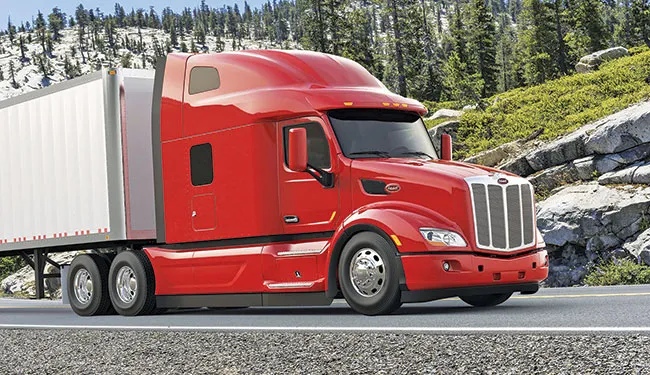
Peterbilt parent company Paccar said in February that Kenworth and Peterbilt would launch two EPA 2027-compliant engine platforms but reversed course later in the year. (Peterbilt)
Under EPA’s July proposal, a model-year 2027 heavy-duty engine certified at 100 mg/hp-hr would incur a $5,875 penalty, while an engine certified at 45 mg/hp-hr would incur a $904 penalty.
VTNA and Mack are open to using NCPs. Each will offer EPA 2024-compliant engines to customers for some part of 2027. Spokespeople for the truck makers told TT separately, however, that they were waiting on the final rule to decide on their exact strategy.
That said, both VTNA and Mack will have 35 mg/hp-hr D13 and MP-13 engines available from Jan. 1, respectively.
Traton Group division International Motors will offer customers a choice of two engines for heavy-duty trucks in 2027, the parent company’s top executive confirmed Oct. 28.
Image

International Motors CEO Mathias Carlbaum and TT staff reporter Keiron Greenhalgh. (Karen Foote/American Trucking Associations)
“The first customers will get their EPA ’27-compliant engines in the second quarter,” Traton CEO Christian Levin said.
International does not plan to use NCPs to help customers meet the 2027 regulations, CEO Mathias Carlbaum said in an interview on the sidelines of the recent ATA 2026 Management Conference & Exhibition.
Neither does Freightliner and Western Star parent company DTNA. The compliance approach for the truck maker, whose Freightliner Cascadia is the best-selling truck in North America, involves emissions credits plus updated engine and aftertreatment technology, a spokesman said in a Nov. 5 email.
In-house DTNA engine maker Detroit’s Gen 6 DD13 and DD15 models are scheduled to be available beginning in January, the spokesman said in the email while declining to provide individual emissions levels.
Prices set to rise no matter which truck a fleet buys
However, it is certain that no matter what truck a fleet buys for 2027, the price will be higher than in 2026, whether that is a model-year 2027 model or an EPA 2024-compliant option, ATA’s Kelly said.
Indeed, scarcity pricing may have meant prices would have been much higher without the NPRM and NCPs, he said, so there is still something of a bright spot as fleets remain hyperfocused on expenses following the longest rate recession in industry memory. “Scarcity pricing … is just pure cost for our members,” he added.
The availability of NCPs and the staggered introduction of engines meeting the stiffer regulations also offer fleets time to test the engines.
“I think from a customer perspective, I would be leaning toward wanting to pay some NCPs,” Rush said. “Test the new technology before I go all into the pool. Let us dive into the shallow end, not the deep end.”


