
[Stay on top of transportation news: Get TTNews in your inbox.]
Class 8 orders fall on cloudy regulatory picture
October orders decline as fleets weigh EPA 2027 rules, equipment costs and capital priorities
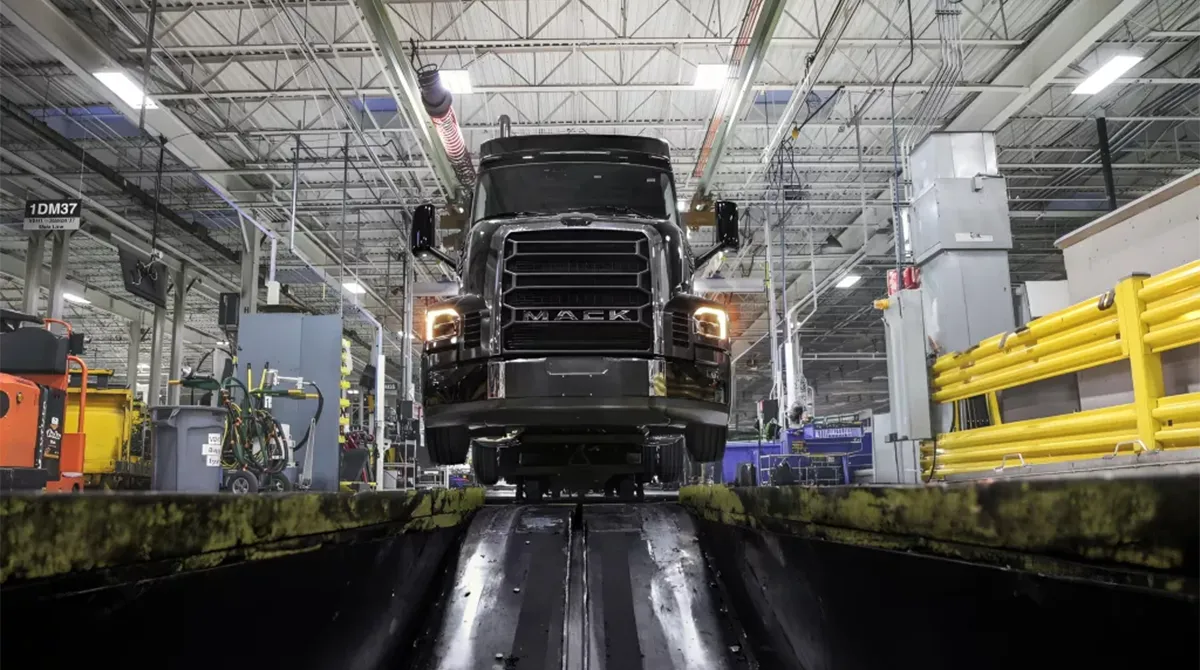 Mack Trucks manufactures the Pioneer at Lehigh Valley Operations in Macungie, Pa. (Volvo Group North America)
Key Takeaways:
- North American Class 8 truck orders fell sharply in October as regulatory uncertainty contributed to a weak start to order season.
- ACT reported orders down 45% year over year, while FTR reported a 36% decline amid EPA 2027 uncertainty and cost pressures.
- Industry executives expect replacement demand and improving freight conditions to support orders, with some purchases likely deferred rather than canceled.
Class 8 truck order season continued its lackluster start as regulatory uncertainty persisted into October.
ACT Research preliminary data showed North American Class 8 truck orders decreased 45% year over year to 13,500 units. The report noted that the decline reflected ongoing regulatory uncertainty among fleets over new truck emissions regulations, ongoing cost pressures and midterm political uncertainty, despite continued strength in spot freight rates.
“While spot rates remain supportive of equipment demand, the lack of clarity around EPA 2027 rules and associated costs has left OEMs and fleets unable to plan for next year,” said Carter Vieth, research analyst at ACT. “It’s not a lack of desire for new equipment holding fleets back but rather the inability to make informed investment decisions.”
The Environmental Protection Agency has proposed changes to its upcoming 2027 heavy-duty engine rule. The proposal would ease warranty requirements that truck and engine manufacturers have warned could increase costs and complicate the rollout of new diesel engines. It would leave the underlying emissions standards in place while easing some of those burdens.
Justina Morosin, senior vice president of sales and field operations at International Motors, said, “Replacement needs remain, but customers are being disciplined as they weigh regulatory clarity, pricing and broader operating costs.”
FTR Transportation Intelligence found that Class 8 preliminary net orders decreased 36% year over year to 15,600 units in October. The results were also down 24% when compared with September. The report highlighted that this reflected a notably weaker-than-expected start to order season, likely due to ongoing uncertainty around emissions regulation.
[November State of the Industry: NA Classes 5-8 Preliminary Update] - Regulatory Uncertainty Drives October Class 8 Order Slowdown Read more from the update here: https://t.co/NsHVAVxNAo https://t.co/5HoCbn1TyM
— ACT Research (@actresearch) November 4, 2026
“Underlying replacement needs, tighter capacity and firmer freight rates continue to support Class 8 demand,” said Dan Moyer, senior analyst of commercial vehicles at FTR. “However, with the earlier EPA 2027 pre-buy now complete, orders are increasingly tied to fleet profitability, capital spending priorities and regulatory certainty.”
Moyer suspects other factors may also be contributing to the slower ordering pace, such as fleet capital spending priorities shifting toward trailers rather than tractors in the near term. He also highlighted fuel costs, insurance, labor and margin pressure as potential obstacles. But he noted that the results may suggest that some purchases were deferred rather than canceled.
“Preliminary orders for October declined month over month and year over year,” said Jonathan Randall, president of Mack Trucks North America. “Uncertainty regarding final EPA27 regulation cost has delayed some fleet order decisions. From a market standpoint, freight rates and fleet profitability continue to improve as freight capacity continues to tighten and freight demand recovers.”
Volvo Trucks North America data showed that Class 8 orders in the U.S. and Canada totaled 12,614 units in October. This was lower than what the truck manufacturer had been expecting. The data showed that this was the weakest order month since July 2025.
Class 8 truck orders dropped to 15,600 units in October—down 36% year over year. Uncertainty around EPA 2027 regs and shifting fleet priorities are reshaping the order landscape. View full release at https://t.co/tM21HgRY29 #Trucking #Freight #truckequipment #oem #FTRintel https://t.co/gnL1PUUR6e
— FTR | Transportation Intelligence (@FTRintel) November 4, 2026
“There is still clearly hesitation in the market amid continued regulatory uncertainty,” said Magnus Koeck, vice president of strategy, marketing and brand management at VTNA. “While we continue to see improvements in freight rates and carriers’ profitability, fleets are still facing tight margins and cost pressure.”
Koeck said fuel, labor and insurance are among the largest cost drivers. He suspects that the midterms may also have had an impact on orders, with planned purchases most likely being deferred rather than canceled. But he also expressed optimism that the underlying need to replace an aging truck population continues to support Class 8 demand going forward.
“I am positive we will see improved order numbers during the last two months of the year,” Koeck said. “We are very well positioned to support the market with a range of solutions tailored to specific business needs.”


