
[Stay on top of transportation news: Get TTNews in your inbox.]
Small trucking companies file 221 bankruptcies in 2026
Two-thirds of small carriers report that revenue is either flat or down compared with the year-ago period
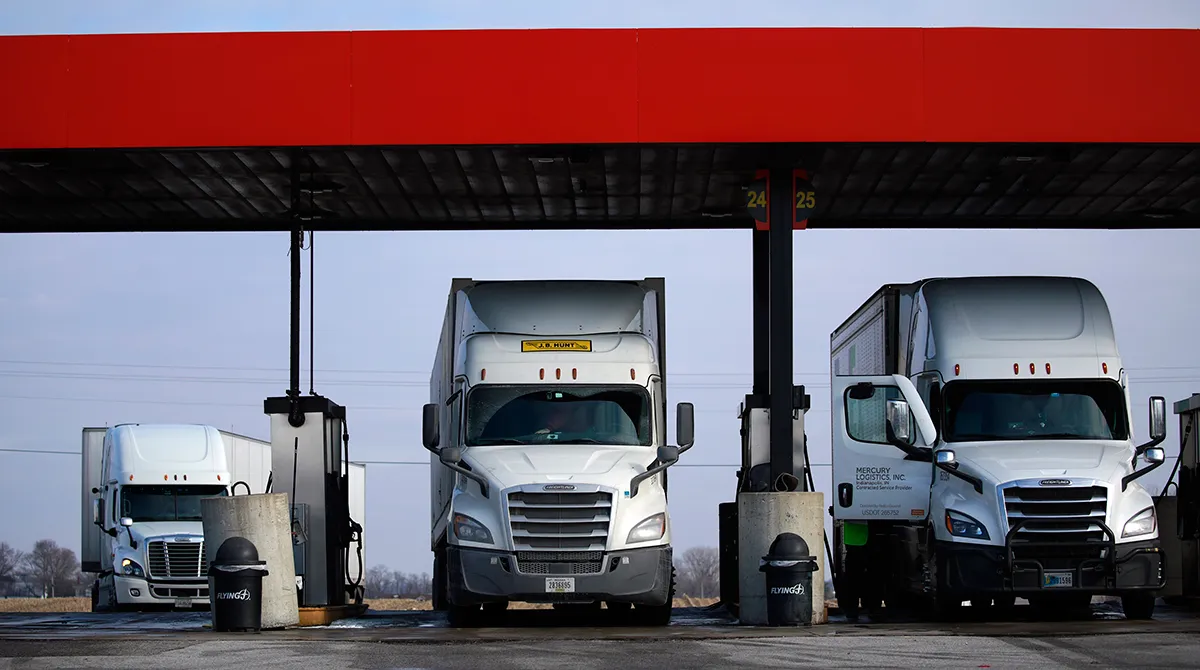 Large companies are better able to absorb higher costs for fuel and insurance, but they're also feeling squeezed. (Luke Sharrett/Bloomberg)
Key Takeaways:
- Some 221 trucking companies filed for bankruptcy this year as small carriers faced mounting financial pressure.
- About two-thirds of surveyed small carriers reported flat or declining revenue, while fuel, insurance and financing costs squeezed already thin margins.
- Nearly 40% of surveyed operators said they expected to leave trucking within six months or were unsure whether they would remain.
Justin Stoneman has been in the trucking industry for 27 years, operating out of central Michigan’s agricultural heartland. Hauling grain and fertilizer around the Midwest, his 12-odd tractor-trailers generated more than $3 million in annual revenue during their best times.
Those days are over. In the past year, Stoneman’s business has been squeezed by a range of pressures, from war-fueled spikes in diesel prices to rising insurance costs and onerous debts — all of which have pushed him to the brink. In May, his company, Stoneman Trucking, filed for bankruptcy protection, but he has since lost hope and is shifting to chapter 7, to fully shut down operations.
“I’m so frustrated,” Stoneman said. “It’s like, what about all this ‘Drill, baby, drill’?”
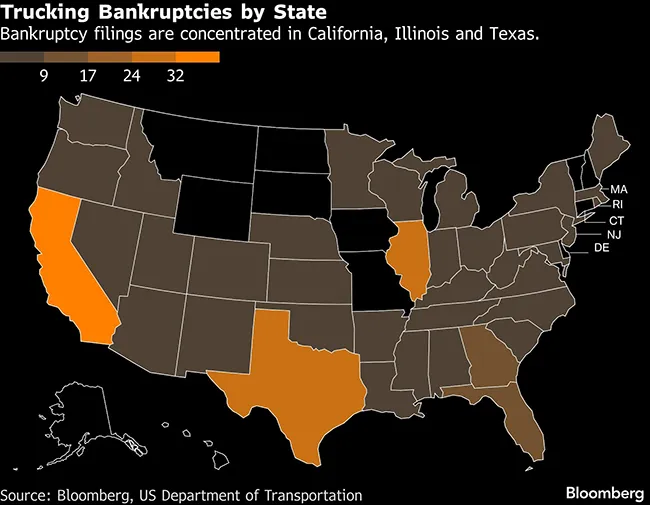
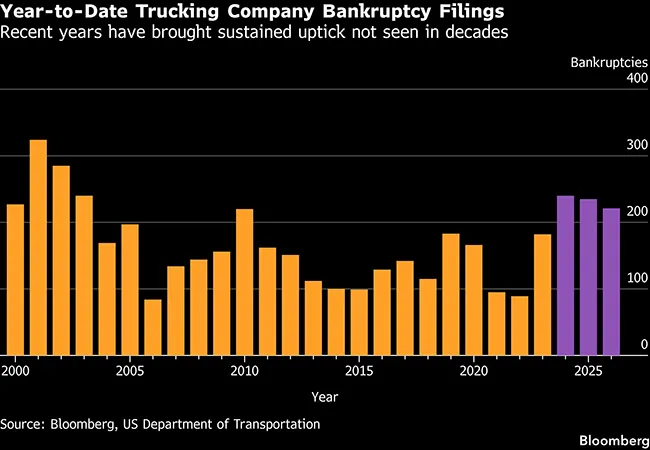
Stoneman isn’t alone. At a time when affordability issues are at the center of U.S. voters’ concerns heading into next week’s midterm elections, America’s smaller trucking operators are feeling the pinch. Some 221 trucking companies have filed for bankruptcy so far this year, according to data compiled by Bloomberg, extending a three-year spike at sustained levels not seen in decades.
Around two-thirds of small U.S. carriers — typically operating 20 or fewer tractors, and oftentimes only just one — report that revenue is either flat or down compared with the year-ago period, according to a survey of hundreds of such companies conducted over the past two months by freight-management firm Truckstop and Bloomberg Intelligence. Almost 40% of these operators said that in six months, they expected to be out of trucking or weren’t sure where they’d be.
Chip Lane, managing partner at the bankruptcy-focused Lane Law Firm in Texas, said he has seen a “massive uptick” in trucking companies approaching his firm to explore restructuring, sometimes as many as three or four in a week. “They are one of the top businesses that we see over and over and over again.”
Image
It’s a function in part of the economics of getting in on the ground floor in trucking. Smaller operators typically begin as drivers for larger companies, then foster contacts and a reputation to strike out on their own, said Lane. But many don’t have the cash to buy a rig outright and often rely heavily on credit. This makes them more vulnerable than industry leaders like J.B. Hunt Transport Services Inc. to rising costs such as the record diesel prices — even when business is still coming in.
“It’s much easier for the large J.B. Hunt to absorb higher fuel prices than it is for the $2.5 million dollar mom-and-pop trucking company that has five trucks doing local deliveries,” said Christopher Ward, a bankruptcy partner at Lowenstein Sandler.
J.B. Hunt itself said this month that it was looking to raise prices to help offset compressed margins, but that’s an option that may not be available for a one-rig firm trying to stay competitive. In fact, companies with no equipment debt and qualified safety records, usually larger companies, are doing well, said Aaron Graft, CEO of Triumph Financial, a payment and banking platform for the freight industry. “It’s a feast or famine,” he said.
J.B. Hunt ranks No. 3 on the Transport Topics Top 100 list of the largest for-hire carriers in North America, No. 2 on the truckload/dedicated sector list and No. 1 in the intermodal/drayage segment. J.B. Hunt also ranks No. 4 on the TT Top 100 list of the largest logistics companies.
At play, too, is the continuation of an industry contraction from the boom days of the COVID era, when demand for deliveries, near-zero interest rates and generous government loans created dream conditions to enter the trucking industry. After the pandemic subsided, many of these new businesses could no longer find enough work. Rates plummeted, and the industry endured a deep downturn, including a wave of bankruptcies.
Image
Now, those operators that managed to survive the freight recession are being hit with “a triple whammy,” said Lane, the Texas lawyer: higher fuel prices, rising interest rates and burdensome credit arrangements.
Small trucking companies often take on large debt loads to finance expensive equipment upfront, Lane said. It’s not uncommon for owners to take what he called “bad money:” variable interest-rate loans, which are susceptible to rising rates, and short-term, high-interest loans, which are designed to cover shortfalls but put debtors deeper in the red. Small trucking companies also often rely on so-called merchant cash advances and factoring, two ways to get cash quickly that piles on extra costs later. Those loans tighten already thin margins.
Stoneman took out equipment loans when he opened his own business, then took out two merchant cash advances totaling around $125,000 in 2023, when his cash was low. Now, he feels duped by bankers who he felt offered him complicated loans they knew he couldn’t pay back. If he’d taken out a normal line of credit, he said, it might have saved his business.
Others also point to fraud, insurance and immigration enforcement.
The freight recession accelerated the trucking industry’s identity-theft problem, according to Jennifer Lockett, operations manager at factoring company altLINE. Fraudsters find a trucker’s identification number, which is valuable because it shows a long history of operation with a clean safety record, and either sell it or use it to intercept loads and carry off cargo. Freight fraud costs the industry an estimated $18 million per day, per Highway’s Freight Fraud Index.
Truckers also say their insurance bills have been climbing, straining their balance sheets. Insurance can increase when carriers are defrauded or get a single speeding ticket, Lockett said. Prices for equipment and labor have also gone up, she said. Stoneman decided to liquidate his business after an insurance company quoted him $155,000 to back two trucks and three trailers after one of his drivers got in an accident.

PCS Software CEO Mark Hill discusses the advance of AI in the trucking industry. Tune in above or by going to RoadSigns.ttnews.com.
Kevin McAllister opened a three-truck business in 2021, hauling everything from auto parts to chemical dyes. He wanted to be an entrepreneur, but saw rates declining amid the post-pandemic industry bloat, and closed his business in 2024. Looking at the challenges swirling around the industry now, he feels relieved he got out early.
“At the end of the day, when you do an evaluation, it was not going to be long-term profitable,” McAllister said. “It was almost like treading water.”


