[Stay on top of transportation news: Get TTNews in your inbox.]
J.B. Hunt focuses on margin repair as costs rise
Revenue increased 21% to $3.68 billion in Q3
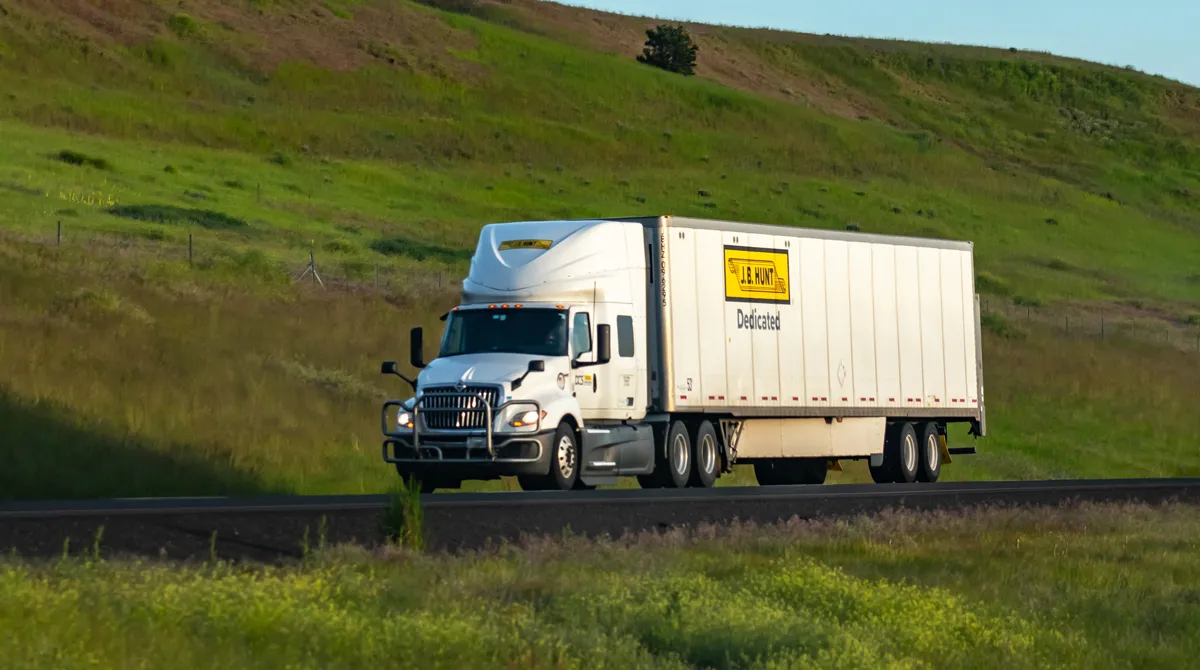 (Jon Tetzlaff/Getty Images)
Key Takeaways:
- J.B. Hunt reported third-quarter net income of $172.4 million on $3.68 billion in revenue as it addressed rising operating costs.
- Operating income took a $50 million-plus sequential hit from driver investments, volatile fuel prices and higher claims and medical costs.
- J.B. Hunt plans to repair margins through improved service pricing, productivity gains and lower structural costs while continuing investments to support growth.
J.B. Hunt Transport Services leadership doubled down on efforts to lower structural costs and adjust service prices in response to industrywide increases in operating expenses.
The Lowell, Ark.-based carrier detailed the approach Oct. 15 while presenting financial results for the third quarter, which ended Sept. 30. It posted net income of $172.4 million, or $1.82 per diluted share, for those three months. That compared with $170.9 million, $1.76, during the same time the previous year. Revenue increased 21% to $3.68 billion from $3.05 billion.
“These results reflect strong demand for our services and disciplined execution,” Brad Delco, the chief financial officer, said during an investor call. “We identified three primary cost headwinds this quarter: driver-related investments, volatile fuel prices, higher claims and medical costs. Driver-related costs include recruiting, onboarding, training, sign-on bonuses.”
J.B. Hunt also absorbed near-term cost pressure while investing in growth opportunities. The aim has been to protect the networks while positioning the company to generate stronger returns as pricing catches up with what company leaders view as a strong value proposition. They also plan to further improve productivity and lower structural costs where opportunities exist.
“In total, these cost buckets … impacted operating income by over $50 million versus the second quarter of this year,” Delco said. “Group medical costs alone accounted for more than $16 million of that increase. These costs are real, but the context matters. Driver investments support visible demand and prepare our networks for growth.”
Delco added that fuel surcharge programs have helped recover costs over time. But he also noted that rapid movements in prices have created a timing mismatch and dilute margins. He said top priorities are margin repair and supporting long-term growth. The plan is to achieve this through securing improved service pricing while also further investing in experienced workers, proven technology and pre-funded capacity.
“Over the last several quarters, we’ve spent a significant amount of time discussing the structural changes taking place across the transportation industry,” said Spencer Frazier, the executive vice president of sales and marketing at J.B. Hunt. “The pace of this change created tender acceptance, cost and driver availability challenges for our customers.”
Frazier added that capacity remains constrained, while operating costs continue to move higher. But he also pointed out that this has resulted in supply chain operators seeking out providers that can deliver reliable capacity at scale. He noted that this comes as customers have gained a much clearer understanding of these realities.
“The conversations we are having today are materially different than those we were having a year ago, six months ago or even last quarter,” Frazier said.
Results by segment
Truckload segment increased 37% to $260.8 million from $189.7 million. Operating income decreased 6% to $7 million.
Final Mile Services declined 3% to $200.1 million from $206.4 million. Operating income decreased 76% to $1.6 million.
Integrated Capacity Solutions increased 57% to $433.9 million from $276.3 million. Operating income was $9.6 million, compared with an operating loss of $800,000.
Dedicated Contract Services increased 11% to $960.2 million from $864.1 million. Operating income decreased 22% to $81.7 million.
Intermodal segment revenue increased 20% to $1.83 billion from $1.52 billion. Operating income rose 18% to $147.5 million.
J.B. Hunt ranks No. 3 on the Transport Topics Top 100 list of the largest for-hire carriers in North America, No. 2 on the truckload/dedicated sector list and No. 1 in the intermodal/drayage segment. J.B. Hunt also ranks No. 4 on the TT Top 100 list of the largest logistics companies.