
[Stay on top of transportation news: Get TTNews in your inbox.]
Cargo theft has entered ‘new normal,’ executive says
Industry experts call for stronger security and a federal response
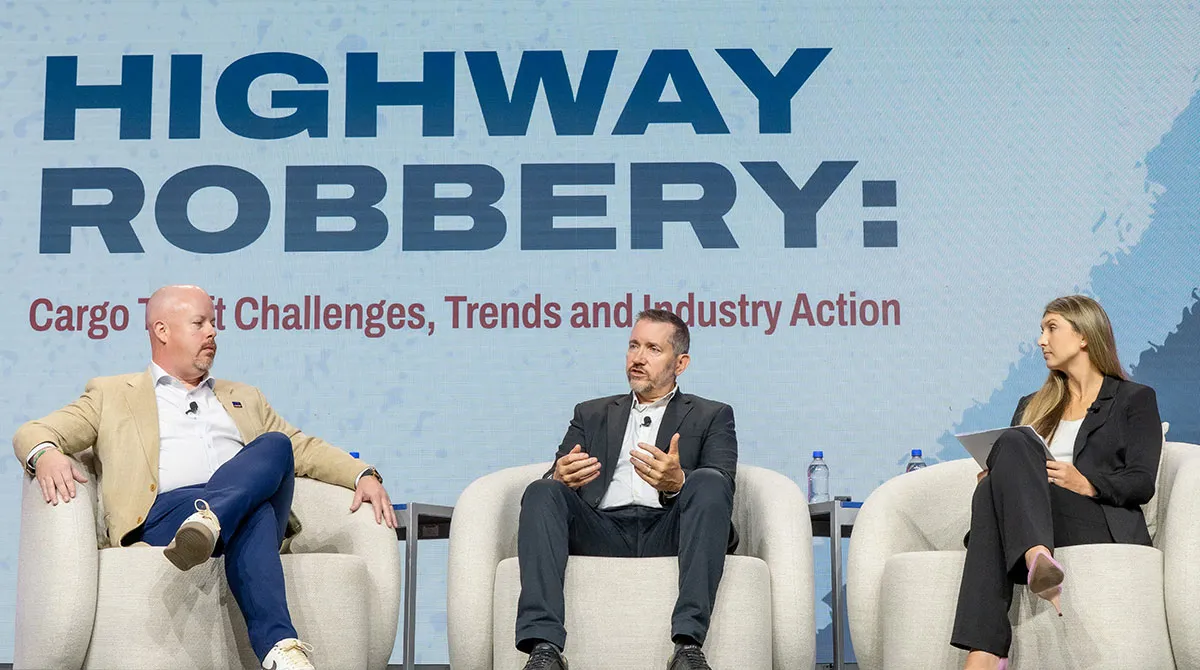 From left: ATA's Henry Hanscom, SPG Cargo & Logistics' Scott Cornell and ATA's Alex Rosen during the MCE panel discussion. (Erin Granzow Photography)
Key Takeaways:
- Scott Cornell told ATA’s MCE attendees Oct. 20 that cargo theft has become more international, sophisticated and reliant on physical theft and fraud.
- Cornell said strategic theft rose 1,475% from 2021 to 2024, while reported 2025 losses represented only a fraction of total economic costs.
- ATA is pushing cargo theft legislation to create a federal reporting repository and strengthen investigations, while Cornell urged better verification, staff training and international cooperation.
CHARLOTTE, N.C. — Cargo theft has changed dramatically since 2020, becoming more international, sophisticated and difficult to counter.
Scott Cornell, executive vice president and crime and theft specialist for SPG Cargo & Logistics, discussed that threat and what the industry is doing to combat it during a panel discussion at American Trucking Associations’ 2026 Management Conference & Exhibition on Oct. 20.
Cornell also led a discussion about industry defenses and federal policy with ATA representatives Henry Hanscom, chief advocacy and public affairs officer, and Alex Rosen, senior vice president of legislative affairs.
Cornell, who also serves as chairman of the Transported Asset Protection Association, warned that companies should not expect theft levels to return to what they once considered normal.
“You are in the new normal,” he said, describing criminal networks that operate across borders and treat cargo theft as a sustained business. He argued that the threat now includes both physical theft and fraud designed to deceive businesses into handing over freight.
One challenge, Cornell said, is that the federal government does not maintain a comprehensive national cargo theft database. Industry organizations such as CargoNet provide useful trend data, but those figures reflect reported cases, not every theft. He estimated that CargoNet captures roughly 1 in 10 full-truckload thefts and an even smaller share when pilferage is included.
He noted that reported totals should be treated as an incomplete picture. For example, Cornell suggested that the $724 million in declared value associated with nearly 3,600 cargo thefts reported in 2025 represents a fraction of the full economic cost, which includes lost sales, damaged brand reputation, insurance impacts, investigations, replacement production and disruption to customers.
“There’s a much deeper value to every theft that we see,” he said.
2 forms of theft, with different defenses
Cornell divided cargo theft into two broad categories: straight theft and strategic theft.
Straight theft, the physical taking of freight from places such as truck stops, drop lots, parking areas or distribution centers, accounts for about 70% of cargo theft, he noted, making it a continuing concern even as attention shifts toward fraud schemes.
Strategic theft, by contrast, uses deception to make businesses release freight to the wrong party. Methods include identity theft, fictitious pickups and double-brokering scams. Cornell said strategic theft increased 1,475% between 2021 and 2024 and now accounts for roughly 25% to 33% of thefts, depending on the quarter.
Image
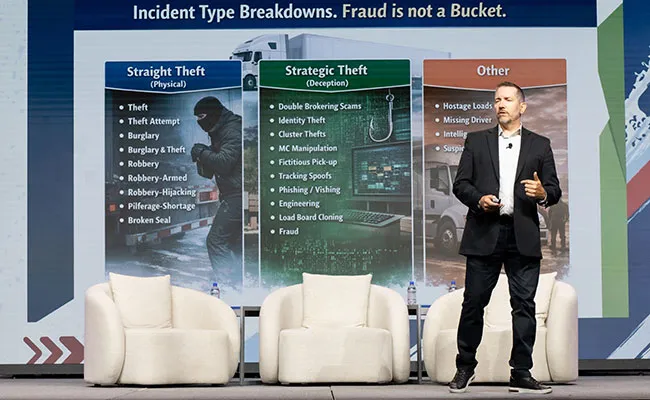
Cornell describes the two kinds of theft: straight and strategic. (Erin Granzow Photography)
The two categories can also overlap. Cornell described “Trojan drivers,” criminals placed inside legitimate trucking companies who may complete lower-value jobs before using their access to target a valuable load.
He also warned that stolen company identities and compromised email accounts can let criminals book or redirect freight while appearing to act through legitimate business channels.
Other methods exploit tracking and operational routines. Cornell said some crews use devices to locate tracking equipment or spoof electronic logging device information. Pilferage has also grown, with thieves taking a few pallets from a trailer rather than stealing the entire vehicle. That approach, Cornell noted, can reduce the need to deal with a tractor, trailer or tracking device and can make the perpetrators harder to identify.
“The best thing that you can do … is train your frontline staff,” he said.
Image
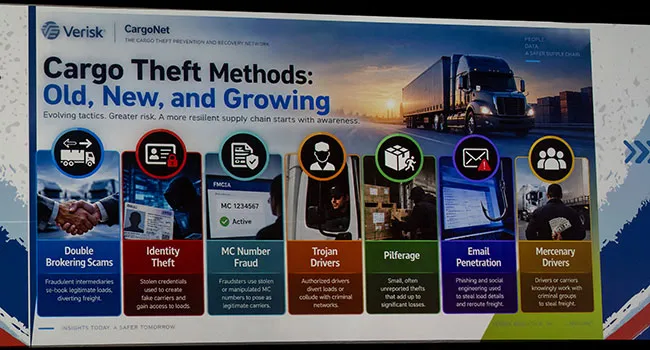
Cargo theft is a growing problem in trucking, and it takes many forms. (Erin Granzow Photography)
Food and beverages have long been prominent targets, Cornell said, partly because they are widely needed and can be difficult to trace after they are consumed or spoiled. Criminals also shift targets as conditions change. Cornell described how household goods became more attractive during the early COVID period, and electronics rose in prominence amid demand for home technology.
More recently, Cornell said, metals such as copper and tungsten have been targeted for their potential industrial uses, not simply their scrap value. He also drew attention to data center equipment and bitcoin-mining machines. Some reported shipments have carried declared values in the tens of millions of dollars, making them especially attractive to organized theft networks.
PERSPECTIVE: Cargo theft starts where vetting ends
PCS Software CEO Mark Hill discusses the advance of AI in the trucking industry. Tune in above or by going to RoadSigns.ttnews.com.
He identified the point where freight changes hands as a critical vulnerability, recommending that brokers verify the carrier and that shippers and warehouses confirm that the driver and truck at the dock are authorized to collect the load. Verification platforms and other tools can help, Cornell said, but technology is not a complete solution.
CORCA progress
The policy discussion also centered on the Combating Organized Retail Crime Act of 2025, H.R. 2853 and S. 1404. Rosen described the legislation as a proposal to establish a central reporting repository within the Department of Homeland Security for supply chain fraud and theft, alongside stronger federal tools for investigations and prosecutions. She said the coalition supporting the measure had grown to more than 200 industry partners, bringing together trucking, rail, retail and law enforcement interests.
Rosen also credited that broad coalition — along with member testimony, communications work and state association advocacy — with helping move the legislation forward. She described CORCA as having advanced through key congressional steps and discussed ATA’s effort to include its provisions in the National Defense Authorization Act.
Cornell said a federal response could help address uneven law enforcement resources, improve the tracking of cargo theft and build expertise among investigators and prosecutors. Rosen added that federal reporting could help authorities direct resources as theft patterns shift. Both speakers emphasized that legislation would need to be paired with sustained investigative capacity and funding.
Looking beyond domestic enforcement, Cornell argued that international cooperation will matter because some criminal networks operate from abroad. He also called for greater digitization of supply chain paperwork, saying records should preserve who changed a delivery location or schedule and when. Such traceability, he argued, could help prevent stolen freight from being disguised as legitimate cargo.


