
[Stay on top of transportation news: Get TTNews in your inbox.]
AI alerts help win over skeptical drivers, fleet execs say
Panelists describe camera alerts, fuel recommendations and faster back-office reviews
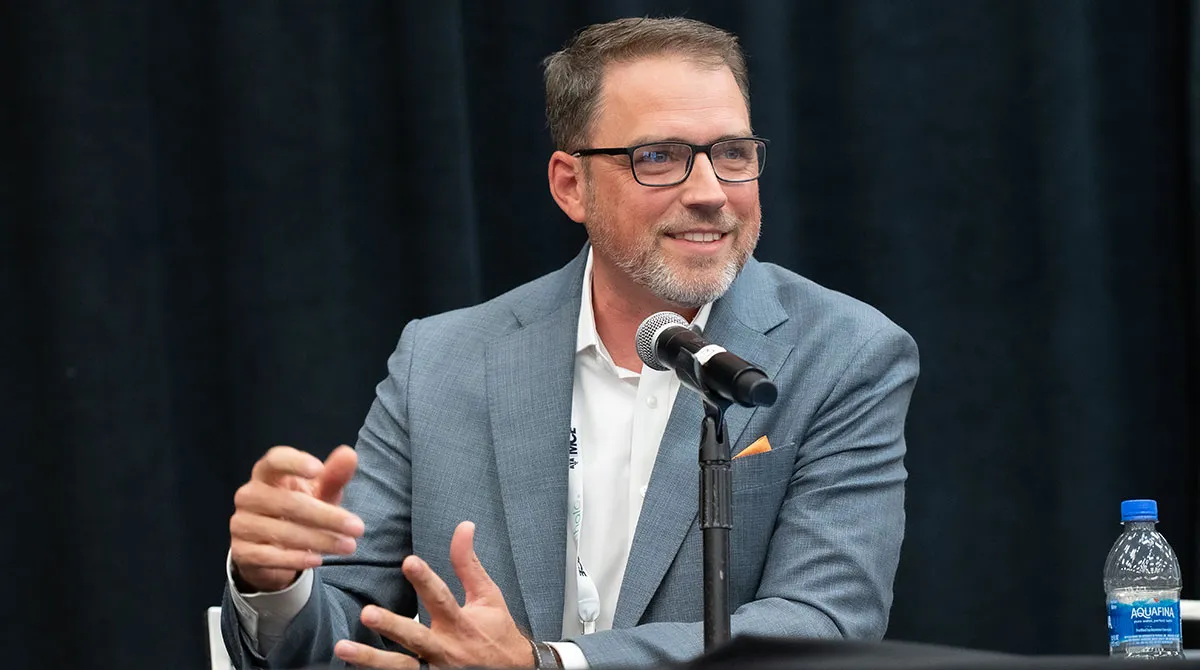 Austin Henderson, vice president of innovation and engineering at Werner Enterprises and FirstFleet. (Erin Granzow Photography)
Key Takeaways:
- Panelists at ATA’s Management Conference & Exhibition discussed AI tools supporting safety, coaching, fueling and administrative work while preserving human oversight.
- Werner executive Austin Henderson said a distracted-driving alert saved a driver’s life, while Bennett's Jared Whitson uses forward-facing cameras on about 2,500 trucks.
- Panelists urged fleets to invest in reliable systems, explain deployments clearly and connect data across platforms as AI accelerates reviews and coaching.
CHARLOTTE, N.C. — Austin Henderson, vice president of innovation and engineering at Werner Enterprises and FirstFleet, recalled a meeting in which a truck driver who once was skeptical of artificial intelligence admitted that an AI-enabled distracted-driving alert saved his life.
Henderson joined Gary Johnson, head of safety and compliance strategy at Motive, and Jared Whitson, senior director of safety and compliance at Bennett Family of Cos., to discuss the technology’s successes and concerns during an educational session Oct. 19 at American Trucking Associations’ Management Conference & Exhibition.
During the session, titled “The Rise of Physical AI in Trucking,” panelists discussed how AI and connected vehicle data can support safety, driver coaching, fueling decisions and administrative work while leaving judgment and oversight to people.
In his story, Henderson said the system detected the driver’s distraction and notified the back office, and staff contacted the driver and talked him through the situation. The driver later watched the video and recognized the danger.
Whitson said Bennett uses forward-facing cameras on about 2,500 trucks, primarily to detect and review events. He also described location-based alerts that notify staff when a truck with a critical fault code enters a shop’s geofence.
“If you cross a geofence at one of our shops and there’s a critical fault code on the truck, then it sends a notification and advises people,” he said. Eventually, he added, the system could go a step further and generate a repair work order.
Image

Jared Whitson, senior director of safety and compliance at Bennett Family of Cos. (Erin Granzow Photography)
Henderson described a prescriptive fueling tool that uses current fuel prices, fuel levels and truck location to make recommendations in real time. If a driver misses a planned stop, the system suggests an alternative.
“If they miss their fuel stop for one reason or another, they don’t take the recommendation,” he said. “We’ll give them another recommendation, which is the next best choice.”
Henderson said the harder work of adopting new technology begins after the software and cameras are installed.
“This is a cultural conversation more than it is necessarily a technical conversation,” he said. Organizations need to explain what they are doing and why, he added, or employees may assume the technology is meant to replace them.
Henderson also recalled a veteran driver who opposed the technology until video showed he was not at fault in a highway incident.
AI tools also are beginning to ease repetitive back-office work. Whitson said staff can spend four or five minutes researching an event to determine whether it represents a violation. AI can pull together the relevant information and offer a recommendation, he said, turning the review into a check that may take about 30 seconds.

PCS Software CEO Mark Hill discusses the advance of AI in the trucking industry. Tune in above or by going to RoadSigns.ttnews.com.
Henderson described self-coaching workflows that prompt drivers to review video soon after an event. He said about 97% of the videos in the company’s process are viewed the same day the event occurs. The company also uses digital avatars of regional safety managers to deliver coaching with familiar faces and voices.
The panel urged fleets to take a measured approach: Invest in reliable systems, communicate clearly and make sure data can connect across platforms.
“AI doesn’t replace judgment,” Johnson said. “It protects time for it.”
Werner Enterprises ranks No. 19 on the Transport Topics Top 100 list of the largest for-hire carriers in North America.


