[Stay on top of transportation news: Get TTNews in your inbox.]
Trust should be at core of driver coaching, executives say
Boyle's Lasko says safety programs shouldn't feel like surveillance with a punishment waiting at the end
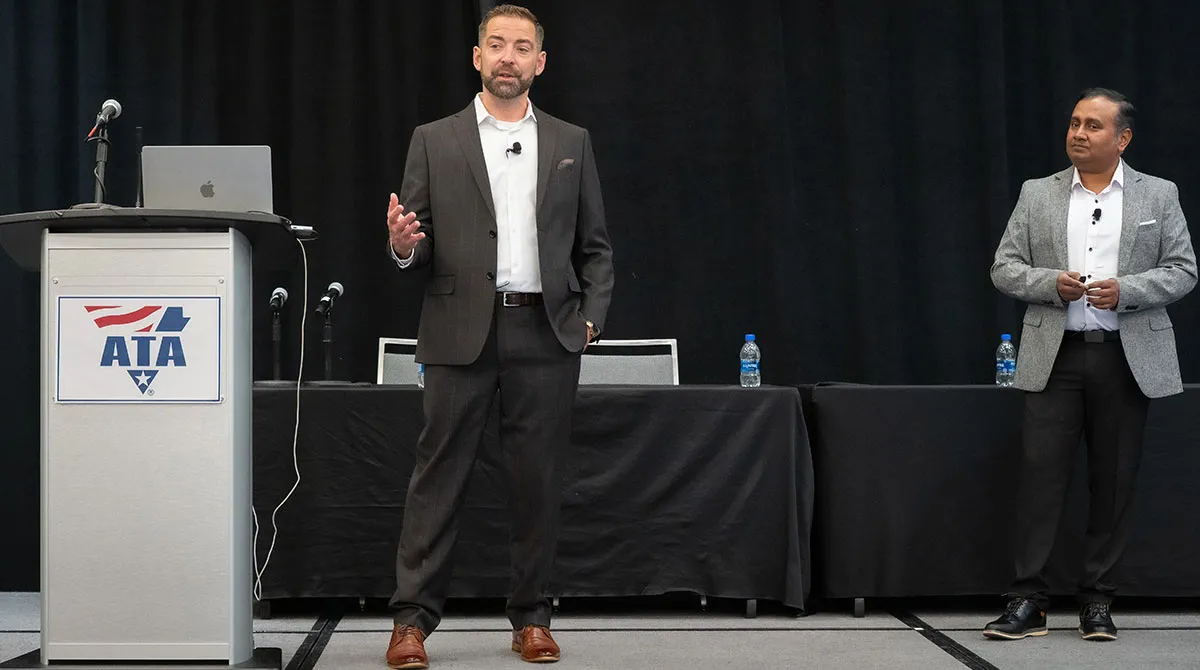 From left: Lasko and Akkarachittor. Lasko said safety works best when drivers feel they are part of the effort. (Erin Granzow Photography)
Key Takeaways:
- Boyle Transportation's Michael Lasko, who appeared alongside Netradyne's Pramod Akkarachittor at an MCE session, described a safety approach shaped by experience both inside and outside the cab.
- Lasko said that approach is increasingly important amid rising litigation, costly claims, driver retention needs and a less-experienced post-pandemic workforce.
- Boyle Transportation uses prompt, personalized coaching, positive recognition and additional training before discipline, except when serious incidents require immediate action.
CHARLOTTE, N.C. — Conversations between drivers and a carrier's safety team aren’t always welcome, said Michael Lasko, general manager and vice president of Boyle Transportation, but a safety program should not feel like surveillance with a punishment waiting at the end.
In a session titled “Building Safety Through Driver Trust,” Lasko appeared alongside Pramod Akkarachittor, chief product officer at Netradyne, and described a safety approach shaped by experience both inside and outside the cab.
The two presented at American Trucking Associations’ Management Conference & Exhibition on Oct. 18.
Lasko said a strong safety program is “heavy on engagement” and not primarily punitive. Safety, he contended, works best when drivers feel they are part of the effort.
That message has become more urgent as carriers face mounting risks, including rising litigation, costly claims and a workforce that has changed since the pandemic, with many newer drivers having less experience. Carriers also must retain the drivers they recruit and train.
Lasko, who began his career as a truck driver, said the challenge is to manage risk without alienating the people fleets need to retain.

PCS Software CEO Mark Hill discusses the advance of AI in the trucking industry. Tune in above or by going to RoadSigns.ttnews.com.
At Boyle, drivers can review camera footage and their performance scores through an app. The system is introduced during orientation, when new hires see how it works and learn the company’s expectations.
“There’s no secrets. There are no hidden tricks,” Lasko said, adding that explaining the process from the start helps drivers understand that the technology is meant to support them.
Recognition is another part of the approach, he noted. Boyle uses monthly incentives and bonuses tied in part to safety and shares examples of positive driving with the fleet. Drivers who stand out may be invited to join an advisory committee or help test new technology. The goal is to make good decisions visible and reinforce them, rather than letting every interaction with the safety team focus on mistakes.
“Anytime that we find something in a video that is positive, we send that out to the entire fleet,” Lasko said. “And of course, everybody wants to watch it, and they’re reading the kind of analysis of why this was good, what this driver did that was excellent.”
He stressed that coaching needs to happen promptly. Invoking the “hot stove” analogy, he said feedback is most effective when it is immediate, consequential and fair. Coaching soon after an event helps drivers connect the conversation to what happened, he said.
Lasko also said coaches should adapt their approach: Some drivers respond to statistics, while others respond to encouragement or discussion of a specific behavior.
Credibility matters, too, he said. Boyle uses experienced company drivers as coaches because they understand the work.
“Coaching should be a two-way conversation, not a lecture,” Lasko said. A driver’s willingness to improve should shape the response, he added. Additional training and more frequent check-ins may come before discipline, though serious cases can require immediate action.
Lasko shared an example of how cameras can protect drivers: A driver who had opposed cameras changed his view after footage documented another vehicle deliberately striking his truck. That example, Lasko said, illustrates why trust depends on using technology as promised.
“The cameras are there for you,” he said. “They’re there to protect you, the professional driver.”