[Stay on top of transportation news: Get TTNews in your inbox.]
Size of trucking verdicts quadruples over 2023-2026 time span
FedEx keys in on interconnected fraud networks
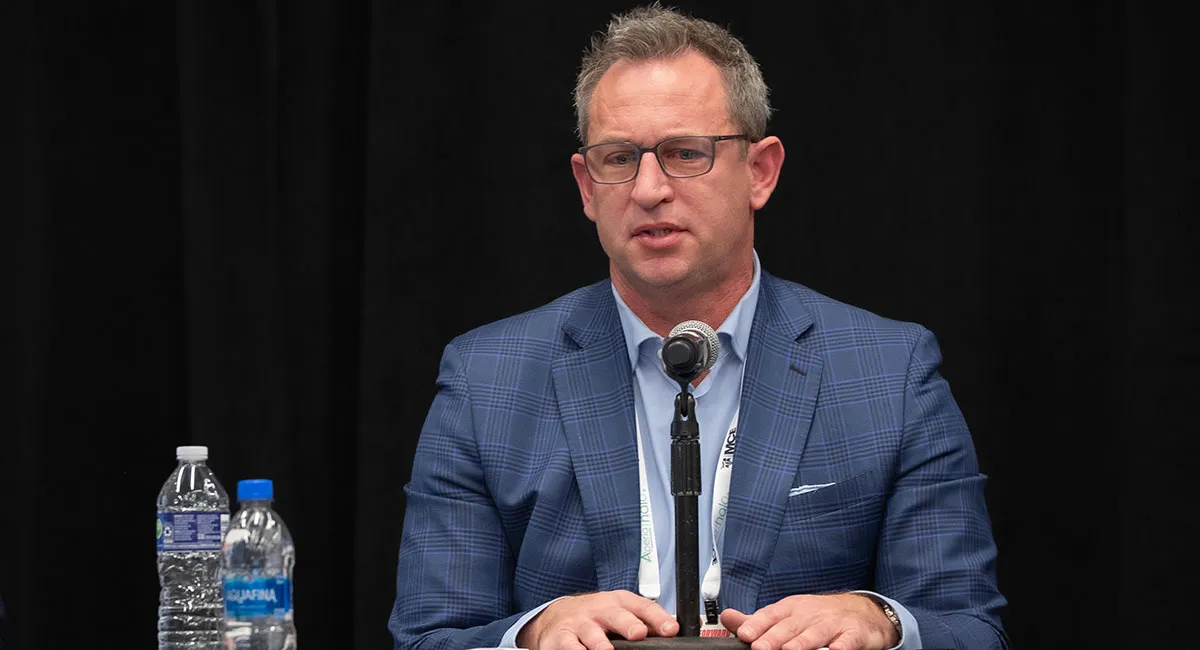 Smith heads the company’s enterprise claims and anti-fraud program. (Erin Granzow Photography)
Key Takeaways:
- A forthcoming U.S. Chamber study found median trucking lawsuit verdicts nearly quadrupled from $760,000 in 2023 to $3 million in 2026.
- FedEx counsel Jerrod Smith said interconnected fraud networks, including staged crashes, are the leading force driving larger awards.
- Trucking advocates are pressing Congress to advance litigation and fraud reforms before the November midterm elections.
CHARLOTTE, N.C. — The size of verdicts in lawsuits involving trucking companies almost quadrupled between July 2023 and July 2026, according to a soon-to-be-released U.S. Chamber of Commerce Institute for Legal Reform study.
And the biggest reason is interconnected fraud networks, FedEx Corp. lead counsel Jerrod Smith told attendees at the 2026 American Trucking Associations’ Management Conference & Exhibition. Smith heads the company’s enterprise claims and anti-fraud program.
The ILR assessed 334 verdicts and settlements from June 2023 through July 2026, the study’s lead author told MCE attendees.
The mean award was $16.8 million and the median award was $3 million. The median verdict in 2023 when ILR last collated analysis was $760,000, but through the first half of 2026 the median was $3 million. In addition, the median settlement jumped from $210,000 to $2.2 million.
With just plaintiff verdicts alone, the mean was $28 million and the median was $5.2 million. When it comes to settlements alone, the mean was $4.7 million and the median was $2.2 million, the study found.
The six factors ILR sees driving verdicts are:
Interconnected fraud networks
Reptile tactics and anchoring
Flawed statutes and evidentiary rules
New lawsuit targets
Uncertain standards of care
Third-party litigation funding
“I think they all kind of work together,” Smith said. “But I think lately it’s interconnected networks, the broad networks that we’re seeing. And I don’t know if it’s because the schemes themselves are developing and evolving so well … or is it the fact that we’re getting better at seeing these schemes.”

PCS Software CEO Mark Hill discusses the advance of AI in the trucking industry. Tune in above or by going to RoadSigns.ttnews.com.
Smith said that any time a claim comes in against FedEx, every entity or person involved in the claim will be run through internal systems to see what other entities, companies, doctors or pain management people may be part of a scheme.
Intentionally staged accidents are colloquially known as stop shorts or swoop and squats.
Smith laid out how events often unfold in metropolitan areas, noting: “You have a carload of folks. The driver will intentionally lay in wait and they’ll find our vehicles. They’ll often have spotters on the side telling them a FedEx vehicle is coming around the corner. As soon as the vehicle comes around, they’ll ram our vehicle.”
An incident may be completely legitimate, but over time, the executive said, companies like FedEx have started to see a more rounded picture of the interconnected networks “that’s somewhat remarkable, to be honest with you.”
New York-based crisis and issues management specialist Marathon Strategies reported in September that nuclear verdicts involving the trucking and automotive industries nearly tripled year over year to $3.4 billion in 2025.
That’s even as the fatal rate of crashes involving large trucks fell from 2.23 for 100 million miles in 2000 to 1.45 per 100 million miles in 2024, and even further since then, according to Prasad Sharma, a partner at Scopelitis Garvin Light Hanson & Feary.
But some states see higher payouts than others, according to the ILR.
“Texas, California and Florida were problematic the first time we looked at this, and they remain problematic, the most problematic states today,” Sharma said.
“One thing you’ll see in common with these states is that for the most part, state trial court judges are elected in those states. And the plaintiff’s court has a lot of money and funds a lot of those elections. Maybe that’s part of the problem there,” he added.

►Freight Upturn Bodes Well
►The Market Has Finally Turned
►Business Optimism Growing
►Fleets Investing in AI, Efficiency
►Carriers See Diesel Enduring
►Interactive Map
►2025 Yielded Mixed Results
Sector Rankings
LTL | TL/Dedicated
Intermodal/Drayage
Package/Courier | Air/Expedited
Refrigerated | Flatbed/Heavy
Tank/Bulk | Household/Commercial
To illustrate this, he cited data that shows the average award in federal court was $2.1 million versus $24.4 million in state courts. And the median in federal court was $550,000 versus $400 million in a state court.
Looking forward, however, trucking advocates — including ATA — are pushing Congress to advance measures on litigation and fraud reforms before midterm elections in November.
FedEx ranks No. 2 on the Transport Topics Top 100 list of the largest for-hire carriers in North America and No. 3 on the TT Top 50 global freight companies list. FedEx Logistics ranks No. 40 on the TT Top 100 list of the largest logistics companies. FedEx Freight ranks No. 4 on the for-hire TT100.