
[Stay on top of transportation news: Get TTNews in your inbox.]
Trucking groups press Congress for lame-duck action
Advocates from 6 states visit Capitol Hill to advocate highway funding and protections against lawuit abuse
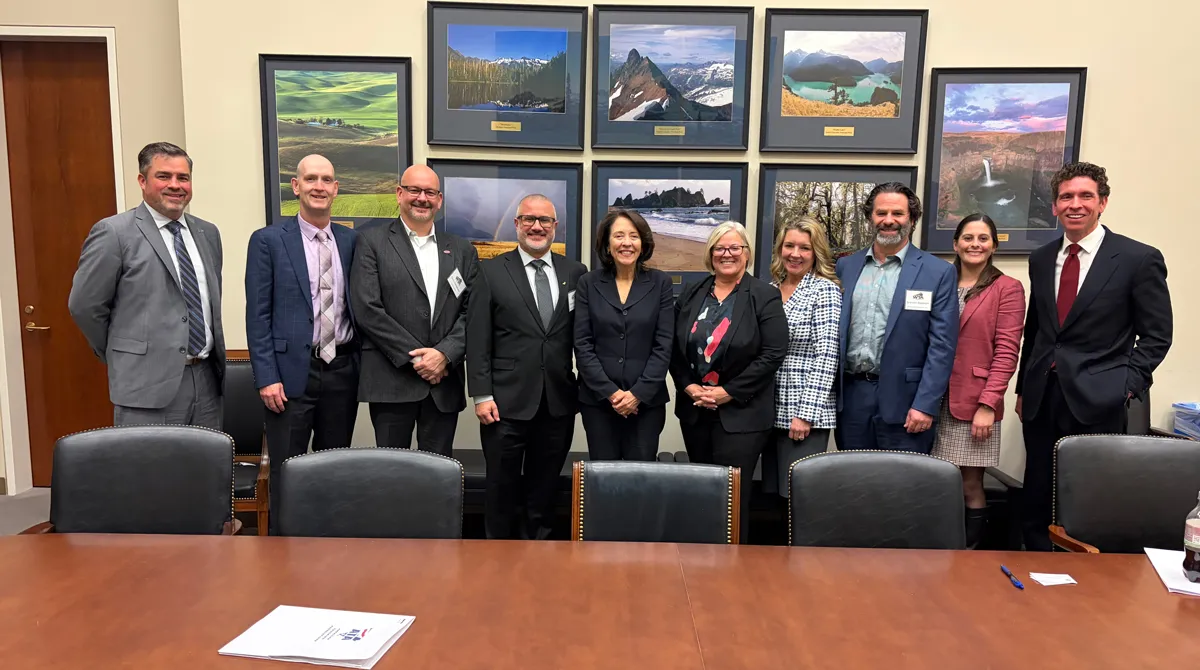 Washington Trucking Association representatives meet with Sen. Maria Cantwell (D-Wash.), center. (Christopher Knight/American Trucking Associations)
Key Takeaways:
- Trucking groups from six states pressed Congress on industry priorities during American Trucking Associations’ Call on Washington events Nov. 17-19.
- About 80 participants advocated legislation addressing lawsuit abuse, staged accidents, cargo theft, truck parking, bathroom access and surface transportation funding.
- Advocates urged action before the lame-duck session ends in mid-December, including on truck parking funding and bills targeting accident fraud and bathroom access.
Carriers from all over the nation are pressing lawmakers to make the most of Congress’ compressed lame-duck session that ends in mid-December.
Trucking groups from Washington, Oregon, North Carolina, Pennsylvania, Maryland and Alabama advocated for federal legislation addressing lawsuit abuse, accident fraud and funding for highways and truck parking during visits from Nov. 17 through Nov. 19. American Trucking Associations hosted the “Call on Washington.”
Around 80 people were involved in the past few legislative advocacy events for the trucking industry before the year ends and a new Congress sets its agenda. There are opportunities to pass bills such as the Trucker Bathroom Access Act, Combating Organized Retail Crime Act and Household Goods Shipping Consumer Protection Act, among other pieces of legislation key to trucking industry priorities.
People from the trucking industry said lawsuit abuse, cargo theft, truck parking and rising health insurance premiums were all issues on their radar as they spoke with lawmakers over the course of the week.
Dale Knox, safety specialist and employee educator for Vorzik Transport, an independent contractor for FedEx Ground, told Transport Topics that lawsuit abuse is the “top issue” for the industry right now.
“It’s lawyers not going after the accident itself. It’s going after how the company wants its safety protocol, and you have these third parties coming in here, and lawyers are suing for large amounts of money just so these companies can settle, and it’s costing the American people,” he said.
Brian Wanner, president of Pennsylvania-based Peters Brothers, said the Staged Accident Fraud Prevention Act, which would make staging a collision with a commercial motor vehicle a federal crime, is an example of the kind of legislation he hopes to see pass Congress. Rep. Mike Collins (R-Ga.) sponsored the bill in the House, and Sen. Ashley Moody (R-Fla.) championed it in the Senate. Wanner said he hoped to meet with members on both sides of the aisle to persuade lawmakers to pass bills on lawsuit abuse, surface transportation funding and more.
“A lot of these have to be bipartisan to get passed. Lawsuit abuse affects everybody, and when we talk about affordability, this is something that affects every family,” he said.
Wanner called a bill requiring many businesses and shippers to provide bathroom access to truck drivers “a no-brainer” for Congress to pass. It advanced through a key Senate committee on Nov. 18. Wanner added that one of the main goals in the next few weeks must be to reauthorize surface transportation funding. The BUILD America 250 Act, which includes a program to support truck parking, has not yet passed the full House, and there is not yet a Senate companion bill for it.
“There’s a lot of things in [surface transportation funding] that would be helpful for trucking,” he said. “I think truck parking is huge. There’s only one spot for every 11 trucks out there.”
RELATED: What to expect from Congress’ lame-duck session
Trucking groups met with staff across a long list of House and Senate offices over their time in D.C. Several North Carolina trucking executives met with staff for many North Carolina lawmakers Nov. 18, including the office of Rep. David Rouzer (R-N.C.), who officially won re-election nearly two weeks after Election Day and could be the next ranking member on the House Transportation and Infrastructure Committee. They had meetings with the offices of lawmakers on both sides of the aisle, including Reps. Deborah Ross (D-N.C.) and Richard Hudson (R-N.C.) as well as Sen. Thom Tillis (R-N.C.). Hudson lost his bid for re-election, and Tillis is set to retire.
Visitors to D.C. from Pennsylvania trucking companies met with the offices of four Democrats and three Republicans, including Sen. John Fetterman (D-Pa.) and Reps. Summer Lee (D-Pa.) and John Joyce (R-Pa.) on Nov. 18.
Maryland trucking executives visited the offices of seven lawmakers Nov. 19. The offices of Sen. Chris Van Hollen (D-Md.) and Rep. Andy Harris (R-Md.) were among their stops in the morning and afternoon.
Trucking company representatives from the state of Washington went to Rep. Rick Larsen’s (D-Wash.) office, among those of other key Washington lawmakers. Larsen is expected to take on the role of chair of the House Transportation and Infrastructure Committee. They also visited with Sen. Maria Cantwell (D-Wash.), who is the ranking member on the Senate Committee on Commerce, Science and Transportation and may lead the committee next year.
The Alabama Trucking Association on Nov. 18 and 19 met with staff of federal lawmakers who will soon be leaving their offices for other elected posts: Rep. Barry Moore (R-Ala.), who has been elected to serve as a senator, and Sen. Tommy Tuberville (R-Ala.), who will be governor of Alabama next year.
Oregon trucking industry representatives were scheduled to meet with staff from several senators’ and representatives’ offices, including Sen. Jeff Merkley’s (D-Ore.) office. The senator said he is seeking to be the chair of the Senate Environment and Public Works Committee, an influential post for shaping policy on infrastructure.
Knox said lawmakers have to recognize that trucking fuels the country and support industry priorities in Congress.
“The trucking industry is the backbone of the United States of America. And if you start tearing the backbone of America down, you’re not going to have America,” he said.


