[Stay on top of transportation news: Get TTNews in your inbox.]
Truck buyers are taking wait-and-see approach, OEMs say
Regulatory uncertainty tempers optimism over improving freight conditions
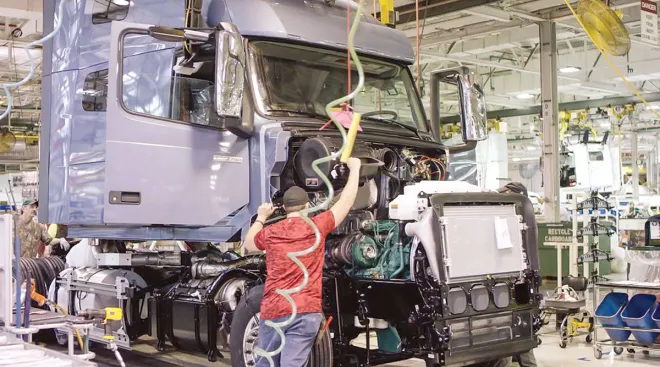
 A Mack Pioneer readies to roll off the Macungie plant production line. (Mack Trucks)
Key Takeaways:
- Truck manufacturers said Class 8 demand is strengthening despite a cautious September as fleets replace aging equipment and 2027 order boards gradually open.
- September orders were mixed, with ACT reporting 18,700 units down 9.5% year over year while FTR estimated 21,300 units up 3%.
- Manufacturers expect orders to increase as 2027 production opens further and fleets weigh emissions uncertainty against efficiency and replacement needs.
Truck manufacturers say Class 8 demand is gaining momentum despite a cautious start to order season in September, citing fleets’ replacement needs, improving freight conditions and the gradual opening of 2027 order boards.
“We expect the pace of orders to increase in the coming months as the industry opens 2027 production and fleets continue to replace aged equipment,” said Jonathan Randall, president of Mack Trucks North America.
The outlook comes as September order data pointed to continued fleet demand even as regulatory uncertainty and delays in opening model-year 2027 order boards weighed on activity at the traditional start of the ordering cycle.
ACT Research reported preliminary North American Class 8 orders totaled 18,700 units in September, down 9.5% from a year earlier. The firm said the softer intake likely reflected uncertainty around future emissions regulations and the fact that some manufacturers had yet to fully open 2027 order boards.
The Environmental Protection Agency has proposed revisions to its 2027 heavy-duty engine rule that would ease warranty requirements that truck and engine manufacturers have warned could raise costs and complicate the rollout of new diesel engines while leaving the underlying emissions standards intact. While some fleets are taking a wait-and-see approach as the EPA weighs adjustments to the 2027 rules, others are investing in new equipment based on calculations tied to total cost of ownership, fuel efficiency, uptime and dealer support.
International Motors senior vice president of sales and field operations Justina Morosin said replacement demand and an aging truck population remain important long-term drivers as fleets evaluate their purchasing strategies.
Image

Morosin
“September orders reflect a market that remains cautious as customers balance freight demand, economic conditions and planning for future emissions requirements,” she said.
“Continued inflation growth represents a headwind, but so far doesn’t seem to have impacted fleet decisions, even with elevated diesel prices,” Randall added. “Freight rates continue to improve as capacity tightens and freight demand recovers.”
In fact, FTR Transportation Intelligence noted that tightening capacity, firmer freight rates and replacement demand continue to support the market. It estimated that September net Class 8 orders reached 21,300 units, up 3% from a year earlier and 18% from August, smaller gains than seasonally expected.
FTR noted that attention is increasingly shifting to MY 2027 engines now that fleets’ opportunity to pre-buy trucks with 2026-spec engines has run its course. The firm noted September was the first full month in which orders reflected manufacturers’ evolving compliance strategies and uncertainty surrounding future pricing.
Volvo Trucks North America reported U.S. and Canadian Class 8 orders totaling 17,749 units in September.

PCS Software CEO Mark Hill discusses the advance of AI in the trucking industry. Tune in above or by going to RoadSigns.ttnews.com.
“Even if the orders were up 14% compared with August, the September numbers were a little lower than we expected, and it seems like not all OEMs have fully opened the order books for 2027,” said Magnus Koeck, vice president of strategy, marketing and brand management at Volvo Trucks North America.
Koeck said while freight rates are improving and carrier profitability is gradually recovering, fleets continue to balance replacement needs against demand levels that remain below historical norms.
“While some uncertainty remains around future regulations, fleet investment decisions continue to be driven primarily by the need to improve efficiency,” Koeck said.