
[Stay on top of transportation news: Get TTNews in your inbox.]
OEMs see positive momentum in Class 8 order activity
Buyers returning as business conditions improve
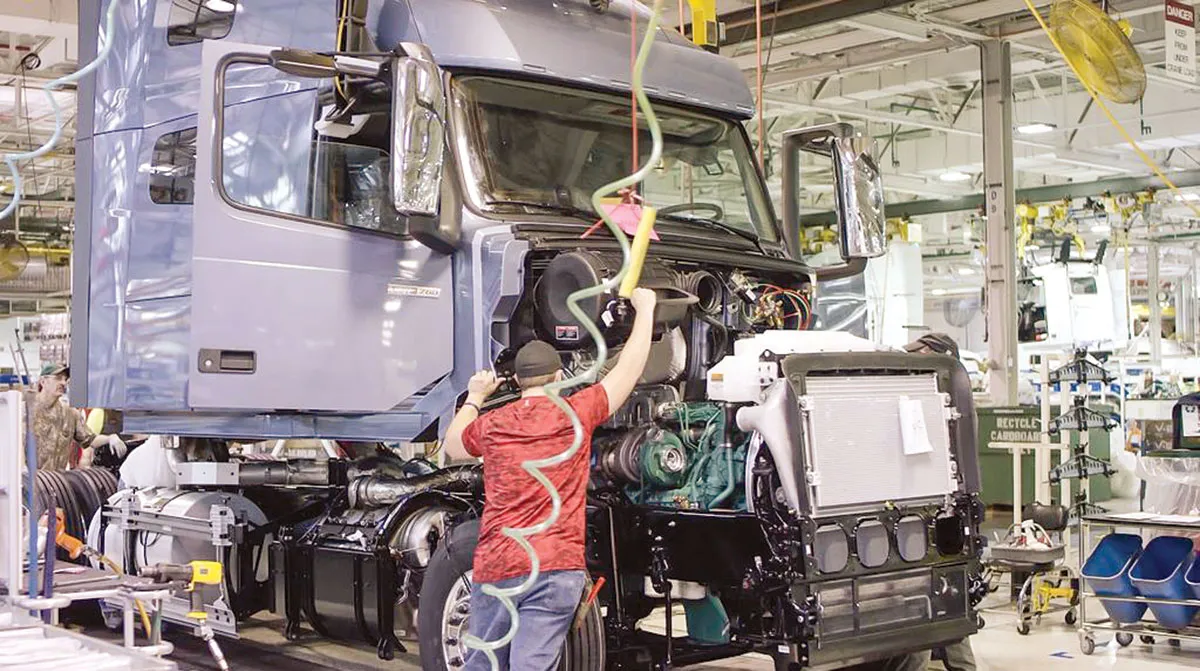 Production at Volvo Trucks North America's New River Valley plant in Dublin, Va. (Volvo Group)
Key Takeaways:
- ACT Research said August North American Class 8 orders rose 31% year over year to 16,800 units.
- Manufacturers attributed the sequential decline from July largely to filled order books and limited build-slot availability.
- Executives said improving freight rates and recovering carrier profitability are supporting fleet investment decisions.
The Class 8 truck order environment remains solid despite a late-summer sequential slowdown as order books fill and buyers become more selective, truck manufacturers said.
“The Class 8 market continues to reflect a disciplined replacement environment, with fleets remaining selective in how and when they invest,” said Justina Morosin, senior vice president of sales and field operations for truck manufacturer International. “While industry retail demand remains below last year’s levels, we’re encouraged by International’s continued momentum.”
ACT Research preliminary data for August showed North American Class 8 truck orders rose 31% year over year to 16,800 units.
The result came against a weak year-ago comparison marked by tariff uncertainty and pressure on carrier profitability.
Morosin said August was a strong month for the company, with volume and market share improving from July. International’s year-to-date market share also continues to outpace last year’s level. She attributed the gains to improving customer confidence, strong dealer execution and the company’s focus on retail customers and expanded market coverage.
Image

The Class 8 market continues to reflect a disciplined replacement environment, says International's Justina Morosin. (International Motors)
On a sequential basis, ACT said orders fell 35% from July. It attributed the decline to oversubscribed backlogs and limited build-slot availability rather than weakening demand.
Volvo Trucks North America data showed Class 8 orders in the U.S. and Canada totaled nearly 15,700 units in August. That represented a sequential decline from July, but orders were up 28% from August 2025.

Arpan Podduturi of Samsara examines how AI, telematics and onboard cameras are converging to protect drivers and reduce risk. Tune in above or by going to RoadSigns.ttnews.com.
“Lower order activity compared with July was primarily driven by build-slot availability and the fact that the 2027 order books were not yet fully open,” said Magnus Koeck, VTNA vice president of strategy, marketing and brand management. “We can now see improved freight rates both in the spot market and contract business, and we also see that carriers’ profitability is slowly coming back.”
He added, “These fundamentals are supporting fleet investments, particularly as fleets look for ways to improve fuel efficiency, productivity and total cost of ownership.”
FTR Transportation Intelligence reported that preliminary net orders increased 42% year over year to 18,200 units in August. Orders, however, declined 19% from July. FTR said the sequential drop largely reflected normal summer seasonality rather than softer underlying demand, marking the end of the order season and pre-buy activity ahead of new emissions regulations.
Image

“We expect the pace of orders to increase in the coming months as the industry opens 2027 production and fleets continue to replace aging equipment," MTNA President Jonathan Randall says. (Mack Trucks North America)
“Preliminary orders cooled in August as the 2026 order boards are mostly full,” said Jonathan Randall, president of Mack Trucks North America. “We expect the pace of orders to increase in the coming months as the industry opens 2027 production and fleets continue to replace aging equipment. Freight rates continue to improve as capacity tightens and freight demand recovers.”
Randall said inflation remains a headwind, but he has not yet seen it alter fleet purchasing decisions, even with elevated diesel prices.


