[Stay on top of transportation news: Get TTNews in your inbox.]
High diesel prices could persist as supply disruptions mount
Persian Gulf conflict and Ukrainian drone strikes limit output from major fuel hubs
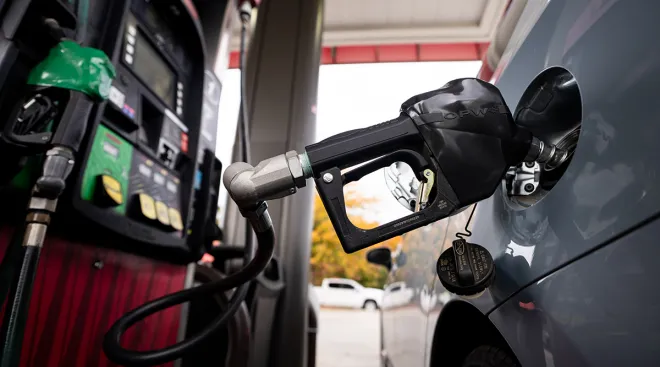
 A driver refuels a vehicle with diesel at a Shell station in Seattle. (David Ryder/Bloomberg)
Key Takeaways:
- War-related disruptions in the Persian Gulf and Russia have tightened global diesel supplies, keeping prices high and weighing on demand.
- Middle Eastern and Russian hubs have each lost 2 million barrels a day in fuel exports, forcing consumers to draw from stockpiles.
- Refiners face growing breakdown risks, while industry executives warned shortages could worsen as European winter demand rises.
The global refining sector’s diesel crunch is likely to result in tight supply for the coming months, keeping prices high and weighing on demand, according to analysts and traders.
On top of more than six months of war in the Persian Gulf, impeding output there — and a fresh flare-up over recent days — the market is contending with the impact of Ukrainian drone strikes on Russian refineries, which have prompted the country to extend a ban on diesel exports.
Fuel exports lost from the major processing hubs in the Middle East and Russia now amount to 2 million barrels a day each, Vitol Group CEO Russell Hardy told the Asia Pacific Petroleum Conference run by S&P Global Energy in Singapore. With refiners elsewhere already at their limit, consumers have turned to distillate fuel stockpiles, and will keep drawing.
“We’re still not running enough refining capacity to prevent those draws,” he said.
The price of diesel — known as the workhorse fuel of the global economy — has run ahead of crude since the start of the war, with the jump in the ICE gasoil benchmark more than twice that seen for Brent, creating inflationary pressures even while oil has remain relatively stable.
Image
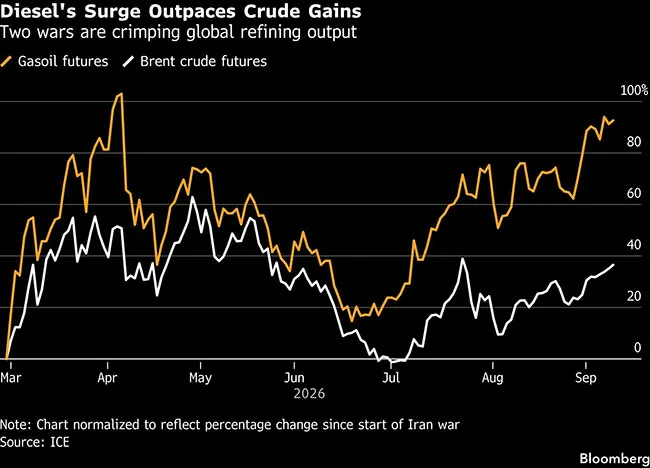
In the U.S., retail diesel has hit records above a former peak set in June 2022.
Eye-watering diesel margins have encouraged refiners outside Russia and the Middle East to run hard to capture gains, but the clock is ticking on how long they can keep up the feat. Refinery equipment gets increasingly vulnerable to breakdowns if operated at high utilization rates for too long. That could mean an outage at a time where buffers are limited, exacerbating the crisis.
“If we can sustain until the end of this year, it is going to be an achievement,” Shaikh Khaled Al-Sabah, managing director for international marketing at Kuwait Petroleum Corp., said of the global refining system. That creates the risk of “a huge shortage that’s going to be seen quite soon” in fuels, he added.
U.S. exports have helped alleviate tightness particularly in import-dependent Europe. But that may not hold as diesel consumption there begins to increase as temperatures drop, given the U.S. is not producing more, even as shipments have climbed.
“I think we’re going to see a very difficult winter coming in Northwest Europe,” Al-Sabah said. “This is only the beginning.”