
[Stay on top of transportation news: Get TTNews in your inbox.]
Oil prices rise with focus on Iran war diplomacy
Brent crude rises 1% to $90.59 a barrel
| Updated:
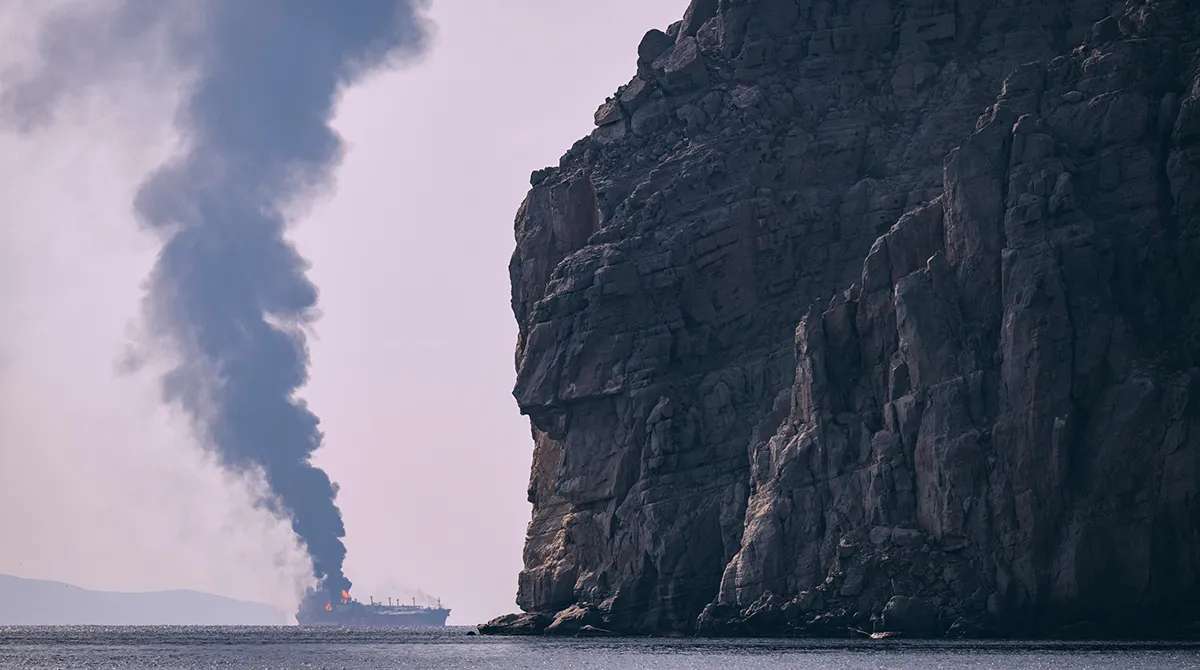 In this photo taken from a boat accompanying endurance swimmer Lewis Pugh, smoke rises from a burning liquefied petroleum gas tanker in the Strait of Hormuz off the Musandam Peninsula, Oman, on Nov. 17. (Lewis Pugh Foundation via AP)
Key Takeaways:
- Oil hovered near $89 a barrel as traders weighed U.S.-Iran diplomacy against improving crude supplies.
- Persian Gulf crude exports rebounded to 74% of prewar levels, with the International Energy Agency forecasting a market surplus this quarter.
- President Donald Trump said diplomacy would continue, but he may resume attacks after the New Year if no agreement is reached.
Oil edged higher in thin holiday trading as reports of further tanker attacks overshadowed the latest diplomatic efforts to resolve the U.S.-Iran war.
West Texas Intermediate crude traded above $81 a barrel, after sliding roughly 4% in the previous session. Volumes are trending lower ahead of the Thanksgiving holiday in the U.S., contributing to exaggerated price moves.
Brent for January settlement climbed 1% to $90.59 a barrel. WTI for January delivery rose 1% to $81.35 a barrel.
More tankers were hit in the Strait of Hormuz, as Iran said it would tighten control over the waterway until its demands are met. Vice President JD Vance met with the prime minister of Qatar to discuss regional developments, with Washington and Tehran struggling to find common ground.
While there is some hope of a negotiated settlement, major differences between the two sides remain. Tehran wants a U.S. naval blockade of its ports lifted, sanctions eased and frozen assets released before fully reopening Hormuz. Trump administration officials are deciding whether the military should target Iran’s top leaders, NBC reported, citing an unnamed U.S. official and a person familiar with the discussions.
Meanwhile, two Saudi nationals and nine foreigners were injured in a Houthi attack Nov. 24 on a tower in Riyadh’s financial district, the state-run Saudi Press Agency said, citing a spokesman for civil defense.
The outlook for energy markets has been tempered by signs that supply is recovering. A widely watched time spread for the Middle East’s Dubai oil benchmark flipped into a bearish structure this week that signals supply is running ahead of demand.
WTI oil on the cusp of falling below $80/bbl, while Brent is already below $90. crack spreads still seasonally strong, but this is the time of year we're likely to see inventories pick up, especially with refinery utilization remaining strong.
— Patrick De Haan (@GasBuddyGuy) November 23, 2026
“Despite continued kinetic action in the Middle East, the market remains risk off, with time spread structure signaling oversupplied,” said Will Cunliffe, an analyst at Onyx Capital Group.
The U.S. benchmark has tumbled by more than a fifth this month after President Donald Trump held off on renewed strikes following the Democratic sweep of midterm elections and as Gulf producers managed to export more crude. Trump has said he would give diplomacy more time, effectively extending a deadline to resume attacks on Iran until after the New Year if no deal is reached.
In the absence of an escalation in hostilities, analysts are pointing to an impending oversupply. Crude exports from the Persian Gulf have rebounded to 74% of pre-war levels, according to the International Energy Agency, which predicted the market will swing to a surplus this quarter. Goldman Sachs Group Inc. has also flagged the risk of a glut next year.
Elsewhere, Iraq has rejected an assessment of its oil production capacity that was commissioned by OPEC+, according to people familiar, setting up a potential clash at this weekend’s key meeting. An Iraq emboldened to pump more could further weigh on prices in a year already expected to be defined by oversupply, market participants said.

Mathias Carlbaum of International Motors discusses the outlook for truck demand and production in 2027, including International’s planned production ramp-up in San Antonio and the transition to new engines under upcoming NOx requirements. Tune in above or by going to RoadSigns.ttnews.com.
There are still signs of tightness, and global benchmark crude prices remain over 40% higher this year. While observed oil inventories rose last month, the increase was also dominated by barrels at sea, as onshore stockpiles remained at their lowest in a decade.
“The status quo remains unsustainable for the medium-to-long term, and so long as a conclusion to the conflict remains elusive crude oil should maintain a risk premium in pricing, which suggests upside from here,” said Ryan McKay, senior commodity strategist at TD Securities.
Refined fuels, which rallied even harder than crude and fanned global inflationary fears, have lost ground too. A barometer that approximates the cost of turning crude into gasoline and diesel — the so-called 3-2-1 crack — was the weakest since March as prices broadly retreated.
Written by Charles Gorrivan, Yurii Stasiuk and Mia Gindis


