
[Stay on top of transportation news: Get TTNews in your inbox.]
Used truck sales take unexpected dip as inventories tighten
Sequential decline of 8.8% in August from July bucks seasonal trends
| Updated:
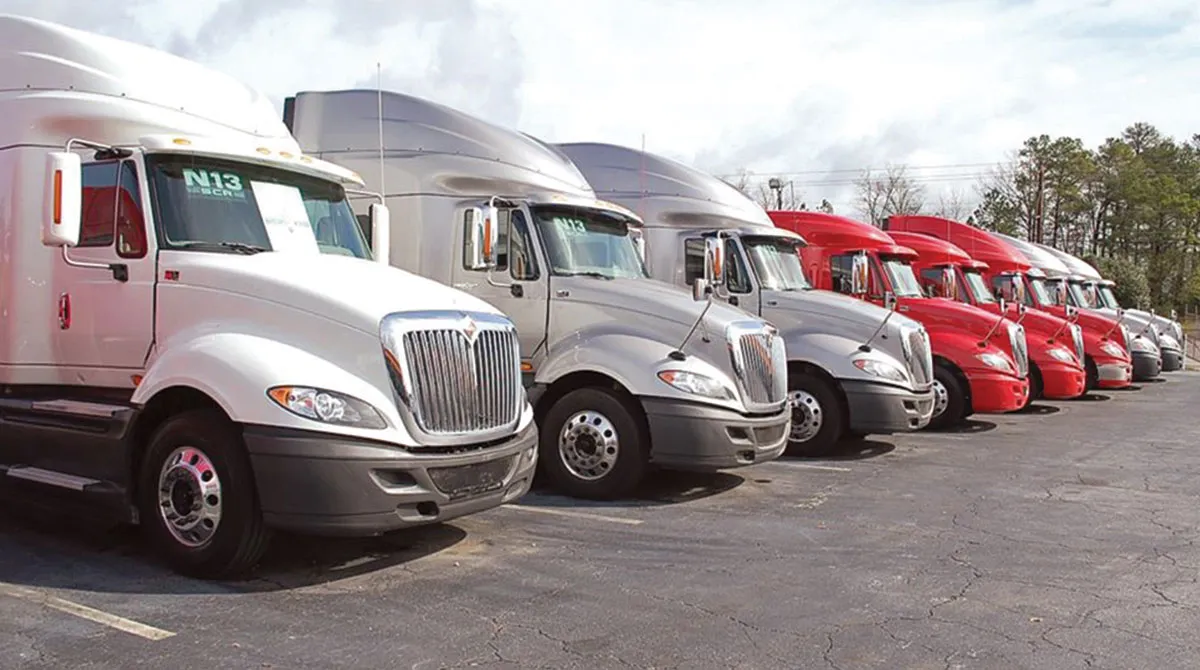 Used Class 8 trucks on a sales lot. (Atlanta International Used Truck Center via Facebook)
Key Takeaways:
- Used Class 8 truck sales fell 8.8% in August to 23,800 units but rose 0.8% year over year.
- Tightening inventory drove dealer used-retail sales down 24% from July while average retail prices climbed 11.3% year over year, ACT Research said.
- Rising diesel costs and scarce newer, lower-mileage trucks are pressuring owner-operators and small fleets while supporting higher prices.
Used Class 8 truck sales slowed in August, defying typical seasonal trends as inventories tightened.
ACT Research reported sales fell 8.8% to 23,800 from 26,100 units in July. However, sales edged up 0.8% year over year from 23,600.
The report also found that dealer used-retail truck sales, which typically increase seasonally, declined 24% from the previous month. ACT noted the drop does not necessarily signal weaker demand.
“More likely a result of tightening inventory,” said Steve Tam, vice president at ACT Research. “Dealers across the country are reporting that used truck inventory is increasingly hard to come by, and our analysis of multiple advertising sources confirms that available units are down meaningfully from earlier in the year.”
ACT also reported the average retail sales price rose 11.3% year over year to $64,367 from $57,846 and increased 2.2% from $62,996 in July.
[September State of the Industry: U.S. Classes 3-8 Used Trucks Update] - Used Truck Sales Fall in August as Prices Continue to Climb Read more from the update here: https://t.co/E2fWC25S0T https://t.co/isfqDf3um5
— ACT Research (@actresearch) September 29, 2026
Average retail mileage decreased 0.7% to 412,000 from 415,000 a year earlier but increased 1% from 408,000 miles the previous month.
“With new truck sales also running below last year’s pace, fewer trades are making their way into the used market, supporting higher prices despite lower sales volumes,” Tam said.
Fuel price pressures
Iran and its allies have put pressure on global energy supplies in response to the war with the U.S. and Israel. This has included an ongoing blockade of the Strait of Hormuz and the Bab el-Mandeb Strait. The Energy Information Administration reported national diesel prices increased 63% since the start of the war to $6.20 by Oct. 6.
“It is a better year than it was last year, but it does seem that it peaked and has come off a little bit,” said Trey Golden, vice president of used trucks at Rush Enterprises. “So fuel, obviously, for the used truck guy, he’s less insulated, he has less protection from surcharges.”
Golden noted that the larger and more sophisticated carriers are better positioned to navigate the downstream costs on diesel. But the used truck market tends to comprise owner-operators and small fleets, so the higher costs have disproportionately hit his customers.
Other factors weighing on used truck market
“The No. 2 thing that probably is worth highlighting is the lawsuits,” Golden said. “Then getting rid of a lot of bad CDLs, which that was all absolutely correct. But now we’re even more so saying, hey, you’ve got legit carriers with legit licensing and legit CDLs.”
Image

Golden
Golden expressed concern that those legitimate smaller carriers could be boxed out as shippers and brokers lean more heavily on the larger and more established companies to avoid potential legal issues. But these are also the types of companies that are more likely to be used truck customers as well.
“As capacity has been coming out, it’s pitting the big guy against the little guy, and the little guy is more likely to be a used truck buyer,” Golden said. “It’s not like owner-operators are going away, but they would be more likely to have to lease on to carriers.”
Golden described used truck inventories as being more unbalanced than tight. He does have a lot of older and higher-mileage trucks because of how much longer carriers were holding onto them during the freight downturn. He said he can only really sell those at a lower price since demand is more focused on the newer and lower-mileage used options that are in short supply.

PCS Software CEO Mark Hill discusses the advance of AI in the trucking industry. Tune in above or by going to RoadSigns.ttnews.com.
“We’ve had two years of below-average new truck sales,” Golden said. “If you look at the public carriers that publish this information, the fleet age is about as old as I’ve seen it. You’ve got public carriers, I won’t name names, that are customers of ours, that never would run a truck past 400,000 miles, and now they have 500,000- and 600,000-mile trucks.”
Golden also pointed to higher new truck costs as adding a further complication since some of those customers have started looking at the newer used options. He has even seen this imbalance impact pricing with costs jumping on the top end but inching down for older models.
“There’s also a [price] where the big carriers just say, heck with it, if that’s all it’s worth, I’ll just keep it, and I’ll just park it out back as a spare, I’ll use it for parts, that kind of thing,” Golden said. “I don’t know what that number is.”


