
[Stay on top of transportation news: Get TTNews in your inbox.]
UPS expects holiday volume dip after Amazon reductions
Carol Tomé says fewer vehicle rentals and aircraft leases should be needed for the seasonal surge
| Updated:
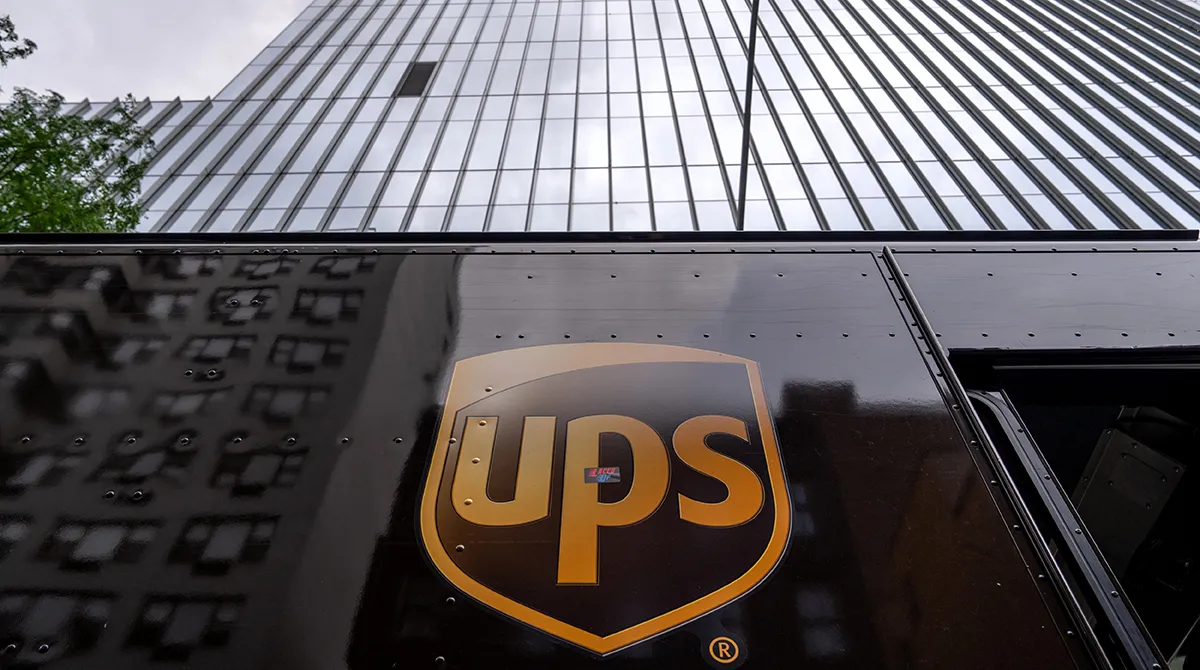 A UPS delivery truck in New York. (Adam Gray/Bloomberg)
Key Takeaways:
- UPS expects lower U.S. package volume this holiday peak after deliberately reducing low-margin Amazon.com Inc. shipments earlier in 2026.
- Carol Tomé said customer forecasts show holiday online retail rising about 9%, while UPS peak customers expect daily volume to increase 25% sequentially.
- UPS plans to add variable capacity as needed, supported by a network where nearly 70% of packages now flow through automated processes.
UPS Inc. CEO Carol Tomé said Oct. 27 that the company expects lower volume during the peak holiday shipping season due to an earlier initiative to strengthen the network.
The Atlanta-based shipping and logistics company is still expecting a strong peak season overall, with its data showing holiday online retail forecasts averaging an increase of about 9% compared with last year. But the expectation that its own U.S. volume will be lower stems from an initiative earlier in the year to reduce shipments from online retailer Amazon.com Inc.
“U.S. consumers remain resilient, and the outlook for holiday demand is strong,” Tomé said on an investor call. “However, fourth-quarter U.S. average daily volume is expected to be lower year over year, reflecting the deliberate actions we took earlier in the year.”
The Network Reconfiguration and Efficiency Reimagined initiative aimed to improve operational efficiency when it was first revealed in January 2025. This included working closely with its customer Amazon to systematically reduce low-margin package volume in what company executives have referred to as a glide-down. The initiative was completed July 28.
“As we head into peak, our network is more automated, more efficient and better positioned than ever to handle the holiday surge,” Tomé said. “We’ll add variable capacity where needed.”
RELATED: UPS calls plan to shed low-margin Amazon packages a success
Tomé added that investments in the network have enabled the company to operate with fewer vehicle rentals and aircraft leases, with nearly 70% of all packages flowing through an automated process. This has also included relying more on sensors than scanners.
“We are ready for peak,” Tomé said. “We’ve been the industry leader in on-time service during peak for the past eight years. And with our network, our know-how and the commitment of UPSers, we’re ready to make it nine.”
Tomé noted that volume would be higher without those earlier efforts. She pointed out that roughly 100 customers in the U.S. account for about 80% of peak surge for the company, with their forecasts showing average daily volume increasing 25% sequentially going into the fourth quarter.
“We’re also finding new ways to make the holiday experience better for our customers,” Tomé said. “We recently launched Protected Delivery, which adds an extra layer of security for high-value shipments by requiring a PIN before the package is released. And we’re adding a little holiday spirit with special holiday-themed express packaging.”
Tomé made her remarks while reporting third-quarter financial results for 2026. The company posted net income of $1.16 billion, or $1.37 a diluted share, for the three months ended Sept. 30. That compared with $1.31 billion, $1.55, during the same time the previous year. Total revenue increased 6.7% to $22.9 billion from $21.4 billion.
“These results show that our strategy is working,” Tomé said. “We’re driving more premium growth, improving revenue quality and mix, and creating greater operating leverage through a more efficient network. All of this is strengthening the underlying performance of our business.”
Results by segment
- U.S. Domestic segment revenue increased 4.5% to $14.9 billion from $14.2 billion the prior year. Operating profit increased 50.3% to $906 million from $603 million.
- International segment revenue increased 7.1% to $5.01 billion from $4.67 billion. Operating profit increased 10.4% to $746 million from $676 million.
- Supply Chain Solutions revenue increased 18.2% to $2.98 billion from $2.52 billion. Operating profit decreased 82.5% to $92 million from $525 million.
UPS ranks No. 1 on the Transport Topics Top 100 list of the largest for-hire carriers in North America. UPS Supply Chain Solutions is No. 6 on the TT Top 100 list of the largest logistics companies. The company also ranks No. 3 on the TT Top 50 list of the largest global freight carriers.


