
[Stay on top of transportation news: Get TTNews in your inbox.]
Uber, Nuro to start driverless testing of Lucid robotaxis
Testing will begin in Palo Alto, Mountain View, Los Altos and Sunnyvale
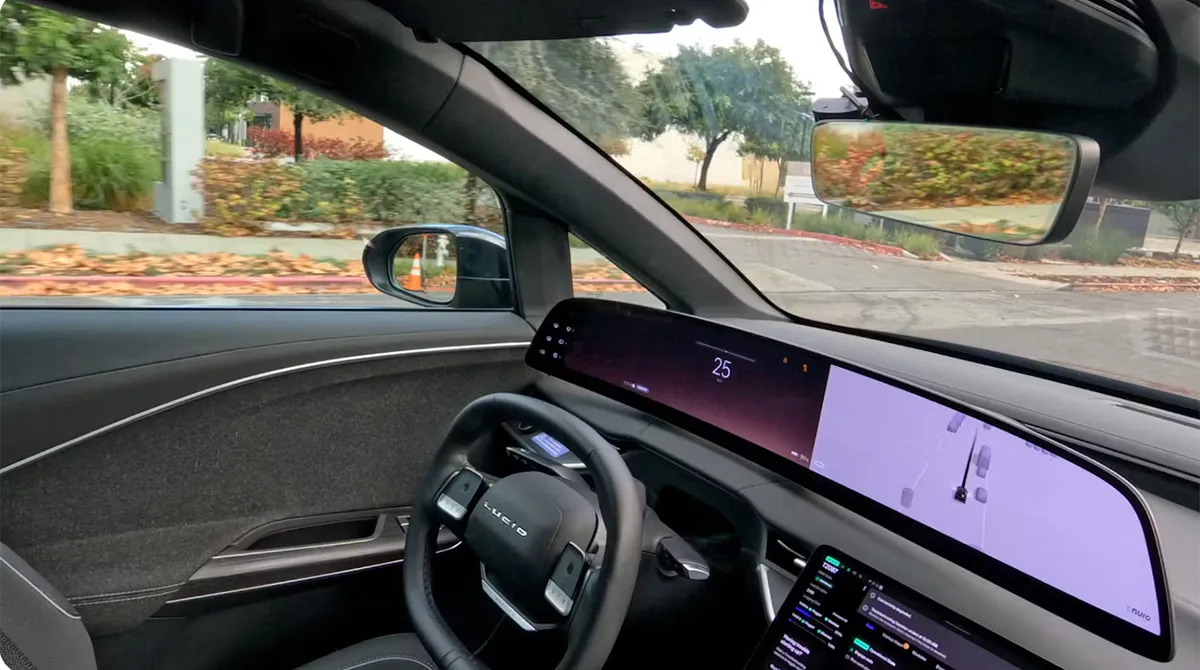 A Lucid robotaxi. (nuro.ai)
Key Takeaways:
- Uber, Nuro and Lucid began testing fully driverless robotaxis in four California cities after nearly a year of trials with safety operators.
- The milestone advances a major Uber robotaxi partnership as its relationship with Waymo unravels and its commercial launch shifts from 2026 to 2027.
- Lucid expects to begin building commercial fleet vehicles soon, with employee rides next and public Uber service planned for early 2027.
Uber Technologies Inc. has started testing robotaxis developed by Nuro Inc. and Lucid Group Inc. without a safety driver, a key milestone ahead of a commercial launch next year.
For almost a year, Nuro has been conducting tests in the San Francisco Bay area and Houston using a fleet of Lucid Gravity robotaxis with safety operators behind the wheel. Now, the companies are ready to remove the safety driver as part of the next phase of development, according to a statement Nov. 24. The driverless testing will begin in four California cities — Palo Alto, Mountain View, Los Altos and Sunnyvale — before expanding to additional area municipalities next year.
Employees will also soon get access to the fully driverless rides, and Lucid expects to start manufacturing the first vehicles for the commercial launch fleet in the coming weeks, the companies added. As the service opens up to the public next year, Nuro expects Uber to take over remote assistance and monitoring of the vehicles, Nuro Co-CEO Dave Ferguson said in a July interview.
The development marks a sign of progress for one of Uber’s biggest robotaxi partnerships and investments, which have gained heightened importance after the rideshare giant’s relationship with Waymo began to unravel. When Uber shared details about the Nuro-Lucid partnership last year, it said it expected service to start in 2026. But the commercial launch has since been pushed to the first quarter of 2027.
Uber has pursued a partnership approach when it comes to autonomous vehicles. Rather than building its own car, the company sees itself as an aggregator that matches riders to both human drivers and robotaxis. It has struck deals with more than a dozen robotaxi makers that will make their cars available on the Uber app in the coming years, but only a few companies in the U.S. so far have made it out of the testing phase, let alone to the fully driverless stage.
Waymo and Amazon.com Inc.’s Zoox don’t have safety drivers, but Motional and Avride — Uber’s partners in Las Vegas and Texas, respectively — still have have operators behind the wheel who can take over the driving if the vehicle makes mistakes, for example.
The driver is officially out. Our @LucidMotors Gravity robotaxis driven by @nuro are now testing fully driverless on public roads in the San Francisco Bay Area. Employee rides are next. The future of mobility is getting closer—coming to @Uber in early 2027. https://t.co/hM5swhIpqP
— Nuro (@nuro) November 24, 2026
Even as Uber, Nuro and Lucid proceed to the driverless testing stage, it will take time for them to catch up with Waymo, the leading provider of driverless rides in the U.S. Notably absent from the list of test markets is San Francisco, where rival Waymo already offers paid trips. Waymo also serves riders throughout the rest of the peninsula, though California regulators recently ordered the Alphabet Inc. unit to suspend freeway testing and operations due to safety concerns. On Nov. 23, Waymo also temporarily paused service in the area, citing weather conditions.
Like Waymo’s vehicles, Nuro and Lucid’s robotaxis feature cameras and lidar and radar sensors so the car can “see” its surroundings. The Lucid Gravity is roomier than Waymo’s Jaguar model, but the in-car experience — which includes a tablet and dashboard display that shows where the car is going and what it’s detecting on the road — should feel familiar to those who have tried Waymo.


