[Stay on top of transportation news: Get TTNews in your inbox.]
Trump faces suit over 50% Canada tariffs
Food importer Gellert Global Group disputes use of Section 338 of the Smoot-Hawley Tariff Act
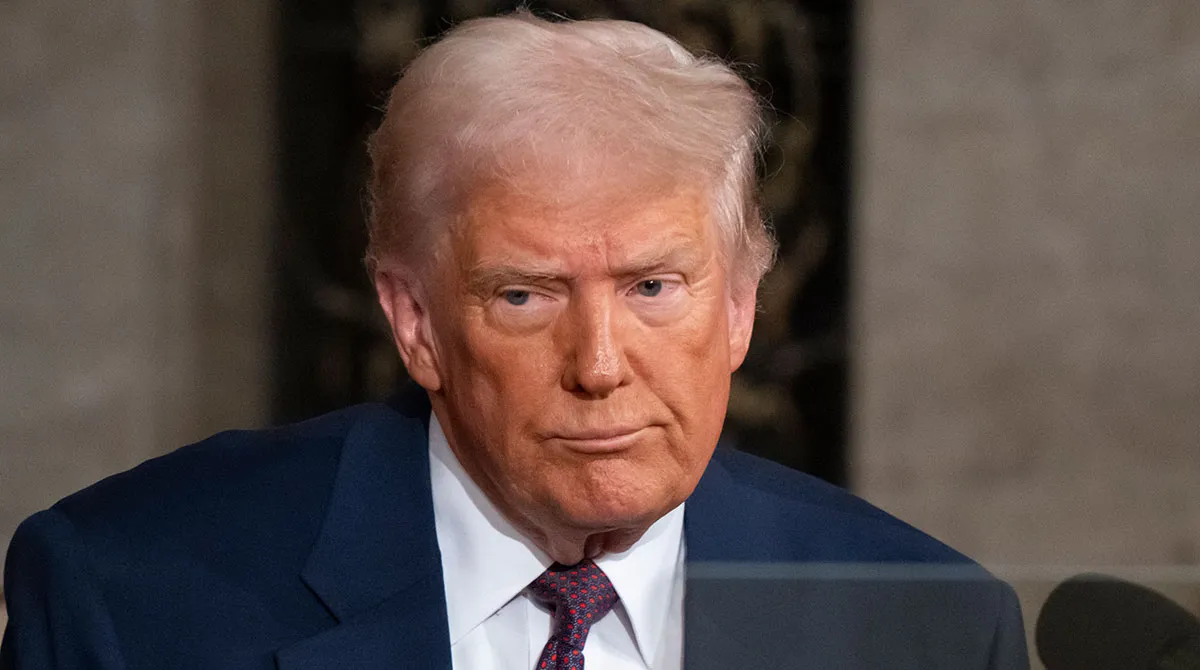 President Donald Trump has faced many court battles over tariffs, the cornerstone of his economic agenda. (Alex Brandon/Associated Press)
Key Takeaways:
- Gellert Global Group sued the Trump administration Oct. 20, challenging 50% tariffs on Canadian goods imposed under Section 338.
- The lawsuit alleges Trump lacked authority to use the dormant statute for tariffs initially covering roughly $20 billion in goods.
- The trade court will consider the case as it prepares to rule on separate Section 301 tariffs in the coming weeks.
The Trump administration is being sued over the imposition of 50% tariffs on an array of Canadian goods, the latest in a string of cases that broadly accuse the president of trying to achieve his trade agenda by asserting a taxing power that belongs to Congress.
The lawsuit, filed Oct. 20, comes amid an ongoing trade war between the U.S. and one of its largest trading partners. The food import business that sued argues President Donald Trump lacked authority to invoke a never-before-used section of U.S. law to order the levies against Canada and that this is part of a trend of unlawful tariff actions by the administration.
The suit centers on tariffs imposed under Section 338 of the Smoot-Hawley Tariff Act of 1930, which took effect at the end of August after weeks of negotiations aimed at lowering trade tensions between the U.S. and Canada. Negotiators had appeared to agree on the broad terms of a preliminary deal before it fell apart.
The initial 50% tariffs applied to roughly $20 billion of Canadian goods, and were followed by later presidential actions to alter and expand the list of covered products. Prime Minister Mark Carney responded with retaliatory tariffs, which took effect on Sept. 8, and the Trump administration eventually excluded certain Canadian goods, including motorcycles, alcoholic beverages and whey products, from being imported to the U.S. at all.
Section 338 was meant to address discrimination against U.S. commerce, but the challengers contend that Congress “abandoned” the statute several years later in favor of a more “comprehensive scheme” and that no president ever issued tariffs under it. Even if the statute is still operative, the suit alleges that Trump’s rationale for the Canadian tariffs failed to meet the necessary criteria and that the 50% rate isn’t tethered to the law’s requirement that it “offset” the actual “burden or disadvantage.”
The challenger, Gellert Global Group Corp., specializes in food imports, including Canadian cheese that is subject to the Section 338 tariffs. The case was brought by Liberty Justice Center, a nonprofit involved in earlier rounds of litigation against Trump’s tariffs.
“No president should have the power to pull a dormant statute off the shelf and use it to impose sweeping tariffs or import bans without the limits Congress required,” Liberty Justice Center Chairman Sara Albrecht said in a statement.
Spokespeople for the White House and Customs and Border Protection did not immediately respond to requests for comment.
The president has faced a slew of legal challenges to his tariff policies. The Supreme Court struck down his first attempt at global tariffs last year under an economic emergency powers law, a loss that has forced customs authorities to refund the $166 billion collected from importers before the justices ruled, plus interest. A court fight over the president’s second attempt at multinational tariffs was pending when those levies expired in July.
The trade court is poised to rule in the coming weeks on the fate of Trump’s third round of global tariffs on dozens of economies under a provision of U.S. trade law known as Section 301 that deals with forced labor concerns. A three-judge panel heard arguments in late September.
The case is Gellert Global Group Corp v. Trump, 26-cv-4636, U.S. Court of International Trade (New York).