[Stay on top of transportation news: Get TTNews in your inbox.]
The road to EBS
Fleets, suppliers map out the path to electronic braking systems
 Industry leaders explained the benefits and challenges of EBS during a technical session at the Technology & Maintenance Council’s Annual Meeting. (Krista Bussey/Transport Topics)
Key Takeaways:
- Fleets, suppliers and service leaders say electronic braking systems are coming to U.S. trucking after decades of lagging behind European adoption.
- Suppliers said EBS offers faster braking, improved diagnostics and support for advanced driver assistance systems while retaining pneumatic backup when electronics fail.
- Industry leaders identified technician training, acquisition costs and a standardized tractor-trailer connector as key challenges to broader EBS adoption.
While electronic braking systems have been common in Europe for more than two decades, adoption in the U.S. has lagged. However, fleets, suppliers and service leaders contend that EBS is coming whether the trucking industry feels ready or not.
“We don’t really get to play multiple choice with this. We’re getting it,” said Dave Donbrock, regional manager at Grand Rapids, Mich.-based truck leasing firm Airoldi Brothers Inc.
Donbrock and other industry leaders explained the benefits and challenges of EBS during a technical session at the Technology & Maintenance Council’s Annual Meeting earlier this year in Nashville, Tenn.
There are core technical differences between pneumatic anti-lock braking systems and EBS.
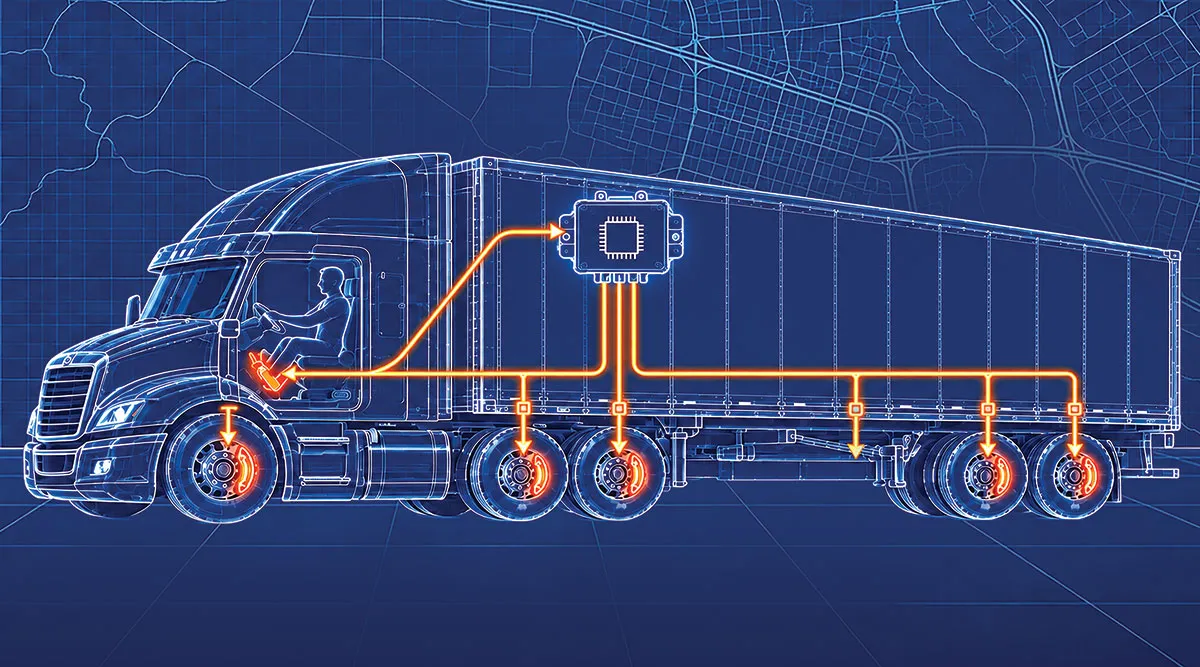
Brian Screeton, manager of technical training and service at Bendix, said traditional systems rely on a pneumatic signal from the foot valve to the service valves, which takes time to propagate down the vehicle. EBS replaces those primary controls with electronics.
“With a traditional system, it’s a pneumatic signal. It takes time for that air to come from the foot valve back to the valves to actually apply the brakes,” Screeton explained. “With EBS, it’s brake by wire. So, it’s almost instant. It’s faster.”
But EBS is not purely electronic. Screeton stressed that the architecture is built with redundancy.
“The system continuously monitors output pressures to each wheel end and can detect when expected braking performance doesn’t match measured response,” he said.
This continuous monitoring opens the door to predictive diagnostics.
“If we’re sending so much pressure and we’re not getting a response like we would expect, that can indicate a problem before it actually happens,” Screeton said. “Diagnostics are just better because we’re simply watching more.”

PCS Software CEO Mark Hill discusses the advance of AI in the trucking industry. Tune in above or by going to RoadSigns.ttnews.com.
EBS is being designed as a native platform for advanced driver assistance systems and future automated functions.
“This system was built from the ground up with all that in mind,” Screeton said.
Wolfgang Hahn, system innovation leader with ZF Group, connected the evolution from pure pneumatic braking to EBS with the industry’s growing appetite for vehicle data and prognostics.
EBS stacks an electronic brake sensor with the traditional valve and wheel components. As explained by Hahn, that sensor reads the driver’s requested deceleration and coordinates multiple torque sources that include regenerative braking, engine retarders and friction brakes.
“The pedal position gives you a deceleration no matter whether the bus is full or almost completely empty,” he said. “The same is also true for a truck, whether it’s unloaded or fully loaded. That makes the whole driving experience much easier to handle.”
Beyond brake control, EBS introduces a wider sensor suite that can include axle load sensing as well as temperature and wheel-end response data. That same data can feed predictive maintenance, vehicle health monitoring and connected fleet analytics, not just brake performance, Hahn added.
Failure modes and redundancy
Most fleet maintenance managers share the concern of what to do when electronic components, connectors or sensors fail on the road.
Kyle Hinton, senior technical services representative for SAF-Holland, noted that the pneumatic brake system is the foundation, with electronics given priority only when available.
“With EBS, we do give the priority to the electronic side, but when you have that failure, the pneumatic system seamlessly maintains control of braking the vehicle,” he said, adding that a failure in the electronic layer does not erase braking capability.
As to whether EBS faults would throw trucks into limp mode or leave them scattered on road shoulders, Bendix’s Screeton noted that there is a redundant mode involved.
“The dash will light up like a Christmas tree. Basically you need to get it serviced as soon as possible,” Screeton said. “But it’s not like if you have a fault, everything goes away.”
Diagnostics and training
When it comes to EBS, technician readiness remains the bigger challenge, said Gerry Mead, vice president of truck service technical services at TravelCenters of America.
“It’s all about technicians and their capabilities,” he said. “We have all this technology. Someone’s got to make a repair, and we have to teach them to make that repair.”
Mead added that moving to EBS means fleets must upgrade from a purely mechanical mindset to a mechatronic one built around sensors, electronic control units and networks.
“It does really get more simplistic in one way and it’s better in another way,” he said. “We’re controlling it now, and it’s more computerized.”
Image

Mead
Mead framed modern troubleshooting as a diagnostic funnel that starts with the driver’s complaint, followed by the technician pulling and interpreting fault codes, then performing signal checks and basic electrical tests. Afterward, network tests are run, leading to root cause analysis at the component level.
With EBS, much of the trouble will be electrical in terms of connectors, wiring and sensors, rather than valves and air lines. That demands solid electrical fundamentals, Mead noted.
“We can’t be guessing. We can’t be parts swapping. We’ve got to have guided troubleshooting,” he said, stressing the need for access to ECU data and up-to-date software. “If I don’t have full access, like we do with some companies today, we can’t really do what we need to do.”
Mead recommended a training path that includes classroom and online materials for EBS awareness, live hands-on guided diagnostics and case-based learning, and higher-level certificated training.
However, he warned of a growing technology and curriculum lag. Systems are reaching the field before training content is fully built.
“We may not see that for 9 to 12 months. At that point, my confidence is dropping, and that just hurts in the long run,” he said. “That’s why toolboxes have wheels.”
Total cost of ownership
Mike Jeffress, vice president of maintenance at Maverick Transportation, approached EBS primarily as a total cost of ownership concern, dividing the challenge into three buckets: technology, operations and finance.
On the technology side, his team compared EBS to ABS in terms of brake performance, stability and compatibility with emerging advanced driver assistance systems. On the operational side, the focus is on drivers, management and training beyond the shop.
“Operations, safety, recruiting and asset management all need to understand how EBS changes their metrics and workflows,” Jeffress said.
Image
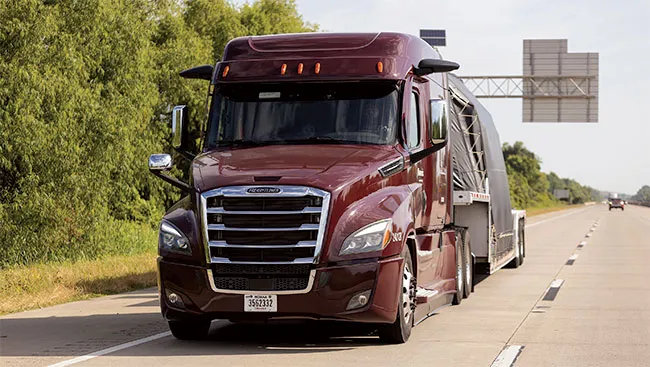
Carriers like Maverick have to take all factors into account when deciding on EBS adoption. (Maverick Transportation)
On the finance side, Jeffress noted the need to reconcile higher acquisition costs with long-term savings in prevented crashes, maintenance and downtime.
“We know it’s new technology. We know it’s not necessarily proven. We know there’s a ton of challenges that’s going to come along with it,” he said. “But all our objectives are to run a fleet more efficiently, effectively, and not be involved in those particular catastrophic accidents that cost us a ton of money.”
Maverick ranks No. 69 on the Transport Topics Top 100 list of the largest for-hire carriers in North America.
Trailer connection
Hinton of SAF-Holland said that EBS delivers its full benefit only when both tractor and trailer are electronically coordinated. For the foreseeable future, most North American fleets will be running mixed combinations: EBS tractors with ABS trailers, or ABS tractors with EBS-equipped trailers.
Hinton explained that an EBS tractor with an ABS trailer will detect that there is no compatible electronic brake system behind it. The tractor EBS then optimizes its own control and manages the pneumatic trailer line accordingly.
On the flip side, an ABS tractor with an EBS trailer leaves the trailer’s system without an electronic command, so the trailer EBS reverts to pure pneumatic control.
“They’re both going to operate independently,” Hinton said. “The EBS system can switch over into that mode that it knows it has a non-EBS trailer, and it will optimize itself for the best performance.”
He added, however, that to unlock full performance and safety gains, the industry needs a standardized, CAN-capable tractor-trailer connector.
“Probably our biggest challenge that we’re going to face to get the EBS systems’ full safety and performance benefits is being able to get this on both the tractor and the trailer,” he said. “We as an industry need input from everybody on helping to develop a new standardized connector.”
Driver acceptance
Beyond technology and cost, EBS adoption will also hinge on driver feedback, Jeffress said, noting that Maverick intentionally deployed a handful of EBS-equipped tractors without making a big announcement to drivers and then monitored feedback.
He described a split between younger drivers who “love technology” and expect automation, older drivers who were apprehensive.
“They would often say, ‘I know how to drive. I don’t need the truck helping me,’” he noted. “That demographic divide will shape driver orientation and coaching.”
Safety departments, he added, are less focused on whether EBS works and more on what it can tell them about near misses and teachable moments.
“I want to know when there is a coachable event that something may have occurred,” Jeffress said. “That’s the information I think that we need to help apply some of this particular technology quicker, sooner, and get adoption.”