
[Stay on top of transportation news: Get TTNews in your inbox.]
No U.S. buyer emerges after Trump's deal on Russian diesel
Oil traders are skeptical any diesel will reach U.S.
 (Jae C. Hong, File/AP)
Key Takeaways:
- An accord brokered by President Donald Trump to sell Russian diesel to the U.S. has failed to find a willing customer.
- Trump announced the deal with President Vladimir Putin in October to supply roughly 36 million barrels of the fuel to the U.S. and other buyers.
- Several commodity trading companies and other potential counterparties have deemed the risks too large to consider importing the cargoes to the U.S.
An accord brokered by President Donald Trump to sell Russian diesel to the U.S. appears to have failed to clear a key hurdle: finding a willing customer.
Trump announced the deal with President Vladimir Putin in October to supply roughly 36 million barrels of the fuel to the U.S. and other buyers, part of a broader effort to lower energy prices that have rallied largely because of the Iran war.
READ MORE: N.J. governor warns ports against accepting Russian diesel
The White House is sticking with the plan even as it earned bipartisan blowback from Republicans and Democrats. Despite efforts to find a buyer, none has so far emerged publicly, and oil traders and analysts are growing increasingly skeptical that any of the four vessels Russia says are carrying diesel will unload in the U.S. Now, Brazilian fuel distributors are being offered Russian diesel instead.
Several commodity trading companies and other potential counterparties have deemed the risks too large to consider importing the cargoes to the U.S., according to people familiar with internal deliberations, who asked not to be identified because they weren’t authorized to talk on the record.
“We understand that there’s strong reluctance by private companies to be involved in these Russian diesel cargoes due to attendant significant legal and reputational risk,” said Bob McNally, founder and president of Rapidan Energy Group.
In particular, firms are skeptical that a sanctions waiver issued Oct. 9 by the Treasury Department supersedes the 2022 law banning imports of Russian oil and fuel, some of the people said, despite assurances from the White House.
Image
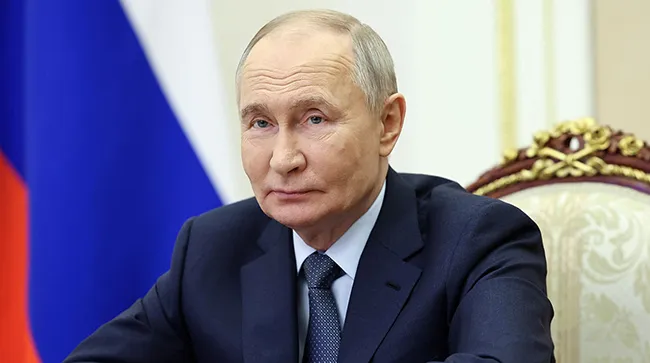
Russian President Vladimir Putin. (Alexander Kazakov, Sputnik, Kremlin Pool Photo via Associated Press)
“The legal ambiguity will scare off a lot of companies,” said Claire O’Neill McCleskey, a former Treasury official and co-founder of sanctions advisory firm Clarity Compliance Consulting.
Russian diesel is on the water and heading to the market, which will ease prices for Americans, an administration official said.
The White House did not immediately respond to a request for comment.
For now, it remains unclear if any of the tankers carrying the Russian diesel are actually headed to the U.S. One vessel carrying the fuel that had signaled it was U.S.-bound was last seen dawdling around 400 nautical miles from the East Coast, tracing a zigzag pattern at sea, according to a port report and data compiled by Bloomberg.
The Iran war and Ukraine’s bombardment of Russian refineries have driven up fuel prices to seasonal records, a key factor in propelling Democrats to historic victories in this month’s midterm elections.
While retail fuel prices have moderated in recent weeks, the national average for diesel stood at $6.10 a gallon as of Nov. 11, according to the American Automobile Association, about 40 cents below its record high. Gas prices at the pump fell below $4 a gallon but still are at a record for this time of year.
Phillips 66, one of the largest U.S. oil refiners, said the volume of Russian diesel exports is too small to make a meaningful dent in U.S. prices. CEO Mark Lashier said late last month his company has “no intent to acquire Russian diesel.”
Ukraine, meanwhile, has resumed its onslaught of drone strikes on Russian refineries and said it attacked Russia’s largest oil refinery deep in western Siberia for a third time.

Bob Toews, CEO of TruckDown, discusses winter readiness in the connected fleet era. Tune in above or by going to RoadSigns.ttnews.com.
Energy Secretary Chris Wright has said the Russian diesel initiative won’t just boost global supplies but incentivize the Kremlin to scale back or end its war in Ukraine. “The only way Russia can benefit meaningfully from exporting diesel is to turn down the war effort,” he said in a recent Bloomberg TV interview.
House and Senate Democrats have vowed to investigate the deal and have asked banks and ports to preserve records related to the issue. New Jersey Gov. Mikie Sherrill, a Democrat, last week warned port operators and terminal owners against accepting Russian diesel, arguing that they might violate federal law. The state is home to some of the biggest petroleum docks and storage tanks that comprise New York Harbor.
Written by Shariq Khan, Lucia Kassai, Will Kubzansky and Charles Gorrivan


