
[Stay on top of transportation news: Get TTNews in your inbox.]
Missouri to raise speed limits to 75 mph on some interstates
For truck drivers, higher speeds on some sections of 4 interstates mean faster traffic, longer stopping distances
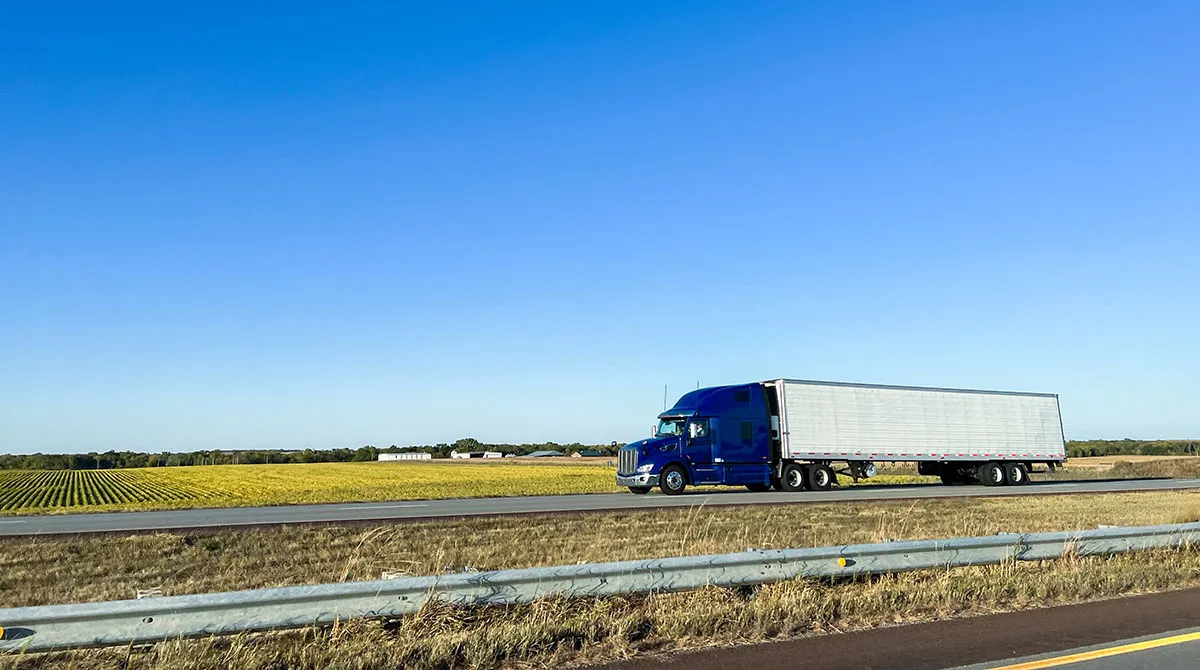 A tractor-trailer on a rural stretch of highway in Missouri. (Jeremy Poland/Getty Images)
Key Takeaways:
- Missouri is set to raise speed limits to 75 mph on designated sections of I-29, I-35, I-49 and I-55 by year-end.
- The affected corridors carry significant freight traffic, and MoDOT is warning truckers that 5 mph higher speeds can add 90 feet to stopping distances.
- MoDOT will install new signs, monitor roadway safety and adjust limits if needed after the changes take effect.
Missouri is planning to raise speed limits to 75 mph on four interstates near the Iowa and Arkansas borders by the end of the year, and truckers are being warned to increase stopping distances with faster-moving traffic.
The move to increase speeds by 5 mph on rural interstate segments is the result of enactment in July of state legislation sponsored by state Sen. Jamie Burger.
He introduced Senate Bill 1408 to increase some interstate speed limits to match those in neighboring states to reduce travel times and alleviate traffic bottlenecks. “I also feel the automated technology and safety features in modern vehicles combined with the improvements made to highways justify the slight increase,” Burger explained earlier this year.
The new speed limits were announced Oct. 21 by the Missouri Department of Transportation. Unless posted otherwise, the current maximum speed limit on rural interstates and freeways in Missouri is 70 mph.
Although the legislation took effect in August, MoDOT was tasked with determining which of the nine interstate corridors were eligible for higher speed limits and in which locations. Missouri has the nation’s seventh-largest state highway system with 33,814 centerline miles, according to the 2026 State Freight and Rail Plan.
Each day, more than 1.5 million tons of freight moves along Missouri’s interstates, where vehicles of every type travel nearly 81 million miles.
The 75 mph speed limits will apply to sections of four north-south interstates: I-29, I-35, I-49 and I-55. The latter two serve as backbones of the state’s freight network, according to MoDOT.
75 MPH Interstate Speed Limits
Missouri map showing sections of interstates moving to 75 mph speed limits in red. (Missouri DOT)
Safety implications for truckers
“This decision is not made lightly and comes after a detailed study into each of those factors to determine where we can move people and traffic efficiently at higher speeds without sacrificing safety,” said Ed Hassinger, MoDOT director. “The department takes careful consideration of all the different factors that make up a roadway when setting speed limits, including how people use it.”
Hassinger told Transport Topics that truckers “should remain ultra-aware in areas where speed limits are going to be increased. They should recognize that other vehicles may be traveling faster than they are accustomed to. This can mean allowing for bigger gaps when changing lanes and leaving additional room for a longer stopping distance. The additional 5 mph can require an additional 90 feet or more to safely stop.”
Where the speed limits will increase
I-29: I-29 runs north from Kansas City to the Iowa border. The 75 mph speed limit will apply from Exit 56 in Andrew County to about 2½ miles south of the Iowa border. This is a 64-mile stretch that carries 3,430 northbound trucks and 3,500 southbound trucks daily, according to MoDOT’s Transportation Planning Unit.
I-35: I-35 runs north from Kansas City toward Iowa. The 75 mph speed limit will apply from the northern Cameron city limit to about 4 miles south of the Iowa border over a 55-mile section carrying some 2,500 northbound trucks and 2,870 southbound trucks each day.
I-49: I-49 is a north-south corridor linking Kansas City with the Arkansas border and providing Fort Leonard Wood — a U.S. Army installation and training center — access to western deployment points. It carries heavy and oversize military equipment, such as armored vehicles requiring special permitting and route coordination. The interstate handles about 2,230 to 2,300 trucks daily. The 75 mph speed limit will apply for 24 miles from the Arkansas border to Exit 24 and for 45 miles from Exit 56 to just south of Exit 101 in Nevada.
I-55: I-55 runs south from St. Louis toward Arkansas and Tennessee, providing access to southern markets and Gulf Coast ports. The 75 mph limit will apply to four sections totaling 137 miles, with daily truck volume ranging from 2,383 to 4,932 northbound and 1,803 to 4,823 southbound:
From the Arkansas border for 17 miles to Mile Marker 16.6 (south of the I-155 interchange)
From Mile Marker 19.8 (north of the Missouri state Route 84 interchange) for 45 miles to Mile Marker 64.9 at the state Route AA bridge
From Mile Marker 70.5 (north of the state Route HH interchange) for 16 miles to Mile Marker 86.6 (south of the Route PP interchange)
From Mile Marker 106.4 (north of Exit 105) for 59 miles to Mile Marker 164.9 at the Jefferson County line
Timeline
Slated for completion by the end of this year, the speed limit increases will take effect once the posted speed limits are changed. A fiscal analysis by the state Joint Committee on Legislative Research’s Oversight Division noted that the higher speed limits could cost $384,000 to replace about 500 speed limit signs along rural interstates and freeways.
Hassinger noted MoDOT will continually monitor the roadway safety implications of these higher speed limits to determine if adjustments are needed.
“We also have a record number of work zones across the state, including many on our major freight corridors. We always want to highlight the importance of paying extra attention in those work zones and following the posted work zone speed limit,” he added. “That way, drivers can make it to their destinations safely, and our construction workers can make it home at the end of their day.”


