[Stay on top of transportation news: Get TTNews in your inbox.]
Knight-Swift eyes leased Pa., Va. terminal options
CEO Adam Miller sees start of Northeast LTL network expansion in 2027
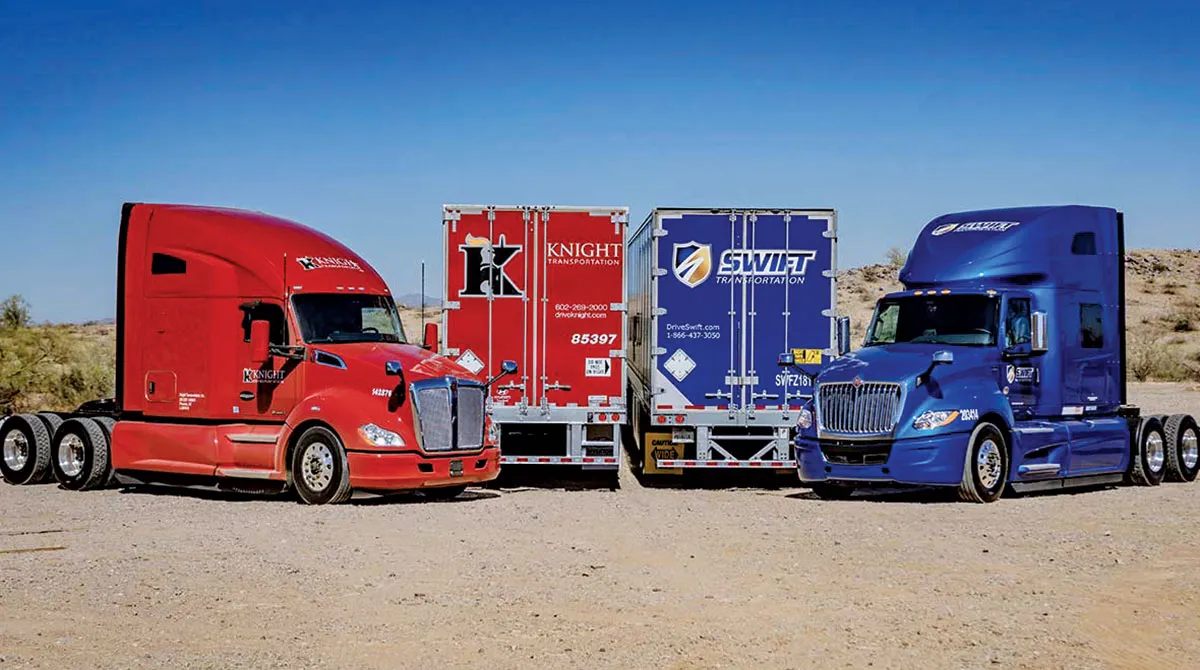 Knight-Swift’s LTL operations, which were unified under the AAA Cooper name at the start of 2026, currently operate 180 terminals. (Knight-Swift Transportation)
Key Takeaways:
- Knight-Swift expects leased terminals in Pennsylvania, Virginia and nearby states to extend its AAA Cooper LTL network into the Northeast in 2027.
- Knight-Swift’s LTL weight per shipment rose 4.8% and length of haul increased 6.2% in Q3 as its operating ratio improved to 94.3.
- CEO Adam Miller said further LTL expansion likely will be organic, contingent on stable market conditions, intact margins and sustained demand.
PONTE VEDRA, Fla. — Knight-Swift Transportation expects leased terminals in states such as Pennsylvania and Virginia to be the next steps in the carrier’s ambitions to build a nationwide less-than-truckload network, CEO Adam Miller said.
Phoenix-based Knight-Swift began building out its LTL network in 2021 and will enter states adjacent to its existing terminal network in 2027 as part of its initial foray into the Northeast, the executive said in an interview on the sidelines of the 2026 WEX OTR Summit.
“We’ll be very deliberate. We don’t want to put too much pressure on the business. There’s already a handful of facilities that we’ve identified that allow us to make that kind of creep into the Northeast,” he told Transport Topics, noting that these plans depend on a stable market, intact margins and no decrease in demand.
“We wouldn’t jump into a state that’s really outside of our service area,” he added.
Knight-Swift’s LTL operations, which were unified under the AAA Cooper name at the start of 2026, currently operate 180 terminals.
AAA Cooper is Knight-Swift’s oldest LTL brand, and its 2021 acquisition marked Knight-Swift’s initial entry into the LTL segment after historically focusing on truckload operations.
Since then, Knight-Swift has acquired Midwest Motor Express and the LTL assets of Dependable Highway Express.
However, Miller said in the interview and a speech at the conference that any further growth in the segment likely would not involve mergers, even though Knight-Swift — which ranks No. 8 on the TT Top 100 list of the largest for-hire carriers in North America — was built upon acquisitions.
“It’s most likely going to be organic, where we just identify terminals and kind of grow into those locations,” he told TT in the interview.
In the conference speech, Miller told attendees: “We’ve done a lot of M&A on the LTL front, kind of piecing the three companies together, and now we operate under just one brand, AAA Cooper. And so I think we’re kind of done with that right now.”
AAA Cooper’s operations are also shifting organically ahead of the expansion, including through increased weight per shipment, although the more buoyant truckload market is helping, too.
In the third quarter of 2026, Knight-Swift said its LTL operations’ weight per shipment rose 4.8% year over year to 1,053 pounds from 1,005 pounds. In addition, the division’s length of haul climbed 6.2% to 715 miles from 673 miles in the year-ago period.

PCS Software CEO Mark Hill discusses the advance of AI in the trucking industry. Tune in above or by going to RoadSigns.ttnews.com.
Miller told analysts during the company’s Q3 earnings call: “We are seeing a shift from really the lion’s share of loads or shipments that we would have hauled two years ago at a one- to two-day transit. Now we’re seeing that shift to where we’re seeing an elevated percentage of shipments that are moving three to four, and some even beyond four days.”
“That tells you it’s a longer-length haul, a heavier shipment, and it represents more of the kind of national network we want. I think part of the challenge is you don’t have the density quite yet,” he said.
Size matters in the top-heavy LTL space, where terminals are necessary for a successful business. However, they require substantial land and are expensive to build, and the land is typically hard to come by near major metropolitan areas.
Still, the LTL division’s operating ratio improved to 94.3 in Q3 from 100.4 in the year-ago period.
A carrier’s OR provides insight on how well a company is balancing its costs and revenue generation. The lower the ratio, the better a company’s performance. An OR of 80 is considered exceptional, with most LTL carriers running an OR between 85 and 90.