
[Stay on top of transportation news: Get TTNews in your inbox.]
Knight-Swift CEO sees opportunities post-Montgomery
Miller says tighter standards could curb low-cost truckload capacity
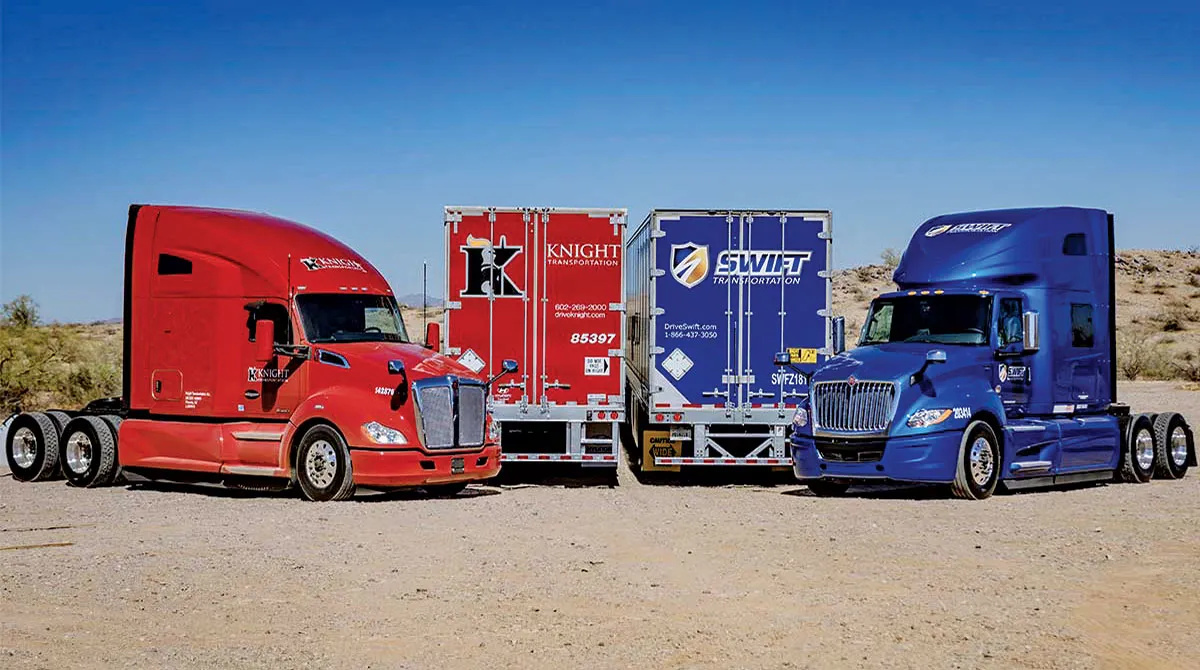 Knight-Swift net income and revenue increased year over year in the third quarter. (Knight-Swift Transportation)
Key Takeaways:
- Knight-Swift CEO Adam Miller said Oct. 21 that the Supreme Court’s broker liability ruling could favor safe, compliant carriers.
- Knight-Swift reported third-quarter net income of $118.3 million as revenue rose 14.2% to $2.2 billion amid tighter truckload capacity.
- The carrier plans targeted driver-pay investments and market-based pricing for screened owner-operators while working to restore truckload margins.
Knight-Swift Transportation Holdings CEO Adam Miller expressed optimism Oct. 21 that the market is shifting to better favor safe carriers after Montgomery v. Caribe Transport II.
The Supreme Court in May ruled that freight brokerage providers aren’t protected by federal law from state-level negligent-hiring lawsuits. This resolved a patchwork of state rules by clarifying that brokers are responsible for drivers they use. Miller is hopeful it will help balance out an industry dragged down by an oversupply of noncompliant carriers.
“That’s been a challenge for all large carriers over the last couple cycles,” Miller said during the truckload carrier’s third-quarter earnings call. “Largely, the growth that has come in during an upcycle has been from the very small carriers with low barriers to entry, and many of those aren’t being as compliant as the large carriers have had to be.”
Miller added that he now feels as though the industry is finally establishing some needed barriers to entry that will bolster those carriers that already understand how to develop safe drivers.
“Now it won’t be easy, and so we’re being very mindful about where we’re making our investments,” Miller said. “We’ve been very targeted and tactical about where we do driver pay and ensuring that we have the rate and the margin to support it. I think we’ve done a good job managing that, and we’ve done some things on the owner-operator front.”
To that end, Knight-Swift has started providing dynamic market-based pricing for small independent owners, which it had historically not done. Miller noted there has been good demand in that space and some growth in the carrier’s owner-operator count over the past nine months. This model allows smaller players that are safe enough to pass Knight-Swift’s screenings to access the market and insurance.
“Which is why we’ve really limited the carriers that we have access to and why we took the approach of let’s maintain profitability with good, safe carriers,” Miller said.
The Phoenix, Ariz.-based truckload motor carrier posted net income of $118.3 million, or 72 cents per diluted share, for the three months ending Sept. 30. That compared with $7.86 million, 5 cents, during the year-ago period. Revenue increased 14.2% to $2.2 billion from $1.93 billion.
Knight-Swift Q3 2026 Earnings Report
“We believe the new cycle still has plenty of gas left in the tank,” Miller said. “The truckload freight market continues to remain tight, and while broad measures of industry demand have been largely stable, demand for our capacity has been strong. We have more peak-season project arrangements in place than at any time since the pandemic.”
Miller was especially encouraged over the improvement in core truckload margins. He views them as approaching recognizable territory after a prolonged and difficult downcycle. But he stressed there is still work left to be done and improvements to make before his company can return to normal operating levels.
“We believe we are well positioned to generate distinctive results for two main reasons,” Miller said. “The differentiation in our service mix and in our business model. So regarding service mix, our single-largest service is the one-way truckload market.”
The Department of Transportation has hastened an ongoing decline in capacity this year through increased regulatory enforcement, including tightening standards for non-domiciled commercial driver licenses and English-language proficiency. Miller noted that the one-way truckload market has been struggling with unusually weak margins for three years due to an oversupply of capacity keeping freight rates artificially low.
“During the downturn, many carriers either went out of business, partially liquidated fleet assets or shifted one-way capacity,” Miller said. “Because we have remained committed to one-way truckload service and operate the largest one-way fleet in the industry, we are now seeing consistent opportunities to deliver valuable capacity solutions to our customers.”
Revenue by segment
Truckload increased 14% to $1.41 billion from $1.24 billion in the year-ago period. Operating income surged 242.8% to $123.1 million from $35.9 million.
Less-than-truckload increased 10.1% to $434.5 million from $394.5 million. Operating income came in at $24.9 million, compared with an operating loss of $1.69 million.
Logistics revenue slipped 1% to $139 million from $140.4 million. Operating income increased 23.2% to $8.42 million from $6.84 million.
Knight-Swift ranks No. 8 on the Transport Topics Top 100 list of the largest for-hire carriers in North America, No. 31 on the TT Top 100 logistics companies list and No. 42 on the TT Top 50 global freight companies list.

