
[Stay on top of transportation news: Get TTNews in your inbox.]
Isaac adds AI in-cab alerts to ease fleet safety management
Telematics vendor also highlights fuel saving features at 2026 user conference
 J.S. Bouchard, Isaac Instruments’ co-founder and chief product officer, outlines the company’s investments in AI and fuel saving features at its 2026 Horizon user conference. (Seth Clevenger/Transport Topics)
Key Takeaways:
- Isaac Instruments introduced configurable AI-enabled in-cab safety alerts and fuel-management tools during its Oct. 6-8 Horizon conference near Montreal.
- Isaac expects driver self-correction to reduce critical-event videos from about 330 to 60 per 100,000 miles.
- Isaac’s fuel platform will flag possible theft, while Fuel Coach testing showed fuel economy improvements of 12.8% and more than 9%.
SAINT-BRUNO-de-MONTARVILLE, Quebec — Trucking telematics provider Isaac Instruments is introducing configurable in-cab alerts that empower drivers to self-correct unsafe behaviors and make it simpler for fleet operators to manage their safety programs.
The technology company also added features to help trucking companies better manage their fuel costs at a time when diesel prices are at historic highs.
J.S. Bouchard, Isaac’s co-founder and chief product officer, announced the new product features during the company’s 2026 Horizon user conference, held Oct. 6-8 at its headquarters near Montreal.
Isaac’s new artificial intelligence-enabled in-cab alerts provide drivers with visual and audible notifications when the system detects safety risks such as close following distance and excessive speed, as well as cellphone usage for fleets using inward-facing cameras.
RELATED: Isaac CEO urges fleets not to relinquish control of their data
Rather than immediately triggering a video recording and sending it to a fleet manager, the system first warns the driver that it has detected an unsafe driving behavior and gives that driver an opportunity to take immediate corrective action.
If the driver addresses the issue promptly enough, no video is generated. Fleets can configure the duration of those warning periods based on their preferences.
The result, Bouchard said, is “monitoring more, managing less.”

PCS Software CEO Mark Hill discusses the advance of AI in the trucking industry. Tune in above or by going to RoadSigns.ttnews.com.
“Drivers are self-correcting because they want to put a good score up on the board,” he said. “They don’t want you to know what happened.”
With the addition of in-cab alerts and the opportunity for driver self-correction, Isaac anticipates that the number of critical-event videos that fleets will need to manage will drop to about 60 per 100,000 miles, compared with about 330 for fleets using AI detections without in-cab alerts and warnings.
This means that fleets would be reviewing, on average, about one video a week per driver, Bouchard said.
Image
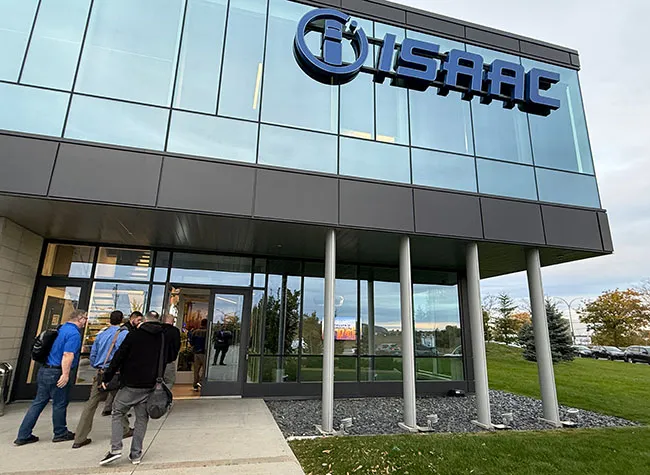
Isaac Instruments hosted its 2026 Horizon user conference at its headquarters just outside Montreal. (Seth Clevenger/Transport Topics)
Isaac also introduced Power Backup, which provides enough power to send onboard video to the server in the event of a very severe crash that otherwise might have made footage unretrievable.
The company is rolling out these new safety features at a time when nuclear verdicts against motor carriers have continued to escalate.
Meanwhile, the Supreme Court’s Montgomery v. Caribe Transport II ruling earlier this year removed a legal defense for freight brokers in state-level negligent hiring cases. As a result, many shippers and brokers will apply more stringent safety standards for the carriers hauling for them, Bouchard said.
Controlling fuel expenses
Another top concern for trucking companies is the high price of diesel, which not only raises expenses but also increases the risk of fuel theft and fraud.
Isaac is debuting a fuel platform to address that issue. The Isaac Fuel Module uses AI to detect exactly what went into the truck’s fuel tank and compares that with fuel purchases to flag possible theft.
On a related note, Isaac also recently worked with fuel economy testing and consulting firm Mesilla Valley Transportation Solutions to validate the savings that fleets can realize through its existing Isaac Fuel Coach program, which gives drivers color-coded feedback on their in-cab tablet so they can adjust how they operate the truck in real time.
That testing showed that raising driver performance from an average Fuel Coach score of 75 to a score of 95 improved fuel economy by 12.8% in a Freightliner tractor with a Detroit engine and more than 9% in an International truck equipped with a Cummins engine, Bouchard said.


