[Stay on top of transportation news: Get TTNews in your inbox.]
How AI agents can go from hype to results
Eranova’s Ethan Barnes outlines safeguards for moving agentic AI from pilots to enterprise operations
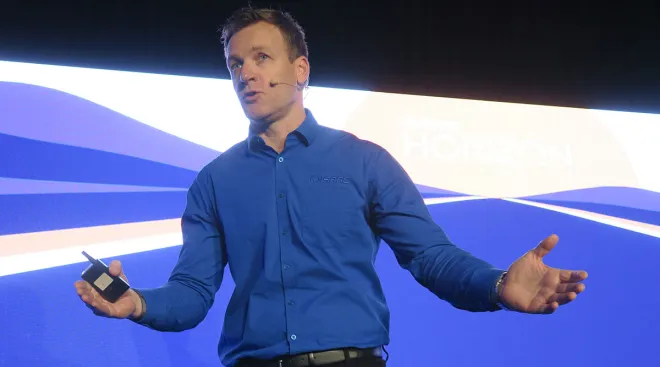
 “Your agent should never have direct access to your ERP system or your TMS system,” Barnes says. (Erin Graznow Photography)
Key Takeaways:
- Ethan Barnes said AI agents need carefully designed controls because mistakes in business operations can have immediate consequences.
- Eranova sees an average touchless rate of about 70% across deployments in logistics and finance.
- Barnes advocated constrained system access, deterministic validation and human involvement tailored to each workflow.
CHARLOTTE, N.C. — AI agents can take on substantial business processes, but reliable automation requires carefully designed controls.
Ethan Barnes, head of engineering and deployment for Eranova, explained the complexities of moving agentic AI from promising demonstrations into dependable enterprise operations during an educational session at American Trucking Associations’ Management Conference & Exhibition on Oct. 17.
He described agents as “digital workers” that can carry a task from start to finish. That distinguishes them from the large language model chatbots and copilots that became widely used around 2022, which can summarize documents, interpret spreadsheets and assist people with individual tasks.
An agent, Barnes noted, is a language model operating in a loop toward a defined objective, with a trigger that starts its work and tools that let it take action.
Tracking progress
Automating a business process requires an agent to understand and track progress across multiple steps, connect to organizational knowledge, use tools to interact with business systems and provide an audit trail.
“One of those could be multichannel communication: the ability for an agent to send and receive emails, to send and receive phone calls or SMS messages,” he said. “[Or] the ability for it to pull documents or files that are relevant to its task at hand.”
At Eranova, Barnes works on applications across logistics and finance, including order-to-cash processes such as order entry, dispatch, document review and billing, as well as accounts payable and receivable.
He said the AI-centric firm sees an average touchless rate of about 70% across its deployments. Barnes cautioned that coding agents’ ability to iterate through mistakes does not translate neatly to business operations, where errors can have real consequences.
“You need that agent in every decision and final action it makes to be sound,” he warned.
A coding agent may make many attempts before producing satisfactory software. That iterative approach can be useful when writing code, Barnes said. When an agent handles invoices, modifies business records or communicates with customers, mistakes can have immediate consequences.
The goal, he said, is to engineer a system that uses an agent’s flexibility while limiting the consequences of its errors.
Confidence must be designed
One challenge is that language models are probabilistic: The same input can produce different outputs. Barnes warned that a model’s own stated “confidence” is not a dependable safeguard.
“There is no such true thing as a confidence score out of the box with large language models and agents,” he said.
Barnes said organizations need to build confidence into each deployment with controls suited to the task. He explained a concept known as deterministic validation, using an example in which an agent might review an invoice, find a possible purchase order, compare amounts, suggest an accounting code and propose posting the transaction. The agent’s access to the company’s financial system should be restricted, Barnes said.
“Your agent should never have direct access to your ERP [enterprise resource planning] system or your TMS system,” he noted.
Partial automation
Barnes also advocated partial automation in which a person might click a button to start an agent, review its proposed work before it is posted, or handle only exceptions after the agent completes the research.
In one order-entry deployment, the initial plan was for an agent to respond to incoming requests and create loads automatically. Operators began entering the same orders themselves while the agent worked in parallel, leading to duplicate records and little adoption. The team removed automatic customer replies and added a button in Outlook so operators could choose when to run the agent.
“All it took to drive this workflow to north of 80% adoption was put a button directly in Outlook that says run this agent,” Barnes said. He added that adoption could reach 100% when operators have a say in the process.
A similar design can preserve human judgment in financial workflows. In an accounts receivable example, an agent researched a remittance, matched payments and prepared a proposed payment application. People then reviewed discrepancies, such as underpayments or overpayments, without having to manually enter every line. Barnes said this reduced processing time for a large payment from as much as two hours to about two minutes of review and posting.
He emphasized that the right controls depend on the process. The safeguards needed for accounts payable, dispatch and appointment scheduling will vary with each task’s risk, operational importance and adoption needs.
“There truly is no one size fits all,” Barnes noted.
He said agents can deliver meaningful automation when organizations establish a defined objective, constrained tools, relevant context, tested outputs and a clear way for people to inspect the work or intervene. Barnes concluded that moving from pilot to business value requires making agents’ autonomy manageable.