

[Stay on top of transportation news: Get TTNews in your inbox.]
Derek Leathers’ detour into trucking became a career of leadership
Werner’s longtime CEO sees safety enforcement as key priority for ATA chairmanship
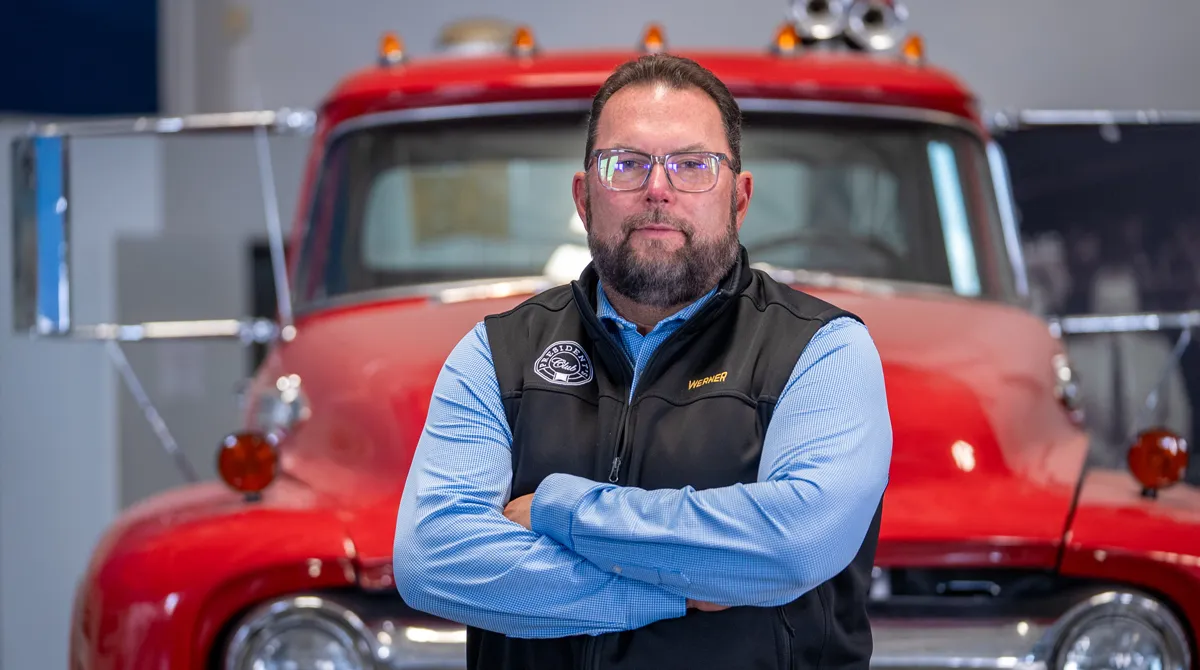 “Working together, we can get a lot more done than working separately,” Leathers said. (Camille Touissant/American Trucking Associations)
Key Takeaways:
- Werner Enterprises CEO Derek Leathers was elected American Trucking Associations’ 82nd chairman Oct. 20 at its Management Conference & Exhibition in Charlotte, N.C.
- Leathers said his chairmanship will emphasize stronger safety enforcement, addressing lawsuit abuse and unifying trucking’s advocacy around shared industry priorities.
- Leathers will help guide ATA’s leadership transition as Mark Colson succeeds Chris Spear as president and CEO on Dec. 1.
As the long-tenured chief executive at a major, publicly held motor carrier, Derek Leathers has become one of the most prominent leaders in today’s trucking industry, but he nearly took a very different career path.
Before entering the transportation business and eventually rising to his current position as chairman and CEO of Werner Enterprises, Leathers had a job lined up in investment banking.
He was set to join the finance sector after graduating from Princeton University with an economics degree, but when the bank that hired him pushed back his start date by six months, Leathers needed a way to support himself.
“I was a low-income kid and I needed to make money to put a roof over my head,” he said.
To bridge that gap, Leathers took a job in trucking, initially viewing it as a short-term detour before starting the career he had mapped out. Instead, as he worked directly with professional drivers as a fleet manager, he quickly discovered an industry he did not want to leave.
When the six months were up, Leathers decided against banking and leaned into trucking as his true calling. Friends and family members thought he was crazy.
“I just had a feeling that this was right for me,” he said.
Now, about 35 years later, that decision has led him to the chairmanship of American Trucking Associations.
ATA’s board of directors elected Leathers as the federation’s 82nd chairman on Oct. 20 at the national trade organization’s 2026 Management Conference & Exhibition in Charlotte, N.C.
Leathers said his year as ATA chairman represents an opportunity to give back to trucking.
“This industry has been great to me,” he said. “I’ve enjoyed my time for over three decades in the industry and just love what trucking does to keep America moving every day. It’s just an honor and a privilege to be able to play some small role in helping to represent it.”
Image
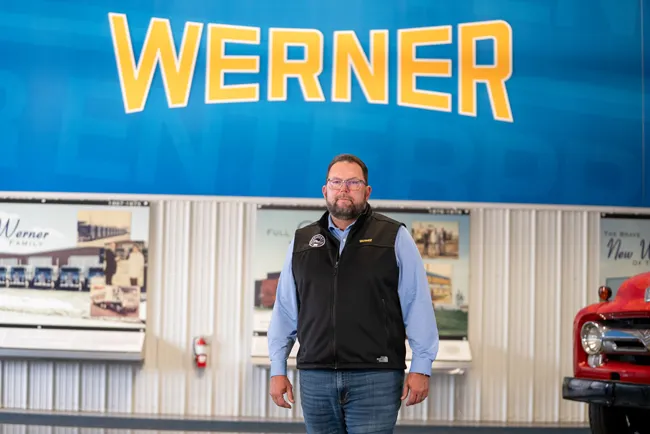
“I just had a feeling that this was right for me,” Leathers said. (Camille Touissant/American Trucking Associations)
In the year ahead, Leathers will guide ATA while applying a leadership philosophy focused on transparency, finding solutions to problems and allowing data rather than emotion to drive decision-making.
He believes the industry should adopt a more united front on advocacy.
“We’re only as strong as our ability to unify our voices,” he said. “Working together, we can get a lot more done than working separately.”
Strengthening enforcement
Leathers said enforcement of safety regulations will be every bit as important as legislative advocacy during his chairmanship.
He takes the helm at ATA at a time when regulators and law enforcement are cracking down on bad actors within the industry that have been skirting regulations at the cost of highway safety.
He expressed strong support for the Federal Motor Carrier Safety Administration’s recent efforts to remove noncompliant carriers, sideline unqualified drivers and shut down inadequate training schools.
“The actions that FMCSA has been taking to go out and increase enforcement are applauded by myself and ATA,” Leathers said. “I hope they continue to do so.”
Image
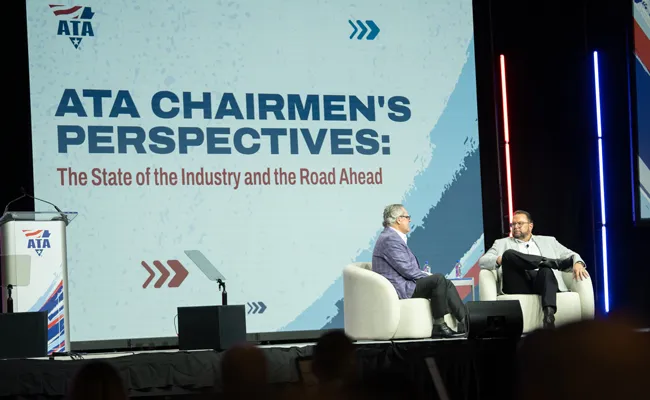
Outgoing ATA Chairman Greg Hodgen sits with Leathers Oct. 19 at MCE. (Karen Foote/American Trucking Associations)
While stronger enforcement is primarily a matter of safety, it also helps burnish the trucking industry’s public standing, he said, because unsafe operators can damage the image and respect that professional truck drivers have earned.
“There are a lot of issues in this industry that do need to be cleaned up,” he said.
Leathers identified lawsuit abuse as another major challenge.
When motorists are wrongly injured, they deserve justice and accountability, he said, but verdicts must remain reasonably connected to the underlying circumstances of a case.
“Nobody’s trying to skirt that accountability,” Leathers said, but runaway verdicts threaten companies’ ability to operate and “keep this economy moving.”
Addressing such challenges will require sustained advocacy in Washington, he said, not simply occasional meetings with policymakers.
“You’ve got to have a presence, you’ve got to be working it every day,” Leathers said.
As trucking looks to continue making progress on these and the many other issues it faces, Leathers said he believes industry participants should stop turning disagreements into divisive rhetoric.
He lamented instances where trucking companies that operate legally and agree on the need for increased enforcement have nonetheless attacked each other instead of attacking the actual problems.
He offered an alternative: follow the data, identify the problem and address it together.
Learning from legends
Leathers brings to the ATA chairmanship decades of experience from multiple corners of the trucking business and knowledge passed down from some of the industry’s “Mount Rushmore” figures who helped shape modern freight transportation.
Before joining Werner in 1999, he spent eight years with truckload giant Schneider. For several of those years, he was based in Mexico City and was given the opportunity to run a Mexican carrier operating about 300 trucks.
Working in another country and in another language while managing a relatively small trucking fleet gave Leathers responsibilities early in his career that he doubts he would have been afforded at the same age in the United States.
His time there also exposed him to trucking’s role in international commerce as the North American Free Trade Agreement was being implemented. During that time, he became one of the first foreign members of CANACAR, Mexico’s trucking association.
After joining Werner, Leathers helped establish the company’s Mexico operations and held roles across its business before becoming president in 2011. He became CEO in May 2016, joined the company’s board in 2020 and has served as chairman since May 2021. He remained president until January 2024.
Omaha, Neb.-based Werner generated just under $3 billion in revenue last year and ranks No. 19 on the Transport Topics Top 100 list of the largest for-hire carriers in North America.
Image
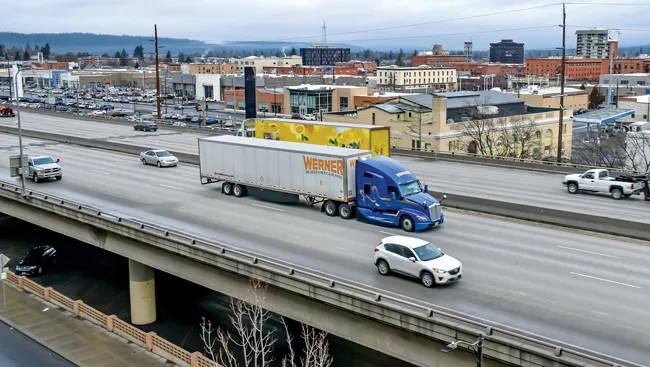
After joining Werner, Leathers helped establish the company’s Mexico operations and held roles across its business before becoming president in 2011. (Jon Tetzlaff/Getty Images)
Through the course of his career, Leathers learned from industry pioneers, particularly Schneider founder Don Schneider and Werner founder C.L. Werner.
Leathers described both men as foundational figures in trucking and said his relationship with Werner remains important to him.
But his education in trucking also came from moving through the business himself. He started in dispatch and worked closely with drivers. He spent time in driver training, safety and customer service, and earned his commercial driver license earlier in his career to better understand the job.
Although Leathers has spent most of his career with two of the industry’s biggest and most widely recognized companies, he also highlighted the knowledge, expertise and know-how that smaller carriers bring to the table.
Collectively, those experiences have shaped how Leathers views ATA, a federation that represents trucking businesses of every size and operating model along with state trucking associations across the country.
The best approach, he said, is to concentrate on common ground rather than policies that create winners and losers within trucking.
“We basically have way more in common than we have differences,” Leathers said, pointing to highway safety, a fair legal environment and better opportunities for professional drivers as examples of issues around which the entire industry can unite.
Finding his path
Leathers’ appreciation for work began long before his trucking career.
He grew up in a low-income household in Houston, where his mother was single for part of his childhood and money was a persistent concern. Some of his earliest memories involve finding ways to earn it, “whether it was paper routes, cleaning gutters, whatever it was,” Leathers said.
As soon as he was old enough for regular employment, he worked through high school and college to help pay his way.
At Princeton, football provided another formative experience.
Leathers played offensive line, although multiple knee injuries and surgeries limited his college playing career. Nonetheless, he credits the experience and the team environment with fostering competitiveness, camaraderie and an appreciation for straightforward feedback.
“If you play college football, you get plenty of feedback,” he said. “And you learn how to accept it, how to internalize it and how to try to improve as you go forward.”
Sports also eventually became a vehicle for Leathers to give back.
He and several former Princeton teammates founded PlaySmart, a nonprofit aimed at helping young students build leadership and character through sports and education. In Omaha, the organization focuses on a summer leadership academy for young people.
Leathers views that work through the lens of his own upbringing. Sports helped open a door that took him from a low-income childhood in Houston to an Ivy League campus and eventually into business leadership.
He wants young people to see “the art of the possible,” he said, and understand that opportunities extend beyond athletics.
During time away from work, Leathers enjoys pursuits that involve a different kind of focus.
“I have an expression that outdoors is always better than indoors,” he said.
He hunts, fishes and spends weekends at a farm, where working with tractors and other equipment offers a release from his executive responsibilities.
Image
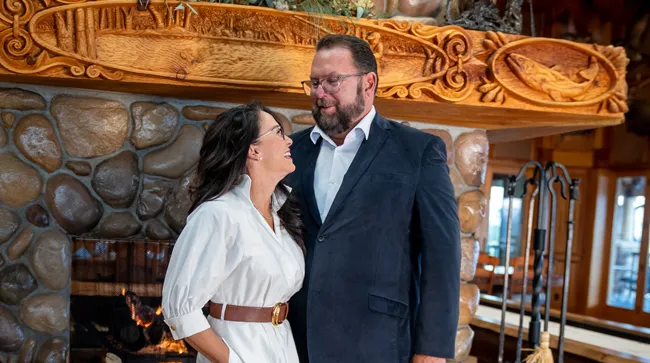
Nicole and Derek Leathers. (Camille Touissant/American Trucking Associations)
He also enjoys cooking and prepares most of the meals at the Omaha home he shares with his wife, Nicole. The couple have been married for 27 years and have two adult children, Olivia and Creed.
Leathers cooks everything from brisket and other barbecue to Mexican dishes influenced by the years he spent living there.
One particular favorite is paella.
“It’s a bit of a process to get it right,” he said.
Cooking, farm work and outdoor activities appeal to him in part because all demand attention to the task immediately at hand while producing tangible results.
That echoes what kept him in trucking all those years ago.
As his college friends moved into other professions, Leathers increasingly concluded that trucking offered something he valued more: work with a direct connection to the broader economy.
“You can always put your head on the pillow at night and know that what you did today made a difference,” he said.
The road ahead for ATA
During his chairmanship, Leathers will help guide a leadership transition at ATA, which recently appointed Mark Colson as its next president and CEO. Colson, who has led the Alabama Trucking Association since 2019, will step into his new role on Dec. 1, succeeding Chris Spear.
Leathers said ATA is equipped, staffed and qualified to advance the priorities that matter most to trucking companies across the country.
Dan Horvath, ATA’s chief operating officer, said Leathers’ advice and direction to ATA staff as a vice chairman have helped the organization better support its membership.
“Whenever we need support, he’s there for us,” Horvath said. “I am truly looking forward to the year ahead with Derek as our chairman and continuing the great work we do advocating on behalf of our great industry.”

PCS Software CEO Mark Hill discusses the advance of AI in the trucking industry. Tune in above or by going to RoadSigns.ttnews.com.
Leathers also views independent research as essential to understanding the increasingly complex issues confronting the trucking industry.
He joined the American Transportation Research Institute’s Board of Directors more than a decade ago and became its chairman in 2022.
ATRI’s longtime president, Rebecca Brewster, credited Leathers’ guidance and support with strengthening the not-for-profit organization’s research work.
“His unwavering belief in my leadership of ATRI has given me the confidence to trust and empower our research team to do what they do best. For that I will always be deeply grateful,” said Brewster, who plans to retire in February after 34 years with the organization.
For Leathers, the ATA chairmanship is an opportunity to represent an industry that he didn’t originally intend to join but ultimately chose to make his life’s work.
“I’m proud to be in the role for the next year and I’m very, very proud to be part of this industry,” he said.


