
[Stay on top of transportation news: Get TTNews in your inbox.]
Cross-border calculus: North American freight networks adapt
USMCA uncertainty has forced shippers and transportation providers to become more flexible
 The United States declining to confirm an extension of USMCA added more unknowns to an already challenging operating environment. (Krista Bussey/Transport Topics)
Key Takeaways:
- The U.S. declined to confirm a 16-year USMCA extension July 1, triggering annual reviews that could continue until the pact expires in 2036.
- Shippers face shifting tariffs, tighter truck capacity, higher rates, changing customs requirements and uncertainty that can quickly render supply chain plans obsolete.
- To build resilience, companies are adding redundant carriers, multimodal options, flexible warehousing and customs expertise while remaining cautious about new production investments.
Years of shifting tariffs, customs requirements and trade policies have forced shippers and their transportation providers to become more adaptable, but previous disruptions offer little guidance for what lies ahead, especially as uncertainty surrounding the U.S.-Mexico-Canada Agreement has increased.
The U.S. declined to confirm a 16-year extension of USMCA on July 1, triggering annual reviews that could continue until the trilateral trade pact expires in 2036, adding more unknowns to an already challenging operating environment.
“The best indication of future behavior isn’t past behavior where trade is concerned,” said Mark McKendry, president of IMC Logistics’ Canada business. “Because of the capricious nature of trade policy these days, I don’t believe anyone could predict what next month will look like.”
Transportation providers are responding by creating optionality across modes, manufacturing networks, warehousing and customs services. The goal is to give customers multiple ways to keep freight moving when regulations, costs or capacity shift.
Still, some companies hesitate to adjust operations because a new plan can become obsolete almost as soon as it is implemented.
“Some of our customers got tariff fatigue the last time tariffs started changing at a rapid pace,” said George Chasteen, chief operating officer of Mesilla Valley Transportation. “By the time they implemented a new plan for an announced tariff, the plan was no longer relevant or valid due to a change in the tariff policy the following week or month.”
Jonathan Starks, CEO of FTR Transportation Intelligence, said the policy environment has stabilized somewhat since last year, giving companies greater confidence in their decisions.
Cross-border freight volumes continue to increase. Dean Croke, principal analyst at DAT iQ, said southern border freight volumes are running about 6.5% higher than a year ago. At the same time, tightening truck capacity is driving an increase in freight pricing, with spot rates climbing 24% on lanes out of the Texas border.
“Capacity exiting is doing all the heavy lifting, not demand,” Croke said, citing increased enforcement of English-language proficiency requirements, non-domiciled commercial driver rules and cabotage restrictions, which prohibit foreign carriers from hauling domestic loads.
North of the border
The northern border is experiencing different pressures.
LoadLink Technologies data showed U.S.-to-Canada loads increased 24% in September, but Canada-to-U.S. loads declined 12%, creating an imbalance that could drive up rates.
Anne Reinke, president and CEO of the Intermodal Association of North America, said northbound intermodal volumes from Mexico increased 17% over the past 12 months, while U.S.-Canada volumes declined 2%.
Image
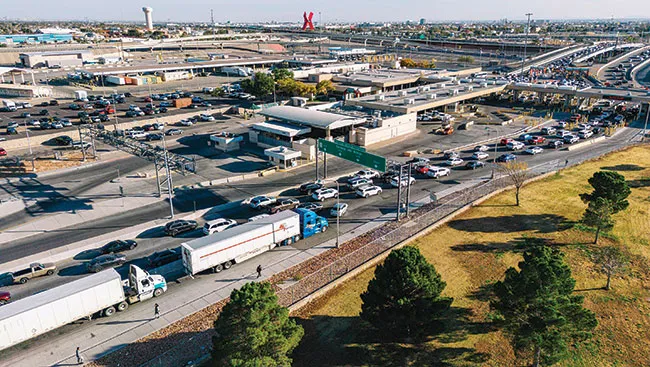
Cross-border freight volumes continue to increase, particularly at U.S.-Mexico crossings. (Mesilla Valley Transportation)
The increase in Mexican intermodal traffic suggests some shippers may be shifting freight from trucks to rail, potentially easing their exposure to truck capacity constraints.
“Today’s uncertainty is just the latest in a series of disruptions and Black Swan events to which we’ve had a front row seat in the current decade, including, most notably, the pandemic,” Reinke said. “This has made resilience, in general, part of the intermodal muscle memory.”
Longer term, Canada’s efforts to diversify could have a more significant impact.
The country is seeking to reduce its reliance on the U.S. market, signing approximately 20 trade, economic or strategic agreements with other countries since January 2025.
“While the United States is going to remain Canada’s largest export market for quite some time, ongoing diversification will lift containerized imports and exports of goods that used to travel by truck across North America,” IMC’s McKendry said.
IMC Logistics ranks No. 50 on the Transport Topics Top 100 list of the largest for-hire carriers in North America.
Despite the uncertainty, Bob Costello, chief economist for American Trucking Associations, said established North American manufacturing networks remain largely unchanged, and he expects that to continue during the USMCA review.
“[It] gives businesses heartburn and makes them worry a bit but doesn’t change their business for now,” Costello said.
South of the border
MVT’s Chasteen said major manufacturers returning some production to the U.S. haven’t abandoned Mexico.
“Instead, we are seeing optimization of manufacturing lines — certain products manufactured in Mexico and certain in the U.S.,” he said.
MVT anticipates Mexico freight volumes will continue growing at a mid- to high-single-digit pace, barring a demand-side or other shock catalyst to the market.
“We haven’t delayed our investments on the U.S. side of the southern border as a trucker, warehouse provider and logistics company,” Chasteen said.
MVT ranks No. 61 on the for-hire TT100 list.

Bob Toews, CEO of TruckDown, discusses winter readiness in the connected fleet era. Tune in above or by going to RoadSigns.ttnews.com.
Some foreign entities are hesitant to make new investments in Mexico.
Troy Ryley, president of Echo Global Logistics’ Mexico division, said some Chinese manufacturers have postponed plans for Mexican factories until country-of-origin requirements become clearer.
“They need to know that clearly before they could pull the trigger to build a factory,” he said.
DAT’s conversations with shippers indicate growing caution about adding production or warehouse capacity.
“I think what we’re seeing increasingly is shippers are erring more towards the worst-case scenario,” Croke said. “When we talk to them, they say things like, ‘Well, we’re not adding in that third production line or that third shift.’ ”
Investment decisions
Trade policy is not the only factor shaping freight decisions. The cost of capital, fuel prices and tax incentives also play a part.
“As far as new production and site selection, it’s fair to say that investment in ex-NAFTA partner countries is being disincentivized by the present administration,” McKendry said, adding that Canada is seeking new tax incentives with a promise to lift regulatory barriers to development.
Image
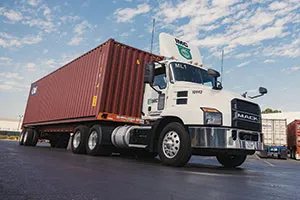
Transportation providers are prioritizing flexibility, optionality, and stronger freight networks. (IMC Logistics)
IMC is moving forward with its plans to expand into Canada, with a Toronto operation expected to open in the fourth quarter. McKendry said the expansion will allow IMC to serve customers as they adjust their North American freight networks.
Because policy changes have become an ongoing challenge, transportation providers are also investing in services and infrastructure that allow customers to adjust their operations without completely rebuilding supply chains.
Chasteen said MVT has added bonded and foreign trade zone warehousing along the southern border, allowing customers to defer duties and improve cash flow, and has crossdocks, rail-served warehouses, partner carriers and an in-house licensed customs broker. He said many shippers are becoming more thoughtful in their planning.
“We also see a few that are prisoners to their current freight network and supply chain setup as they might not have the ability to change as the market changes, the regulatory market changes, or their business changes and grows,” Chasteen said. “These shippers inevitably have margin compression and struggle to compete.”
Redundancy is central to managing that risk because having one asset-based carrier, one port and one customs broker and no backup is no longer enough, Echo’s Ryley said.
“That’s not what we consider to be adequate protection,” he explained.
Echo ranks No. 19 on TT’s Top 100 list of the largest third-party logistics providers in North America.
Building resilience
Technology also plays a role by providing shipment visibility and helping identify alternatives when disruptions occur.
IMC is investing in artificial intelligence to enhance freight planning and flexibility.
“It can help us figure out where we can jump in and determine a different workaround for customers,” McKendry said.
Changes in customs requirements and enforcement priorities are adding complexity beyond the actual USMCA review.
Echo’s Ryley said Mexican crossing agents must submit more information before freight crosses the border, including driver names and license plate numbers.
“It’s become a much more dynamic and much more compliance-focused environment,” he said. “That’s going to be a key element in a client’s success running freight in and out of the border.”
The increased complexity makes relationships with logistics providers and customs experts more important for shippers navigating shifting regulations.
Image

Minarro
Customs decisions have become a higher priority for corporate leadership, said Jose Minarro, Echo’s managing partner for Mexico client sales.
“Over the last year, when they went from paying zero duty to thousands of dollars,” he said.
Despite the uncertainty, those within the industry expect the three countries to maintain their trading relationships.
ATA’s Costello remains optimistic about the ultimate outcome.
“I really believe that a deal gets done and USMCA remains a trilateral agreement,” he said. “Now, the finished product may not be until next year, but it will most likely happen.”
Reinke said IANA will urge the three countries to commit to a long-term agreement in comments to the U.S. Trade Representative for the 2027 annual review.
“The annual review requirement to which the USMCA is currently subject increases uncertainty, creates cross-border friction and slows the movement of goods,” she said.


