[Stay on top of transportation news: Get TTNews in your inbox.]
CBP pilot to test electronic truck export manifests
Program will evaluate whether carriers can be required to submit data before loading cargo
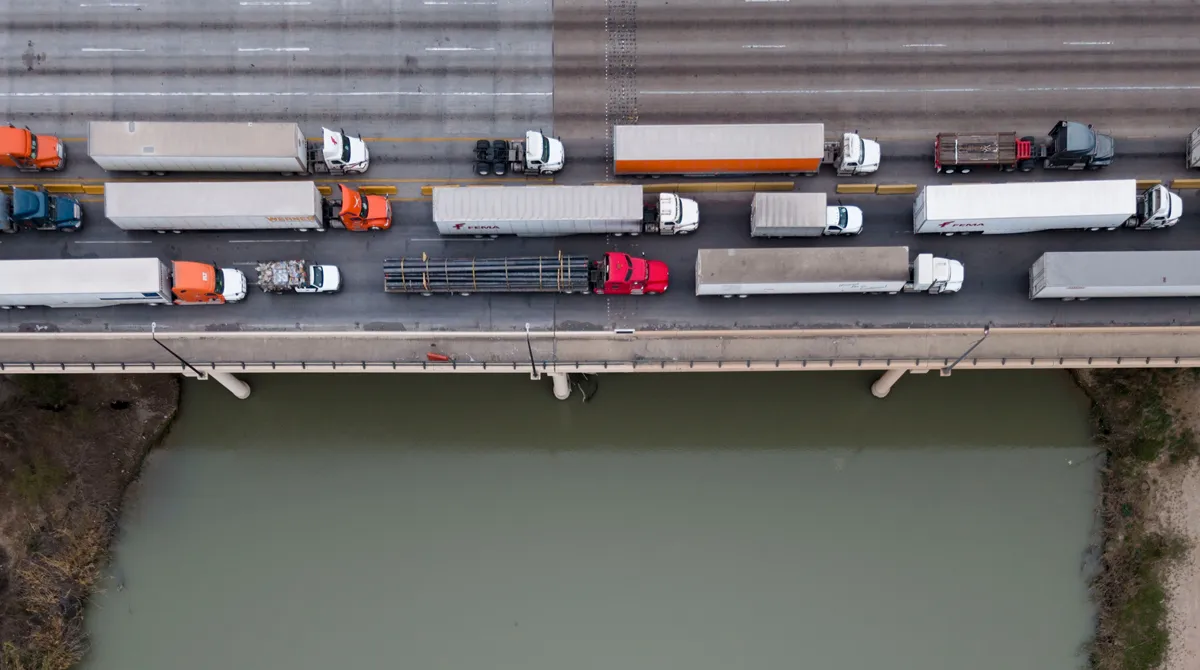 Currently, truck carriers are not required to submit manifests for cargo exported from the United States. (Cheney Orr/Bloomberg)
Key Takeaways:
- Customs and Border Protection will launch a two-year electronic export manifest pilot Oct. 23 with nine truck carriers serving Canada and Mexico.
- CBP said advance electronic filings could improve risk assessment, cargo security and shipment processing while reducing inspections, border delays and costs.
- Carriers must submit limited data 24 hours before departure and complete manifests two hours before shipments reach their final export ports.
Customs and Border Protection will launch a two-year pilot program Oct. 23 with nine truck carriers to test electronic export manifests for freight moving from the United States to Mexico and Canada.
The project, known as the Electronic Export Manifest truck cargo test, will evaluate whether truck carriers can be required to submit manifest information electronically before cargo is loaded.
Currently, truck carriers are not required to submit manifests for cargo exported from the United States. Federal regulations, however, require the U.S. Principal Party in Interest to provide certain advance export information to CBP for truck shipments leaving the country.
“CBP believes this process will also reduce costs for CBP, partner government agencies and the trade community, improve facilitation of export shipments through the supply chain, and enable CBP to identify high-risk shipments for purposes of ensuring cargo safety and security, including compliance with export controls,” the agency said.
The pilot is part of the Automated Commercial Environment, a modernization effort intended to streamline trade processes and improve cargo security. ACE is being developed as a centralized digital system for processing U.S. imports and exports, including tariff collection, regulatory enforcement and import controls.
Participating carriers must be capable of submitting data electronically through ACE. CBP has placed no restrictions on carriers based on location, commodities handled or company size.
Under the test, carriers will be asked to submit limited export manifest information at least 24 hours before cargo departs the United States. A complete export manifest would be required no later than two hours before the shipment reaches its final export port.
CBP said the timeline would allow the agency to link export information submitted by the U.S. Principal Party in Interest with manifest data provided by carriers.
“CBP believes this capability will better enable CBP to assess risk and effectively target and inspect shipments prior to the loading of cargo to ensure compliance with all U.S. export laws,” a Federal Register notice said.
The agency said the program could strengthen security and reduce supply chain disruptions by giving officials more time to assess risk and identify shipments that may require inspection before departure.
Image
(Justin Hamel/Bloomberg)
“Although CBP will aim to identify shipments for inspection prior to loading, inspections could potentially happen at any time before the truck departs the United States. Any truck cargo identified as potentially high-risk will receive a hold until required additional information related to the shipment is submitted to clarify non-descriptive, inaccurate or insufficient information, a physical inspection is performed or other appropriate action is taken, as specified by CBP,” the agency said.
Once cargo is cleared, CBP will generate and transmit a release message authorizing loading.
Trucks account for most surface freight trade with North America’s two largest U.S. trading partners, moving 55.7% of trade with Canada and 73.6% of trade with Mexico in 2025, according to the Bureau of Transportation Statistics.
“America’s land borders with Canada and Mexico are economically vital conduits for North American supply chains, with about $4 billion in daily cross-border freight shipments,” the bureau said. “In addition to oil and energy products, automobiles and electronics, Canada and Mexico are also America’s largest trading partners in agricultural goods.”
CBP said participating carriers may benefit from fewer post-loading inspections, reduced border delays, improved export data accuracy, enhanced cargo security and better preparation for any future electronic filing requirements. The agency also said the test will give carriers an opportunity to help shape the development of an electronic export manifest system and support more efficient freight movement across U.S. borders with Canada and Mexico.