
[Stay on top of transportation news: Get TTNews in your inbox.]
Carney says Canada could turn to Chinese automakers
Trade talks with U.S. must preserve an integrated North American auto industry, PM says
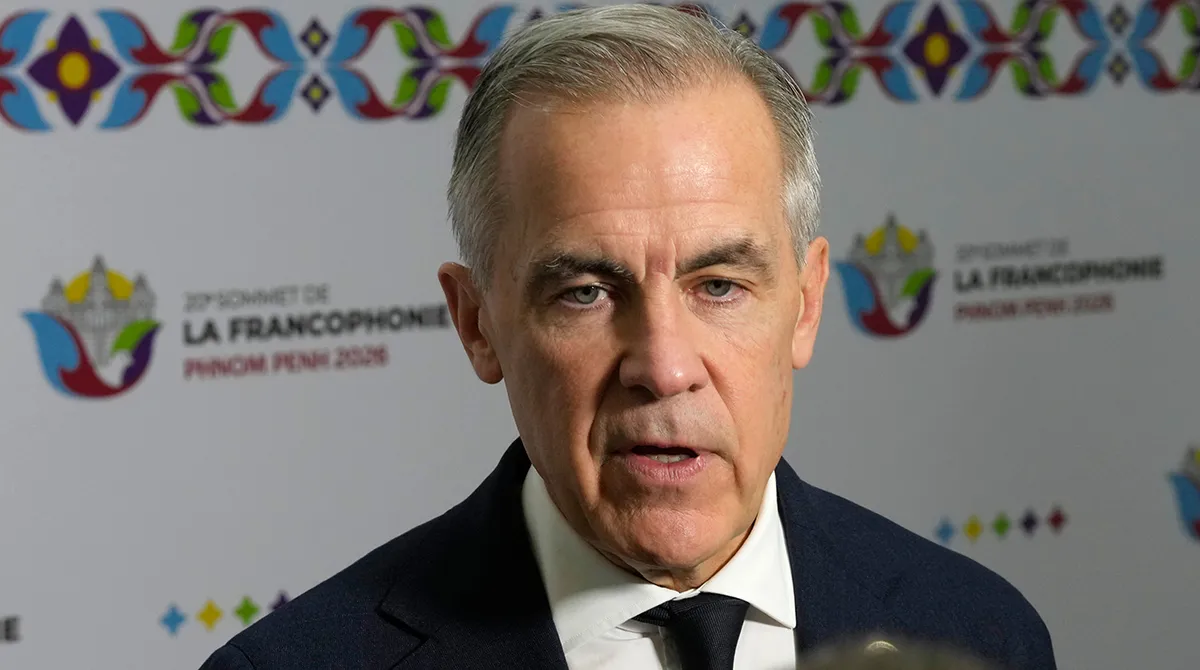 Canada's Prime Minister Mark Carney speaks with reporters at the Francophonie Summit in Phnom Penh, Cambodia, on Nov. 16. (Adrian Wyld/The Canadian Press via AP)
Key Takeaways:
- Canadian Prime Minister Mark Carney said Canada could turn to Chinese automakers if U.S. trade talks fail to preserve North American auto integration.
- Canada cut tariffs on Chinese electric vehicles to 6.1% in January, while Carney said any investment must include substantial Canadian manufacturing.
- Carney planned to meet Chinese President Xi Jinping this week as U.S. and Canadian officials continued negotiations toward a possible trade agreement.
PHNOM PENH, Cambodia — Canadian Prime Minister Mark Carney said Nov. 16 that Canada could turn to Chinese automakers if trade negotiations with U.S. President Donald Trump fail to preserve an integrated North American auto industry.
Carney’s comments in Cambodia came ahead of a planned meeting with Chinese President Xi Jinping this week in Shenzhen, China, where Chinese auto manufacturing is expected to be discussed. The two leaders reached an agreement in January allowing tens of thousands of Chinese electric vehicles into Canada at reduced tariffs.
“We have the best auto workers in the world, and we want them fully deployed, full opportunity, in an integrated North American market,” Carney told reporters in Cambodia. “That market has become less integrated because of U.S. trade actions.”
Carney said Nov. 14 in Manila, Philippines, that any trade agreement with Washington must leave Canada with a viable auto industry. He said Nov. 16 that negotiations with the United States remain his priority, but their outcome could determine whether Canada pursues alternatives involving European, Chinese or Japanese automakers.
Asked whether potential Chinese investment was leverage in the U.S. negotiations, Carney replied: “It’s not leverage. But action, reaction” on behalf of Canada's auto workers and manufacturing assets.
“If they’re not fully utilized in a North American context, that provides other opportunities,” Carney said. “Canada is going to move forward either way.”
Memo to @MarkJCarney @canadianpm Are u really threatening to play China off the U.S.? This is offensive in the extreme. You should be far more worried China is going to eat Canada alive--as it is already doing. Vancouver is not BC, its PRC. Carney says Canada could turn to Chinese automakers if Trump trade talks fail https://t.co/Y0Tq0N4Cu3
— Peter Navarro (@RealPNavarro) November 16, 2026
White House trade adviser Peter Navarro lashed out on social media Nov. 16 in response to Carney's suggestion that Canada could turn to Chinese automakers.
“Are u really threatening to play China off the U.S.? This is offensive in the extreme,” Navarro wrote on X. “You should be far more worried China is going to eat Canada alive.”
The Detroit Three — Ford, General Motors and Stellantis — operate factories across Canada, the United States and Mexico, with parts sometimes crossing borders multiple times before a vehicle is completed. Trump has repeatedly pushed automakers to move production to the United States from Canada.
Carney said any Chinese investment would have to involve substantial manufacturing in Canada rather than simply assembling imported parts. He said it would require proper labor standards, manufacturing facilities and domestic supply chains that expand over time, including the use of Canadian critical minerals in electric vehicles.
“It’s not just about kit cars,” he said. “There has to be a manufacturing aspect involved.”
Under the January agreement, Canada reduced its 100% tariff on Chinese electric vehicles to 6.1%, initially allowing up to 49,000 vehicles annually, with the cap increasing over time. In exchange, China agreed to lower tariffs on Canadian agricultural products, including canola.
Carney said at the time that he expected the agreement to attract Chinese investment in Canada’s auto industry and create jobs.
The deal drew criticism from Ontario Premier Doug Ford, whose province is the center of Canada’s auto industry. Ford warned that allowing Chinese electric vehicles into Canada could threaten Canadian jobs and jeopardize access to the U.S. market.
The federal government’s focus needs to be on protecting Canadian auto workers, not undermining them by importing even more state-subsidized cheap Chinese cars. https://t.co/3GSs56Una7
— Doug Ford (@fordnation) November 16, 2026
“The federal government’s focus needs to be on protecting Canadian auto workers, not undermining them by importing even more state-subsidized cheap Chinese cars,” Ford said on social media on Nov. 16.
Trump’s tariffs have battered Canada’s auto industry, potentially unraveling decades of cross-border integration. Canada recently threatened to sue Stellantis after the company moved its plans for Jeep Compass production from Ontario to Illinois and agreed to sell its idled Canadian assembly plant.
Carney said Nov 14 that he had spoken at length with Trump and senior U.S. officials and that the two countries were making progress toward a possible trade agreement, although differences remained.
Associated Press writer Rob Gillies in Toronto reported from Toronto.


