
[Stay on top of transportation news: Get TTNews in your inbox.]
Autonomous EV developer Humble Robotics adds $51M to expand
Series A financing will support pilots, tests and early production of autonomous trucks
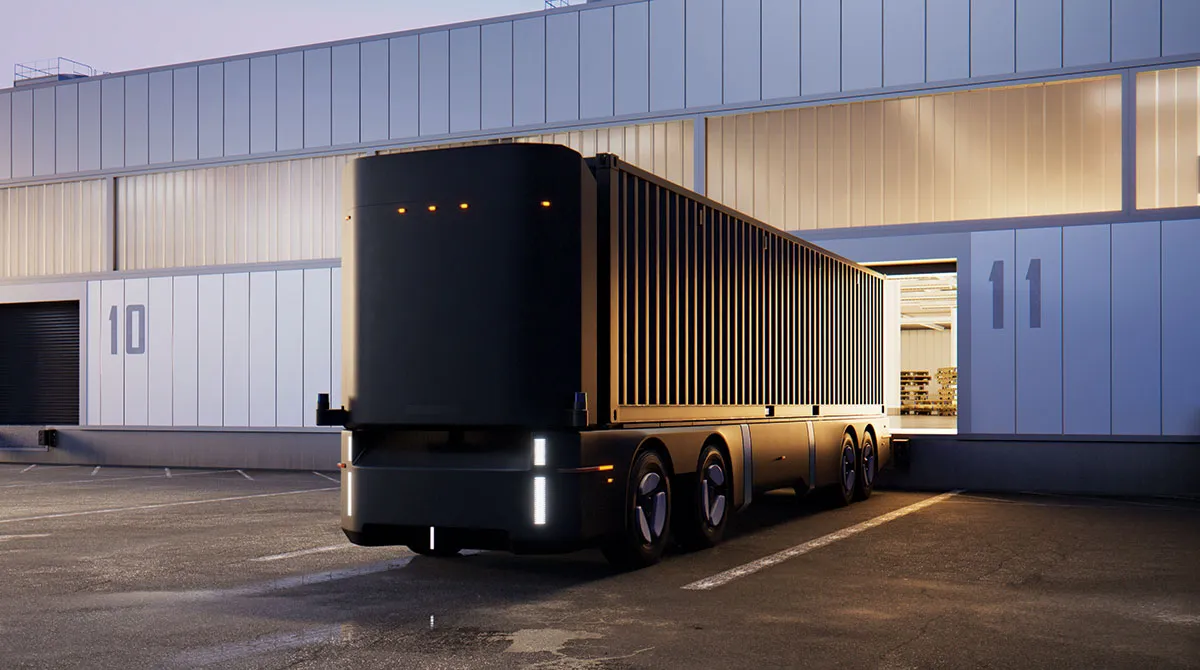 The Humble Hauler, a battery-electric, cabless Class 8 autonomous vehicle. (Humble Robotics)
Key Takeaways:
- Humble Robotics raised $51 million in Series A financing, bringing its total funding to $75 million less than a year after its founding.
- The company is developing the Humble Hauler, a battery-electric, cabless Class 8 autonomous vehicle for regional freight routes under 250 miles.
- Humble will fund customer pilots, testing, early manufacturing and expansion into vehicles for 40-foot containers and 53-foot dry van and refrigerated trailers.
Humble Robotics secured $51 million in new financing, bringing the autonomous electric vehicle developer’s total funding to $75 million less than a year after its founding.
Obvious Ventures led the Series A round, with participation from existing investors Eclipse, Energy Impact Partners and others. Humble said it will use the funding for customer pilots, testing and validation, early manufacturing, and expansion of its modular platform into a broader family of regional freight vehicles.
“We’ve spent years proving that a truck can drive itself. The harder question is how to make autonomy something a freight operator can depend on every day,” founder and CEO Eyal Cohen said.
PERSPECTIVE: From proving autonomy works to proving it scales
The financing comes six months after the San Francisco-based company emerged from stealth with the Humble Hauler, a battery-electric, cabless Class 8 autonomous vehicle. Humble previously raised $24 million in seed funding led by Eclipse.
Cohen, a former Apple, Otto, Uber and Waabi executive, took his vision for the vehicle from concept to prototype in six months. He told Transport Topics in May that Humble expected to complete testing and begin a customer pilot involving dock-to-dock transportation of 40-foot shipping containers within 12 months of the interview.
The company plans to adapt the design for 53-foot dry van and refrigerated trailers.
“It’s an interesting question of ‘How do you rethink this but how do you also plug into a well-oiled machine?’ ” Cohen said in the May interview, referring to the freight industry. “When we were working on this project, the goal was ‘How do we get the lowest cost of moving freight?’ ”
The Hauler uses vision-language-action models and is equipped with cameras, lidar and radar that provide 360-degree coverage of its surroundings. The battery-electric skateboard platform has an aerodynamic shield at the front, while shipping containers can be attached through a twist-lock interface.
Humble initially is focusing on regional routes of less than 250 miles, which the company said account for 87% of U.S. truck tonnage. Its platform is designed to transport freight among ports, rail terminals, warehouses and distribution centers.
Image

Cohen
Cohen previously said Humble would build the vehicles in the United States and seek a domestic battery supplier as development progressed. The company said it is working with customers, partners and regulators as it prepares for commercial deployment and integration into existing freight operations.
Testing will rely heavily on simulation and AI rather than accumulating extensive highway mileage, Cohen told TT in May. Humble maps prospective freight routes, constructs simulated versions of them and repeatedly tests its autonomous-driving technology in those virtual environments.
“We learned that [real-world mileage] is a very bad method for two reasons. One, there’s a lot of miles driven where nothing happens, especially when you’re driving on highways. And two, you know, it is more efficient just to test the simulation,” Cohen said.
“Often what we do here is we go map the roads that we’re excited about. We build a simulated world of that freight link, and then we go driving it over and over again,” he added.
The latest funding also will support development of vehicles for other regional freight applications.
Assisted by AI.


