

[Stay on top of transportation news: Get TTNews in your inbox.]
ATA chairmen, new president chart federation’s future at MCE
Colson pledges member focus as newly appointed president and CEO
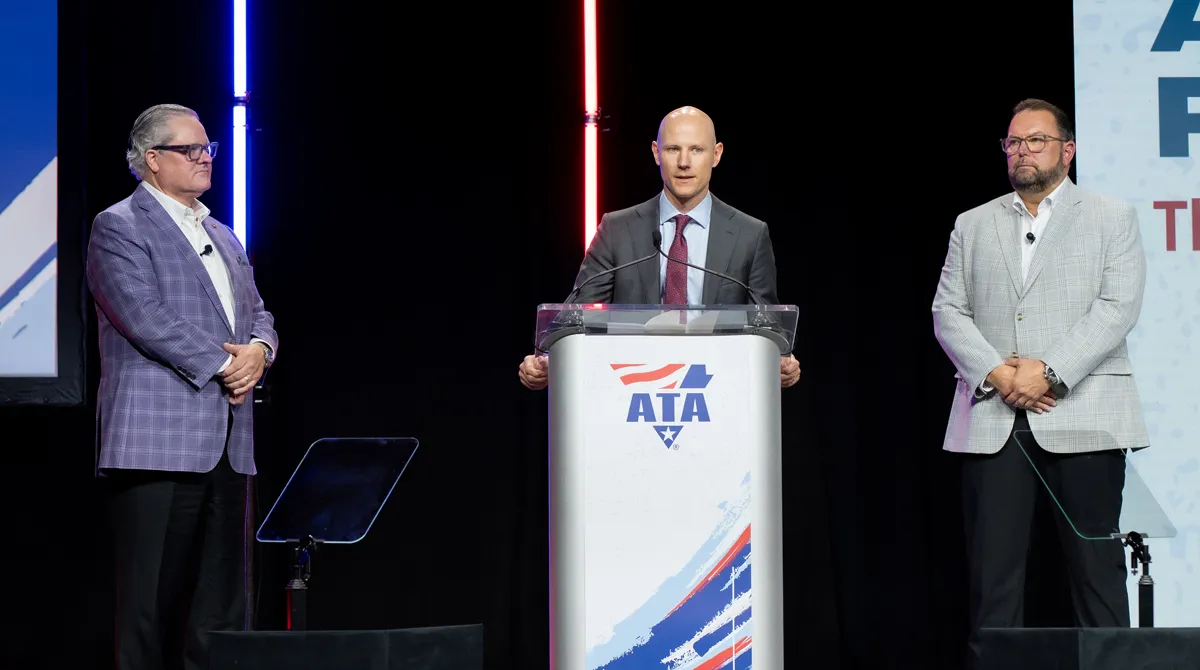 Hodgen, Colson and Leathers on stage Oct. 19 at MCE 2026. (Erin Granzow Photography)
Key Takeaways:
- ATA introduced incoming President and CEO Mark Colson at its Oct. 19 Management Conference & Exhibition in Charlotte as leaders outlined priorities.
- Leaders said ATA remained focused during its CEO search and highlighted FMCSA enforcement that removed nearly 10,000 noncompliant driver training schools.
- Colson pledged greater member engagement while ATA plans continued advocacy on safety, truck parking, emissions rules, cargo theft and independent contractors.
CHARLOTTE, N.C. — The incoming and outgoing chairmen of American Trucking Associations mapped out the road ahead for the federation and formally introduced the organization’s next leader on Oct. 19 at ATA’s 2026 Management Conference & Exhibition.
In his remarks to MCE attendees, Mark Colson pledged to listen to members and put trucking’s professionals at the center of ATA’s advocacy as he prepares to take the reins as its next president and CEO.
“It is an incredible honor to stand here before you today,” Colson said. “The trust that’s been placed in me and my family to be a part of this association is something that I take with great responsibility.”
Colson, whose appointment was announced just days before MCE, said ATA will emphasize member engagement and value.
“We need to listen to our members,” he said. “We need to meet you where you are in these challenging times. We need to build trust. We need to grow our membership. We’ve got to return maximum value. And I’m confident we can do this.”
Colson highlighted his personal connection to trucking, tracing it to his upbringing in his family’s tire business in Alabama and later to his work in trucking advocacy.
He also vowed to prioritize the hardworking people who keep freight moving every day.
“One thing I want you to know about me is I believe the professionals in our industry matter most,” he said. “Everything we do, from the language we use to the policy we promote, must be guided by empathy and respect for the trucking professional.”
Image
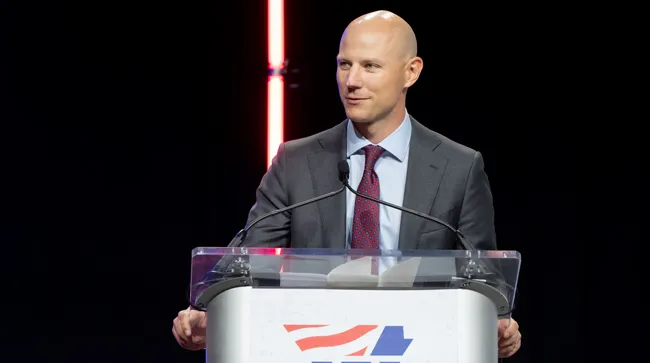
“I believe ATA’s best days are ahead of us,” Colson said. (Erin Granzow Photography)
Colson asked for the opportunity to earn the trust of ATA members, as well as nonmembers and those who may be critical of the association.
“I believe ATA’s best days are ahead of us,” he said.
His remarks followed a wide-ranging discussion between outgoing ATA Chairman Greg Hodgen and incoming Chairman Derek Leathers about the association’s leadership transition and its top priorities moving forward.
Leathers, who is chairman and CEO at Werner Enterprises, stressed that ATA’s advocacy work continued throughout the search for its next chief executive.
“The board is engaged. Staff has remained focused throughout. ATA’s work has not paused,” he said. “The mission of ATA hasn’t changed.”
Leathers said ATA conducted a “thoughtful, disciplined search” focused on finding a leader capable of representing carriers of every size and segment, working with policymakers and industry partners and speaking credibly for trucking.
“The transition is not simply something just to manage,” he said. “It’s an opportunity to sharpen the focus. It’s an opportunity to raise our expectations and build a strong foundation for the future.”
Safety and enforcement
The two chairmen also underscored the importance of highway safety and removing bad actors from the industry.
ATA has continued to press for driver qualifications, greater oversight of training providers and tougher enforcement against unsafe carriers, and the results are “substantial,” Leathers said.
The Federal Motor Carrier Safety Administration has ramped up enforcement actions over the past two years, removing nearly 10,000 noncompliant driver training schools from its federal registry, investigating hundreds of high-risk carriers and placing thousands of unqualified drivers out of service.
“You’ve heard the FMCSA say this many times, but we’re in the early innings,” Leathers said. “There’s a lot more work to be done.”
Image
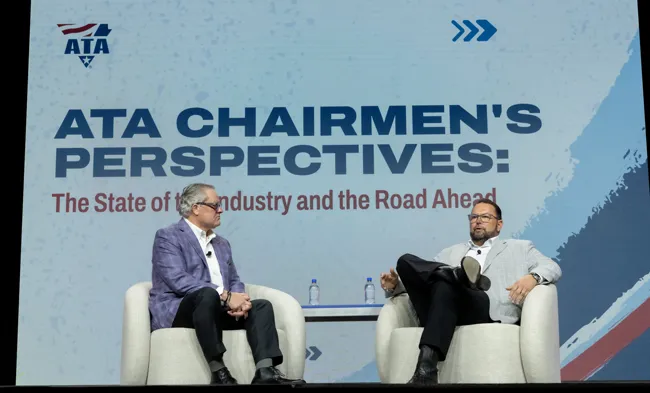
Hodgen and Leathers. (Erin Granzow Photography)
Hodgen, who is CEO of Groendyke Transport, noted that federal agencies are strengthening their coordination against fraud in the trucking industry.
“The goal is not just a few high-profile enforcement announcements — it’s a system that consistently rewards professionalism and holds accountable anyone who cuts corners,” he said. “I think that means stronger oversight, fewer loopholes, and reforms that will last.”
They discussed a range of other key policy priorities as well, such as expanding truck parking, pursuing sensible emissions regulations, preventing cargo theft, fighting lawsuit abuse and defending the independent contractor model.
Member value
Leathers and Hodgen also addressed broader operating conditions as the trucking industry continues to emerge from a prolonged freight recession that squeezed carriers’ margins.
Leathers said that downturn reinforced the importance of managing trucking companies for an entire freight cycle rather than only during favorable market conditions.
“It means knowing your costs and taking care of your customers,” he said. “It means making really tough, disciplined decisions about where you invest and why. It means protecting the things you cannot lose, like your people, your safety standards and your reputation.”
He said that same discipline applies to ATA, which must ensure that members see value from their dues.
“When members are watching every dollar, we have to make every dollar they invest in this association count,” Leathers said.
Image
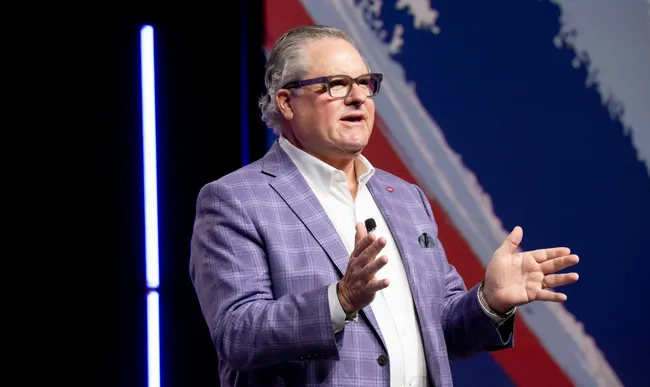
Hodgen. (Erin Granzow Photography)
Hodgen, concluding his term as chairman, described ATA’s value in terms of legislative influence and regulatory engagement.
“ATA can’t single-handedly turn the freight cycle,” he said. “But what ATA can do is challenge unnecessary costs, push for workable rules, and insist that everyone competes under the same standards.”
Looking ahead to his term as ATA chairman, Leathers said the federation must remain “relentlessly member focused” while pursuing fact-based advocacy and building support across party lines.
“We’re not going to just respond to what’s next,” he said. “We’ve got to try to shape what’s next.”


