[Stay on top of transportation news: Get TTNews in your inbox.]
Asian steel gains ground in U.S. despite 50% tariffs
Shift alarms domestic producers, which have complained that some foreign competitors use U.S. as dumping ground
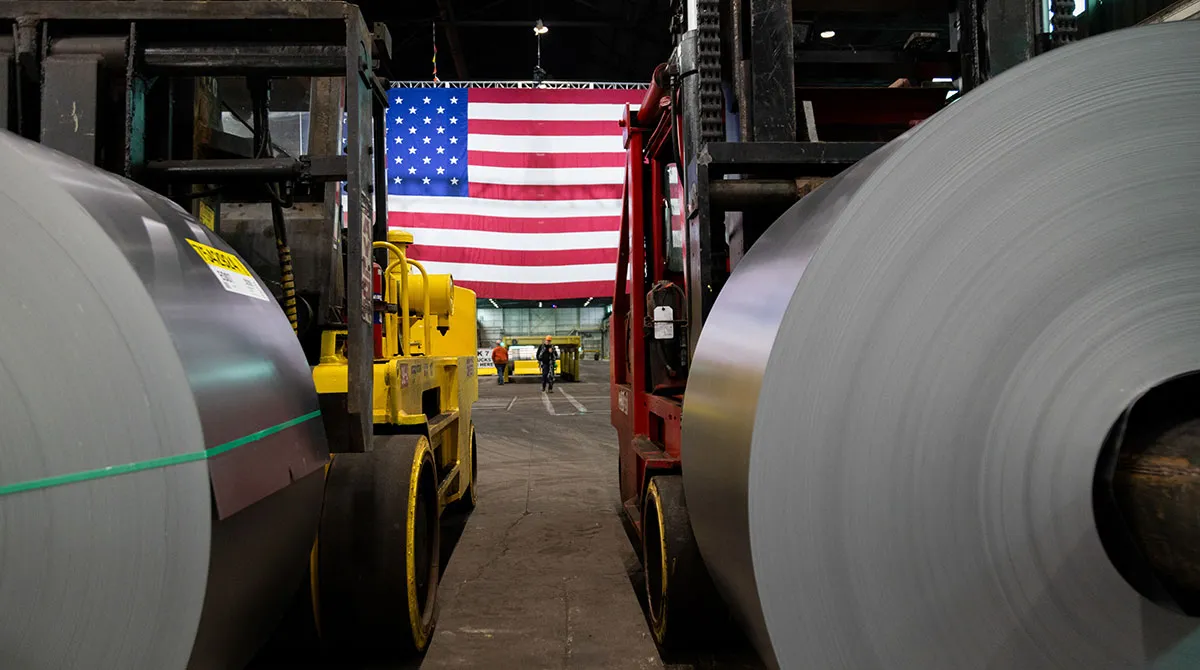 Steel coils in front of a U.S. flag at a facility in West Mifflin, Pa. (Rebecca Droke/Bloomberg)
Key Takeaways:
- U.S. steel buyers are turning to cheaper Asian imports despite 50% tariffs as a data center construction boom strains domestic supplies and drives up prices.
- Some imported steel costs nearly $400 less per ton than domestic steel even after tariffs and shipping, according to Jefferies analyst Albert Realini.
- U.S. steelmakers urged the Trump administration in September to investigate rising South Korean shipments of construction steel, pipes and flat-rolled products.
Cheaper Asian imports are gaining traction with U.S. steel buyers despite Washington’s tariffs, as a data center construction boom squeezes domestic supplies and drives up prices.
President Donald Trump’s 50% levies have sharply curtailed foreign steel shipments into the U.S. But with domestic prices of the metal reaching four-year highs, cheaper supply from East Asian sellers has flowed into the country in recent months.
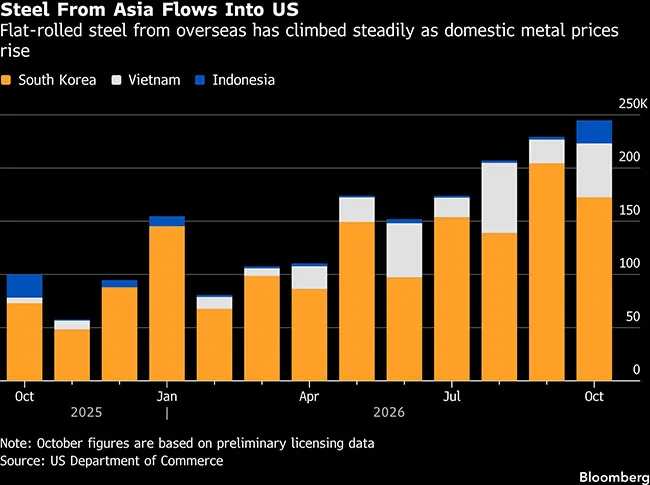
Imports of South Korea’s flat-rolled steel surged 68% through October compared with the same period in 2025, according to data compiled by the American Iron and Steel Institute. October applications for steel from Vietnam more than doubled from September’s final import volumes, reaching 213,000 net tons and making it the fourth-largest foreign supplier that month.
The rapid expansion of AI and its needed power infrastructure has juiced up U.S. demand for steel beyond expectations. The rush of projects — which use steel in anything from laying a building’s foundation to server racks and ductwork — is straining domestic supply, with steel orders booking up fast and U.S. mills struggling to fulfill demand.
“There’s a mad scramble for tons,” said Timna Tanners, an analyst at Wells Fargo. “The U.S. mills are not giving buyers enough steel — they’re cutting back on their supply agreements into 2027.”
The steady return of foreign imports reveals the limits of the Trump administration’s tariffs, which were designed to make foreign material prohibitively expensive and insulate domestic producers, like Nucor Corp., Steel Dynamics and Cleveland-Cliffs Inc. Persistent demand for steel has driven U.S. prices to a height where foreign sellers can now afford the associated levies.
Some imported steel can be nearly $400 a ton cheaper than domestic supplies even after accounting for tariffs and shipping costs, according to a recent note from Jefferies analyst Albert Realini.
Image
This week, Nucor, the largest American steel producer, raised its advertised price for hot-rolled coil to $1,330 a short ton, extending a run of weekly increases that began during the summer. Hot-rolled coil, which is used to make products ranging from cars to construction materials, is the most widely traded form of steel.
Broader market prices have also climbed with U.S. hot-rolled steel recently quoted at more than $1,300 a ton, compared with less than $900 a year earlier.
“Import volumes have been increasing in recent months, including a massive surge from South Korea,” Leon Topalian, Nucor’s CEO, said during the company’s late October earnings call. “But make no mistake, demand is very healthy. Even as imports have crept higher this year, domestic shipments have risen in each of the past three quarters.”
Nucor’s steel shipments were up 10.3% year over year through the third quarter, alongside a rise in capacity utilization to 89% from 83% a year earlier, according to a Nov. 24 report from Bloomberg Intelligence.
Wait times
American mills have ramped up production as prices climbed and foreign supplies dwindled. U.S. steel output rose 5.9% through the week ending Nov. 14 from a year earlier, according to the American Iron and Steel Institute. But the higher output hasn’t alleviated supply constraints, with mill outages, strong order books and declining imports limiting the amount of steel readily available to buyers.
For small manufacturers like Marlin Steel, which makes custom products from steel wire and sheet metal, that can mean a longer wait for orders.
Drew Greenblatt, CEO of Marlin Steel, says he only buys from American producers, and the orders he places with steel mills are now taking between eight and 12 weeks to fill, rather than the one- to three-day shipment time his company enjoyed a year ago. In turn, Greenblatt says his company has stocked up on inventory.
“It’s very awkward for us to have to reframe our pricing to our clients,” he said. “So I try to overbuy now so that I can keep shipping volumes to them. We’ve been buying a lot more than we really need.”
In Korea, the steel industry is dominated by giants like Posco Holdings and Hyundai Steel Co., which have substantial capacity to produce metal and have searched for overseas markets as demand at home remains sluggish. Vietnam, meanwhile, has rapidly expanded its steelmaking capacity in recent years, supplying everything from construction steel and hot-rolled coil to pipes and galvanized sheets.
That shift has alarmed domestic producers, who have long complained about competitors from Asia that they say use the U.S. as a dumping ground.
U.S. steelmakers in September urged the Trump administration to investigate a surge in South Korean shipments, pointing to sharp increases in imports of construction steel, pipes and flat-rolled products. Korean steel shipments reached 519,000 tons in September alone, up 21% from August, while imports from Japan jumped 60%.
The U.S. market is “undeniably in the midst of a significant squeeze driven by a combination of low end-customer inventory, data center demand and seasonal restocking,” Alexander Hacking, a Citigroup analyst, wrote in a note to clients. “When this squeeze alleviates remains to be seen.”