
[Stay on top of transportation news: Get TTNews in your inbox.]
AI takes the call
Voice agents are automating freight communications, allowing workers to focus on high-priority conversations
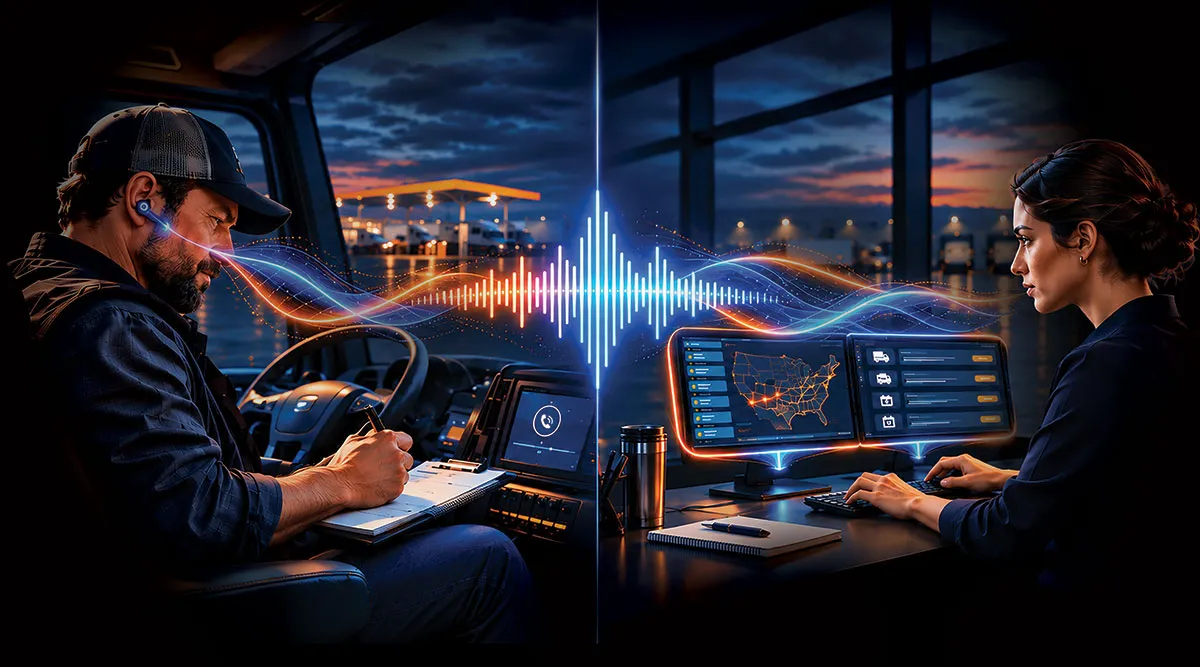 Developers are focusing automation on high-volume transactions, while retaining the human touch for more complex interactions. (Krista Bussey/Transport Topics)
Key Takeaways:
- AI voice agents are increasingly integrated with transportation management systems to automate routine freight communications such as check calls, load updates and appointment scheduling.
- Descartes said its OpsForce agents made 3.49 million calls on 1.2 million-plus loads, saving about 33,600 labor hours over one year.
- Developers are focusing automation on high-volume transactions while routing interactions requiring judgment, relationship management or complex decisions to human workers.
In freight communications, if there’s a practical difference between talking to a human and talking to a voice agent powered by artificial intelligence, technology developers want to remove it. They envision these virtual agents increasingly handling simple and routine interactions while people continue to tackle matters that require a human touch.
To that end, developers of voice agents are teaming up with vendors of transportation management systems to automate specific workflows that are a big part of freight communications: driver check calls, load status updates, appointment scheduling, freight booking inquiries, carrier sales, customer service and after-hours dispatch support.
“Voice agents are well suited to the routine, rote calls that consume operational time today,” said Mario Moore, McLeod Software’s chief AI officer.
Those conversations are predictable and produce structured data, Moore said.
However, a voice agent that fields a check call but doesn’t update the load, trigger the next workflow or flag the exception has just moved the work somewhere else.
“The value comes when the conversation is connected to the system that runs the operation,” Moore said.
That turns an automated conversation into an automated outcome, he added.
Connected fleet technology vendor Samsara reported in October that its latest data indicate that AI voice is becoming “the primary interface for frontline work.”
Businesses are deploying agents that automate reporting, predict compliance risk and talk to drivers in trucks, Samsara said.

Paul Rosa of Penske Truck Leasing breaks down what fleet operators need to know when EPA’s tougher 2027 NOx standard set to go into effect in January. Tune in above or by going to RoadSigns.ttnews.com.
Hyperscale Systems is the developer of “Vic,” short for virtual information coordinator. This “fully conversational” voice agent can be embedded in transportation management systems, maintenance platforms and telematics data.
Hyperscale announced last year that its voice agent was being used by flatbed carrier P&S Transportation, a subsidiary of PS Logistics, which ranks No. 26 on the Transport Topics Top 100 list of the largest for-hire carriers in North America.
Bo DellaMaria, a co-founder of Hyperscale, said, “The best fit right now is repetitive, transactional work: check calls, status updates, maintenance and vendor follow-ups. It’s high volume, low leverage, and delays operations when someone doesn’t get to it.”
Before dialing, Vic pulls up the load and the truck or carrier on it; after the call, it logs the outcome, updates the TMS and sends a text or email when that’s quicker than another call, DellaMaria explained.
He described another example, when a truck is ready to leave a maintenance shop. Vic calls the driver right away with the details, which prevents a driver manager from having to chase an update, possibly for an hour or more, while the driver waits, DellaMaria said.
Once Vic is functioning in one department, it can be employed in others, becoming “one agent for the whole back office, not just a phone assistant,” DellaMaria said. It can handle external emails, order entry and dispatcher questions in Teams, he said.
Automating the mundane
Generally, the creators of voice agents focus on workflows that require frequent, routine phone calls.
Descartes in March introduced Descartes MacroPoint OpsForce, AI agents designed to automate the work of maintaining freight visibility. The agents can help handle much of this routine work, including helping carriers and drivers get tracking started, said Andrew Wimer, associate general manager of transportation management solutions for Descartes.
From October 2025 through October 2026, the OpsForce agents made 3.49 million calls on more than 1.2 million tracked loads, Wimer said, representing approximately 33,600 labor hours saved.
“The value is higher quality and more complete tracking data with less manual effort, giving employees more time for work that benefits from their judgment and relationships,” Wimer said.
Jesse Buckingham, CEO and co-founder of Vooma, said that when Vooma’s voice agent answers an incoming call from a carrier to a broker, for example, it automatically verifies the caller against Highway or other compliance systems, and answers questions about the load, appointment times and equipment required.
It will negotiate a rate “based on negotiating strategies that the brokers implement,” Buckingham said.
One benefit for users is that the voice agent answers every call. Many brokerages miss between 30% and 40% of incoming calls, Buckingham said, because they tend to come in all at once when a load is posted.
“That’s a terrible experience for carriers,” he said, adding that it results in missed opportunities for brokers as well.
Image

Buckingham
Buckingham stressed that businesses should weigh the value of automating versus manually performing different tasks.
“Answering a phone call to reject a carrier because they don’t meet your compliance requirements is not building a relationship,” he said.
A broker’s time is better spent deepening a partnership with a manager at a 20-truck fleet, Buckingham said. “That’s much harder work. You don’t want AI doing that.”
Augment, an AI company established in 2024, announced in August an integration with McLeod Software’s PowerBroker transportation management system to help brokers with carrier selection and shipment tracking.
Those interacting with Augie, Augment’s AI assistant, can do so via voice, text and email. Connecting with people according to their preferences is essential, Augment CEO Harish Abbott said, noting that some people are responsive to phone calls, while others are more responsive on a text or a WhatsApp message.
“AI is quite good at understanding preferences of people,” he said.
Augment’s agent can communicate in Spanish and Canadian French, changing in midconversation. Augie enables those connecting to a broker to switch to a person after informing them of the approximate wait time and noting that an AI agent is available. Given the choice, people opt for AI almost 70% of the time, Abbott said, “because it’s faster to get the answers.”
In logistics, freight and supply chain, there’s a “coordination tax” on the multiple parties that must work together, Abbott said. “Most of that coordination is happening over emails and calls and text messages today.” Users of Augment’s AI agent pay for successfully executed outcomes, Abbott said.
Human judgment
A common question for companies implementing AI voice agents is where in a process should an interaction be handed over to a human.
“For us the line is pretty simple,” Hyperscale’s DellaMaria said.
Transactional, high-volume things are for Vic, and anything that depends on judgment or a relationship stays with a person. If a routine conversation starts turning into something that requires human judgment, Vic hands it off.
David Peckman, chief commercial officer for CloneOps.ai, stressed the efficiency gains unlocked by “putting humans in the position of critical decision-maker, handling escalations, freeing personnel up to do more critical thinking and make more critical decisions.”
CloneOps’ platform for “agentic communication automation” operates in voice, email, text and chat, drawing data from multiple sources.
TMS vendor PCS Software has embedded CloneOps.ai voice automation into its Cortex AI platform.
CloneOps also delivers point solutions to brokers, carriers and other organizations.
Image

Peckman
“Each organization has a different view on where AI should be, and where things need to stay in the hands of humans,” Peckman said.
Typically, pieces of communication are automated, he said, “but it’s an incredibly complex and rich industry and almost every load is different. It’s just about capturing efficiency where it can be captured.”
Qued, a cloud-based, AI-enabled workflow automation platform designed exclusively to manage load appointment scheduling for brokers, 3PLs and carriers, has built connections to 130-plus platforms, plus email and voice.
Qued’s voice scheduling component will schedule appointments at facilities that schedule only via phone. For appointment scheduling, which Qued embeds in partners’ systems, email is by far the favored mode, said Tom Curee, Qued’s president.
Likewise, Buckingham said Vooma’s data reflects a general preference for email over voice.
“Some carriers don’t communicate over voice,” he said. “Maybe they don’t speak good English, and so they find it challenging to call and negotiate. Others do, and they prefer the immediacy of being able to get on the phone.”
Moore of McLeod said the goal of implementing automated voice agents is to automate the transaction, not the relationship.


