
[Stay on top of transportation news: Get TTNews in your inbox.]
Trucking recovery in early stages, ATA’s Costello says
Capacity reductions and tighter driver enforcement have helped turn the prolonged freight downturn
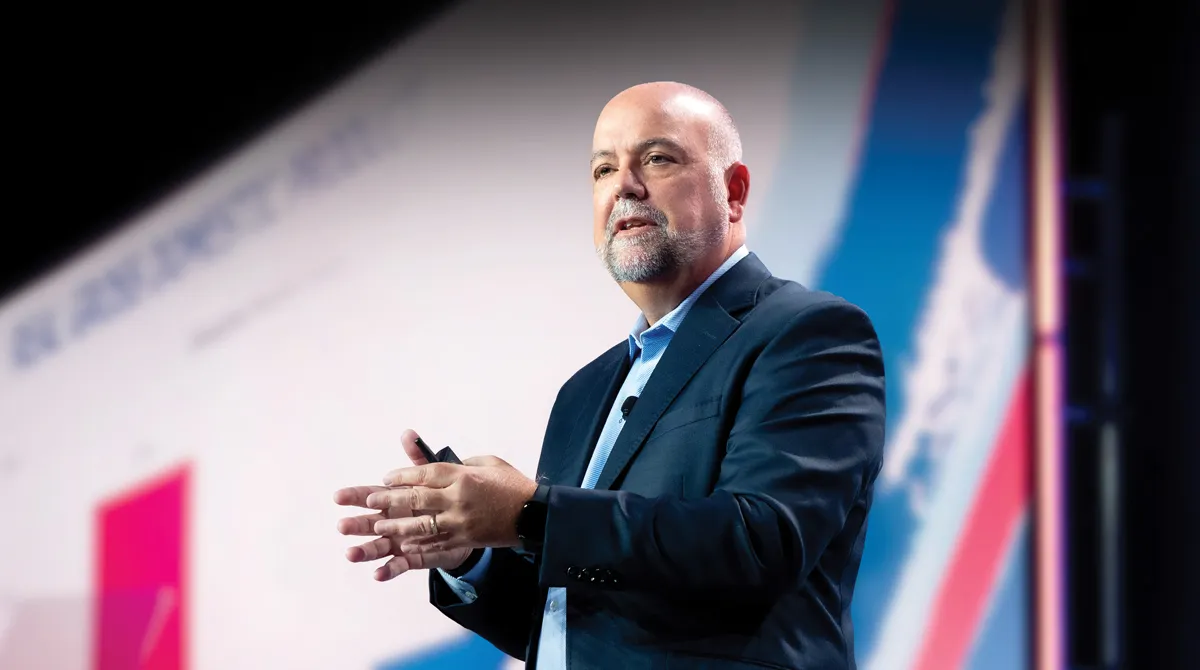 Costello speaks during MCE 2026 in Charlotte, N.C. (Erin Granzow Photography)
Key Takeaways:
- Bob Costello said trucking has entered an early supply-driven recovery as capacity declines after a prolonged freight downcycle.
- Shipper spending rose 32% year over year in the third quarter despite largely flat shipments, reflecting tightening capacity.
- Costello expects the recovery to continue as enforcement constrains capacity, while saying a recession could disrupt the trend.
The trucking industry is only at the beginning of a supply-driven recovery after a prolonged downcycle, American Trucking Associations Chief Economist Bob Costello said.
Costello made his remarks during his annual economic and trucking update in partnership with U.S. Bank. The freight downcycle has become a central topic during these discussions in recent years. The coronavirus pandemic had driven a freight boom that resulted in an oversupply of capacity when freight demand eventually adjusted.
“Broadly speaking, the freight market is not super strong,” Costello said during the discussion. “You might go, ‘I thought he said early on the market has turned.’ It absolutely has. But understand it is all around industry supply, and we’ve never really seen a recovery quite like this.”
Costello noted that the freight market is more uneven than the macroeconomic view suggests, as some trucking companies are doing better than others depending on what they haul or their competition. He pointed to airplane production and equipment going into data centers as drivers of overall factory output. Retail sales and construction show similarly mixed pictures.
“So the good news is the market has turned, and it will continue to turn, I believe, but it’s all based on supply,” Costello said. “Capacity absolutely did come down. It’s just that you never felt it because it didn’t come down enough to meet demand.”
Capacity pressures
Costello noted that trucking companies have been grappling with declining rates and high expenses since the freight market downturn that followed the coronavirus pandemic. He said this has driven carriers out of business, but not fast enough to bring capacity in line with demand. Wages were the biggest cost as competition for qualified drivers grew.
Bob Toews, CEO of TruckDown, discusses winter readiness in the connected fleet era. Tune in above or by going to RoadSigns.ttnews.com.
“Then we entered phase two, and phase two started in say, the spring of 2025, and we were getting new and increased driver enforcement rules,” Costello said. “We’ve had court rulings, we’ve had high diesel fuel prices, and this has been the catalyst.”
The Department of Transportation was a major driver of this escalation with its efforts to crack down on questionable capacity. The federal agency tightened enforcement of rules governing non-domiciled commercial driver licenses, English-language proficiency standards and driver training schools with concerning track records. Customs and Border Protection is also working with the department to stop illegal uses of B-1 business-visitor visas.
Shipper spending rises
“For everybody across all regions combined, you can see that shipments are pretty flat, up a little bit in the third quarter year over year, down a little bit year to date,” Costello said. “But look at shipper spending, up quite a bit, 32% in the third quarter year over year.”
Costello added that this trend is especially pronounced in states with high exposure to cross-border freight like Texas, Oklahoma, New Mexico and Arizona. He noted that shipments in Texas are down 12.9% so far this year, while shipper spending has increased 37%.
“So then the question becomes, how long is this market going to last,” Costello said. “One thing that could bring it to an end is a recession. But even though there’s only some pockets of strength overall for the goods economy and so forth, we just don’t see that at this point. It’s something we’ll watch closely but we don’t see a recession on the horizon.”
Enforcement beyond elections
Costello also doesn’t anticipate changes in political leadership following elections, such as the recent midterm elections or upcoming presidential election, doing much to derail the enforcement crackdowns since many of the initiatives involve administrative actions and are tied to safety. He also doesn’t expect a significant upsurge in capacity.
RELATED: Elections change Congress, but they don’t change trucking’s priorities
“If there’s any OEMs on this webinar, I know this is throwing salt on a wound,” Costello said. “Your sales are definitely improving, orders have improved. But again, we have so far to go because of the very low replacement rates we’ve been experiencing over the last couple of years. So I don’t see that happening, especially when you’re talking about qualified drivers.”


