
[Stay on top of transportation news: Get TTNews in your inbox.]
Truckers grapple with selective, price-conscious criminals
Overhaul executive cites thefts worth tens of millions of dollars per load as averages rise
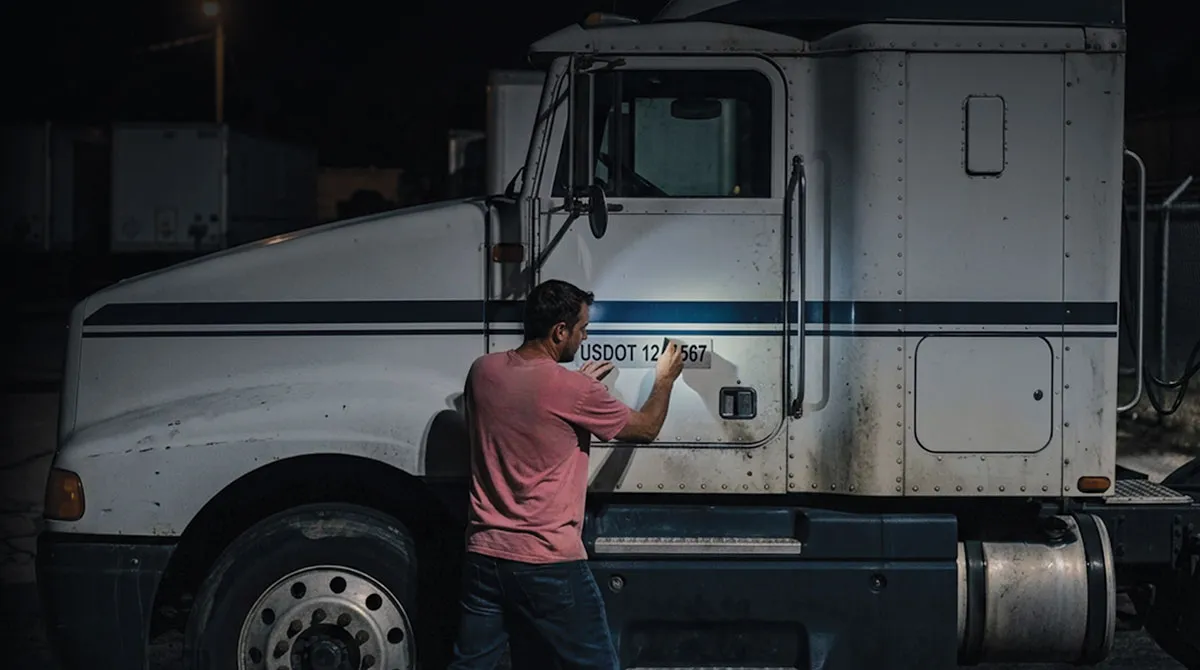 Some criminals disguise their trucks with fake decals and operating authorities to steal a load. (Transport Topics and Adobe Firefly)
Key Takeaways:
- CargoNet reported third-quarter cargo theft incidents fell 33% year over year, while estimated losses rose 12% to $230.1 million.
- Industry experts linked rising losses to targeted thefts of high-value technology, including AI infrastructure and data center equipment.
- Criminal groups are using increasingly sophisticated tactics, including fictitious pickups, truck spoofing, double-brokering schemes and cooperation with other criminal networks.
The cargo theft landscape became more costly in the third quarter as criminals continued to focus on high-value loads.
Verisk CargoNet found in its Q3 report that supply chain crime incidents declined 33% to 547 events across the U.S. and Canada from last year’s Q3. That was also 19% below Q2 2026. But estimated losses grew 12% year over year to $230.1 million.
“We saw mixed results in the third quarter, with a decline in reported incidents and fictitious pickups remaining close to last year’s level, but the estimated financial impact grew significantly,” said Keith Lewis, vice president of operations at CargoNet, which said the commodity category with the most incidents was food and beverage.
CargoNet has been tracking a decline in cargo theft activity throughout the year, but the second and third quarters both experienced increases in total values. It has also warned of increasingly complex deception-based schemes to obtain shipment information or redirect freight.
PERSPECTIVE: Cargo theft starts where vetting ends
“Two quarters to me does not make a trend yet,” said Scott Cornell, chairman of the Transported Asset Protection Association. “If the fourth quarter ends up down or even flat, I would call it a trend, a little bit of a decrease. But it’s a give and take, meaning, we went down in numbers, but we went up in values for the last two quarters.”
Cornell noted that the increase in the value of stolen loads is connected to the global technology sector boom from the data center buildout. He warned that this has resulted in demand for related technology exceeding supply, which creates the right environment for more targeted types of cargo thefts.
“Cargo thieves are exceptionally good at two things in particular,” Cornell said. “They’re excellent at return on investment, meaning they’ll spend a little bit of money to make a lot of money. And two, knowing exactly what to steal and when to steal it.”
Image
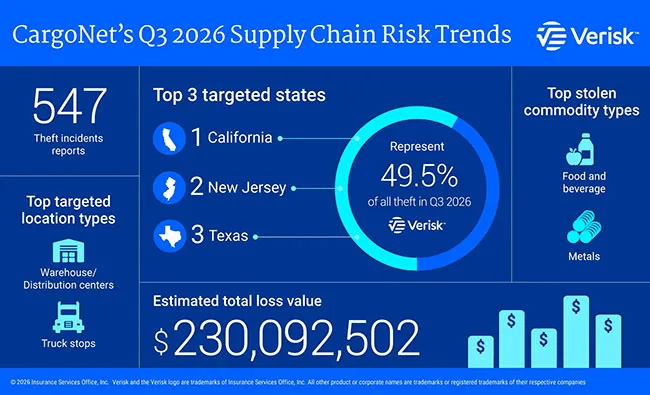
(CargoNet)
The Overhaul United States Q3-2026 Cargo Theft Report found that cargo theft incidents declined 8% from the prior year to 629. The report also found that the most stolen product type was electronics at 23.3%, followed by food and beverage at 13.5% and miscellaneous at 10.2%. Pilferage remained the most common event type, accounting for 32.9% of incidents.
“There’s a continual trend of just extreme high-value theft, specifically around AI infrastructure shipments,” said Ron Greene, executive vice president of risk and intelligence at Overhaul. “We’re seeing every week very large thefts, to the tune of tens of millions of dollars per load, which is skewing the averages.”
Overhaul warned that criminal groups continue to adapt their strategies, including an emerging form of spoofing in which criminals disguise their trucks with fake decals and operating authorities to steal a load. Greene also highlighted what is known as polycriminality, which involves criminal networks cooperating rather than specializing in a single illicit activity.
“What’s happening at the highest levels of law enforcement around the world [is] they’re seeing criminal operations diversifying, criminal operators strategizing and collaborating with other criminal groups, which is a new phenomenon in the world,” Greene said.
Ryan Kiefer, a director with the special investigations group at Travelers, has also seen criminal groups become more willing to cooperate. More significantly, he warned that the increased focus on high-value loads has been driven by criminals gaining a greater ability to target specific commodities, especially cargo associated with metals and data centers.
“What we’re seeing is a pattern where strategic theft is being used more for specific commodities, some of those being the higher-value ones,” Kiefer said. “So where you would still see food and beverage as the most stolen [in the CargoNet report], the data center equipment thefts seem to be more strategically driven than straight theft driven.”
Bob Toews, CEO of TruckDown, discusses winter readiness in the connected fleet era. Tune in above or by going to RoadSigns.ttnews.com.
Kiefer pointed out that some long-term trends remain despite these changes, such as traditional straight thefts being the primary driver of activity across the country, even as strategic thefts become more prevalent.
“In the U.S., we’re seeing a lot of strategic theft and fraud,” said Tony Pelli, director of supply chain security and resilience at BSI Consulting. “We don’t have a single client who has not been impacted by what’s being called strategic theft, or freight fraud, where you have these double-brokering schemes, or you have transfers of [motor carrier] numbers to bad actors.”
RELATED: What to expect from Congress' lame-duck session
Pelli also noted cases in which criminals were running legitimate trucking companies as fronts to steal products. The Department of Transportation has cracked down on carriers and drivers with questionable credentials over the past year. But Pelli hasn’t yet seen much impact from that enforcement on cargo theft, though he is optimistic it could happen down the road.
“It doesn’t seem like the enforcement within the current law is helping a whole lot,” Pelli said. “There’s some legislation that’s being proposed, like CORCA, for example, the Combating Organized Retail Crime Act, which would help and give DOT more authority.”


