[Stay on top of transportation news: Get TTNews in your inbox.]
Toyota sets up robot unit as carmakers push new technology
Japanese automaker raises profit forecast
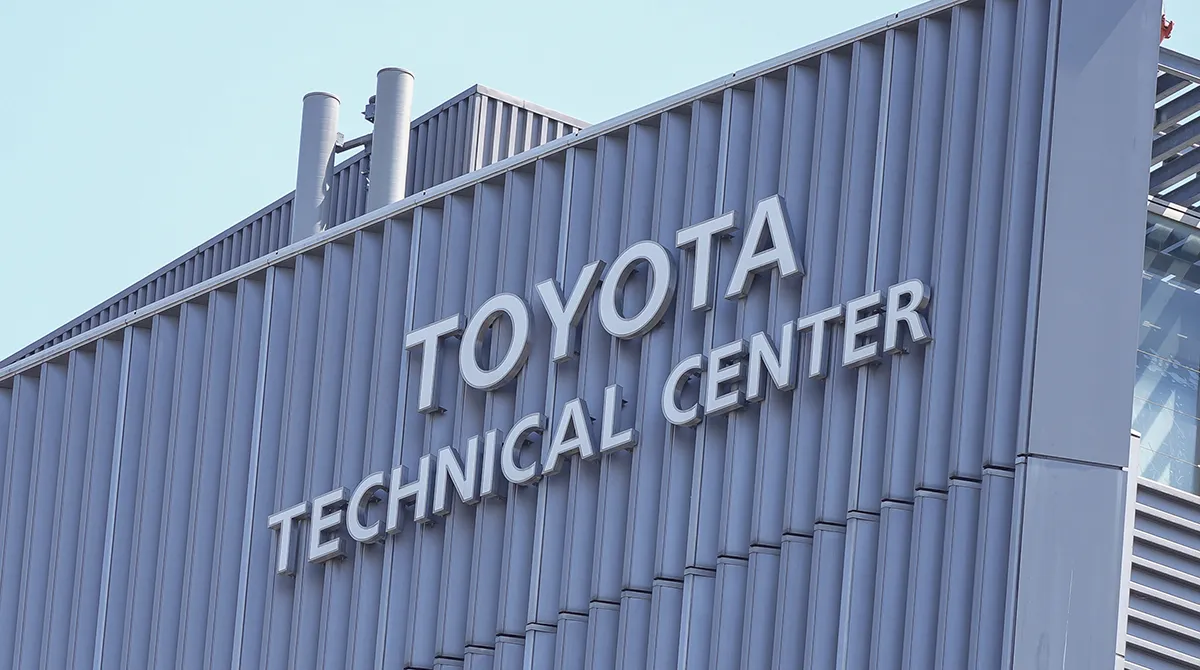 The Toyota Technical Center in Toyota, Aichi Prefecture, Japan. (Toru Hanai/Bloomberg)
Key Takeaways:
- Toyota established a dedicated robotics department led by chief production officer Takefumi Shiga to accelerate commercialization and deployment.
- Toyota raised its annual operating profit forecast 15% to 3.9 trillion yen as quarterly earnings rose 34% on strong hybrid demand.
- Toyota plans a new Shanghai factory producing Lexus EVs beginning in late 2027 while targeting 18-month development cycles.
Toyota Motor Corp. set up a dedicated robotics department as the Japanese carmaker joins major global rivals in building out the technology.
The division will be led by chief production officer Takefumi Shiga to accelerate the practical application, commercialization, and deployment of robots on the front lines, the carmaker said in a statement. The move consolidates the company’s robotics efforts under a single organizational structure, it said.
Toyota joins a growing roster of major carmakers betting that expertise in manufacturing and motion control can give them an edge in humanoid and industrial robotics development.
Hyundai Motor Co., which owns Boston Dynamics, has positioned robotics as a core growth pillar, while China’s BYD Co. has also signaled investment in robotic systems as automakers look beyond the vehicle market.
Toyota raises profit outlook
Toyota Motor Corp. shares climbed the most in nearly four decades after the automaker, emboldened by strong demand for its hybrid vehicles, raised annual profit forecast and stepped up shareholder returns.
The world’s largest carmaker raised its operating income forecast by 15% to 3.9 trillion yen ($24.7 billion) for the fiscal year ending March 2027, it said Nov. 5. For the three months ended September, earnings rose 34% to a higher-than-estimated 1.1 trillion yen, the first gain in six quarters.
Coupled with an expansion of its buyback program, the bullish outlook helped ease concerns about slumping demand in China, the war in Iran and U.S. tariffs.
Toyota jumped more than 16% in Tokyo, the biggest gain since 1987. The stock had already been up ahead of earnings on investor optimism that President Donald Trump’s tariffs could be eased after Democrats swept the midterm elections. But the strong results supercharged the gains.
Toyota’s financial resilience is remarkable given all the headwinds it faces, said Bloomberg Intelligence senior auto analyst Tatsuo Yoshida. “Compared with other Japanese automakers, Toyota has relatively few obvious weaknesses,” he said.
Toyota expanded its buyback program to as much as 1.3 trillion yen in stock, and the carmaker is allocating as much as 14 trillion yen for shareholder returns over the next five years.
Mitsui Sumitomo Insurance Co., Aioi Nissay Dowa Insurance Co., Tokio Marine & Nichido Fire Insurance Co. and Sompo Japan Insurance Inc. have agreed to tender their shares.
Cost reductions helped reduce the effects of rising material costs and the prolonged conflict in the Middle East, said Chief Accounting Officer Takanori Azuma.
China challenges
Still, “competition from Chinese automakers remains a major challenge, not only in China but increasingly in overseas markets as well,” BI’s Yoshida said.
The Toyota group’s annual sales target was reduced to 10.99 million units, compared with its previous forecast for 11.18 million.
The outlook was downgraded as Toyota faces an ongoing slump in China, where foreign brands have continued to lose ground to local manufacturers led by BYD Co. The outlook for that market isn’t bright, with the Passenger Car Association estimating industry sales there to tumble 22% this year before inching up 2% in 2027.

Bob Toews, CEO of TruckDown, discusses winter readiness in the connected fleet era. Tune in above or by going to RoadSigns.ttnews.com.
Earlier this week, Toyota said it’s planning to debut the next generation of its popular Corolla in China. Executives have also hinted at making an all-electric variant, which would be a major pivot for the world’s best-selling car of all time.
Toyota is trying to reverse the tide by building a new factory in Shanghai, where it will produce EVs under the Lexus brand beginning in late 2027.
Production will begin in September and the goal will be to reduce development time to 18 months, Chief Financial Officer Yoichi Miyazaki said.
Written by Phoebe Sedgman and Nicholas Takahashi. This story was produced with the assistance of Bloomberg Automation.