
[Stay on top of transportation news: Get TTNews in your inbox.]
Tesla to wind down Cybertruck production in Texas next year
It's unclear whether Cybertruck production would be switched to another factory or phased out completely
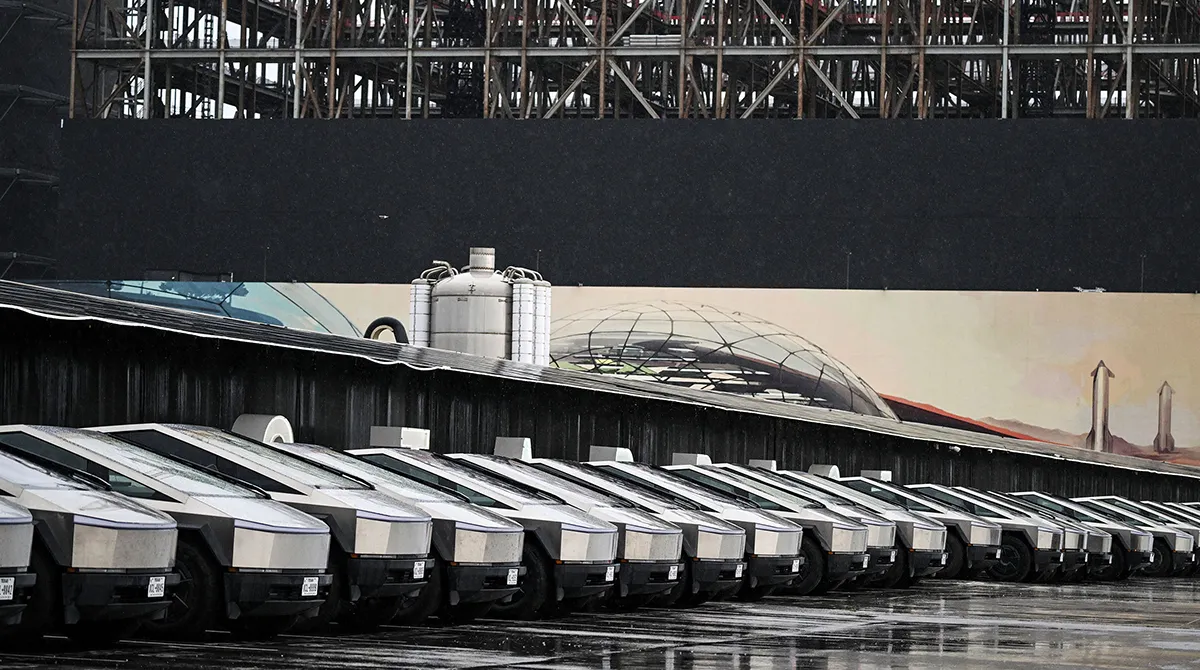 Tesla Cybertrucks outside a SpaceX facility in Starbase, Texas. (Ronaldo Schemidt/AFP/Getty Images/Bloomberg)
Key Takeaways:
- Tesla is scaling back Cybertruck production: The company plans to wind down production at its Texas factory around mid-2027, freeing capacity for increased Cybercab output.
- Cybertruck demand fell well short of Musk’s ambitions: Musk once suggested annual production could exceed 250,000, but first-year sales were less than one-sixth of that level.
- Cybercab is becoming a bigger priority: Tesla is shifting resources toward the two-seat autonomous vehicle, a key piece of its strategy to expand beyond conventional EVs into robotaxis and AI.
Tesla Inc. will pare back production of its polarizing Cybertruck at its Texas plant from mid-2027 to free up capacity for the Cybercab, according to CEO Elon Musk.
READ MORE: Tesla’s Cybertruck could be as big a flop as the Ford Edsel
Tesla began building the distinctive electric pickup at its factory near Austin in 2023, but it struggled to sustain demand and grappled with multiple recalls. It wasn’t immediately clear from Musk’s post on social media Nov. 6 whether Cybertruck production would be switched to another factory or phased out completely.
Tesla began making the gold-colored, two-seat Cybercab, designed for the company’s Robotaxi service, at the Austin factory this year. It’s seen as a key component of the company’s plan to evolve beyond a maker of EVs into a leader of artificial intelligence products, including humanoid robots.
The angular and unconventional Cybertruck has divided opinion since Musk first unveiled a prototype in 2019.
He called it the company’s best product ever and estimated Tesla might build more than 250,000 annually, depending on demand. It sold less than one-sixth of that number in its first year.


