
[Stay on top of transportation news: Get TTNews in your inbox.]
Strathcona, CN Railway plan crude-by-rail link
Northern Express would carry 250,000 barrels a day to the British Columbia coast
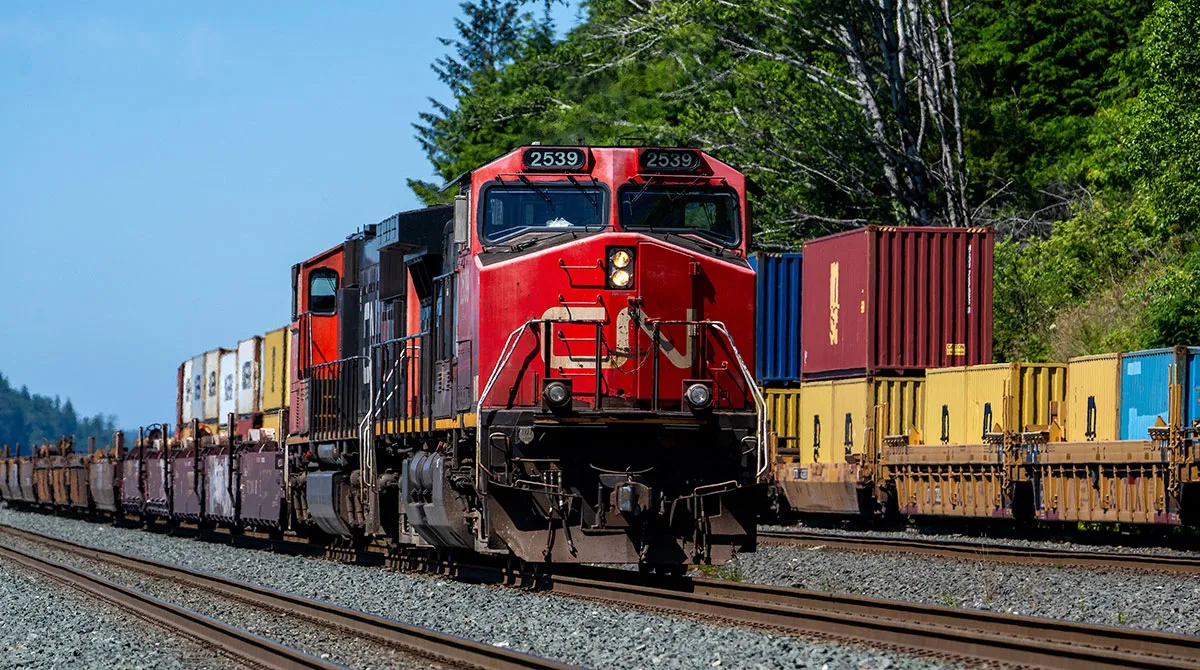 A Canadian National Railway locomotive and railcars at the Port of Prince Rupert, British Columbia. (James MacDonald/Bloomberg)
Key Takeaways:
- Strathcona Resources and Canadian National Railway plan a C$2.5 billion to C$3.5 billion crude-by-rail link to Prince Rupert, British Columbia.
- Northern Express would transport 250,000 barrels daily and could diversify Canadian oil exports before the proposed Pacific Link pipeline begins operating.
- The project requires regulatory approval and faces a federal tanker ban and Indigenous opposition, though Strathcona seeks national-interest designation.
One of Canada’s largest oil producers and main railway operators are moving forward with a plan to ship crude oil to the northern British Columbia coast.
Strathcona Resources and Canadian National Railway Co. are partnering on a project estimated at C$2.5 billion to C$3.5 billion to create a 250,000-barrel-a-day crude-by-rail link to Prince Rupert, according to a statement.
Strathcona Executive Chairman Adam Waterous is fresh off of engineering the acquisition of Greenfire Resources, making his firm into the fourth-largest oil producer in Canada. He is now shifting his focus to a project called Northern Express, pitching it as a fast, cost-effective way crude can be exported by tanker off a yet-to-be-constructed tanker terminal to markets in Asia.
His proposal would be in addition to the Canadian and Alberta governments’ C$43.7 billion plan to build a new million-barrel-a-day pipeline called Pacific Link to southern British Columbia, part of Prime Minister Mark Carney’s bid to expand and diversify oil exports away from the U.S. It also has to overcome significant hurdles in a federal ban on oil tankers off the northern British Columbia coast and opposition from some Indigenous groups.
RELATED: Canada charts transportation routes beyond U.S.
Waterous has spent almost a decade building Strathcona through a series of merger and acquisitions that culminated in the Nov. 8 announcement to buy Greenfire, a company he also chairs.
“One of the reasons we are doing this is we are trying to get economies of scale,” Waterous said. “One of the attractions for combining Strathcona and Greenfire is that, as we build scale, the capital investments become quite large. The Northern Express is a multibillion dollar capital investment, which we think is compelling.”
Image

Adam Waterous, Strathcona executive chairman. (Todd Korol/Bloomberg)
Waterous is also the chair of private equity firm Waterous Energy Fund, and he is looking to raise another $1 billion for investing into Canada’s oil sector.
The combination with Greenfire will make Strathcona into an oil producer slightly larger than ExxonMobil Holding Corp.’s Imperial Oil by oil volumes produced, according to Alberta and Saskatchewan production data posted on the Petrinex website.
The proposed new rail project could be operational within two years, once it receives regulatory approval, according to the statement. The line would provide some additional exports off the Pacific coast before Pacific Link comes into operation in about eight years time.
Strathcona and CN are seeking to have their plan classified by the government as a project of national interest, Waterous said. Strathcona is already a major crude-by-rail shipper, sending as much as 80,000 barrels a day of its own and other companies’ crude south to the U.S. Gulf Coast.
CN “supports projects that help bring Canadian natural resources to market and diversify our trade opportunities,” a spokesperson said in a statement. “We look forward to working with Strathcona to advance their project in collaboration with stakeholders and rightsholders.”
A spokesperson for Carney’s government didn’t immediately respond to a request for comment.
Northern Express has major obstacles. Many Indigenous coastal communities have strongly opposed crude oil exports off of northern British Columbia. The federal government has also imposed a ban on oil tankers along the northern coast since 2019, something Carney has maintained.
Waterous said the rail project will eventually be open to First Nation equity ownership as well as participation in other ways including procurement and employment.
Carney had suggested last year that the tanker ban could be adjusted when work first started on planning a new oil pipeline to the Pacific. The same could be applied to the rail project, Waterous said, adding his team has met with the representatives of the federal government multiple times in recent weeks to discuss the idea.
“They wouldn’t take multiple meetings if there wasn’t some chance of this obviously happening, of course,” he said.
The federal government confirmed it has met with Strathcona to discuss investment opportunities.
“Strathcona Resources has raised ideas to this effect at a high level,” said Charlotte Power, spokeswoman for the minister of energy and natural resources. However, the government meetings should “not be interpreted as an endorsement of any project proposal,” she said.


