
[Stay on top of transportation news: Get TTNews in your inbox.]
Railroad merger opponents lobby White House
Agriculture and chemical industries believe Norfolk Southern-Union Pacific merger would increase affordability pressures
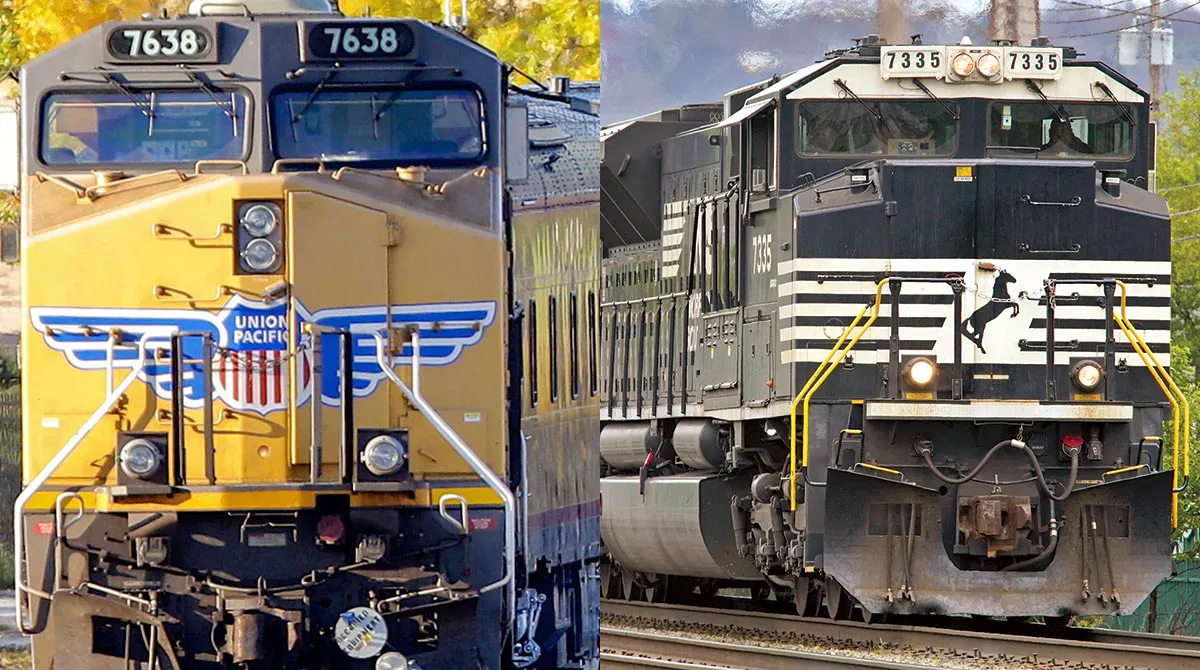 (Union Pacific by Nati Harnik/Associated Press; Norfolk Southern by Gene J. Puskar/Associated Press)
Key Takeaways:
- Shippers and labor unions lobbied the White House to oppose the proposed $72 billion Union Pacific-Norfolk Southern merger, arguing it could increase transportation costs across the economy.
- The deal would create the first coast-to-coast U.S. freight railroad and faces scrutiny from the Surface Transportation Board, which must determine whether it improves competition.
- After rejecting an effort to block the merger outright Sept. 18, the STB set a review schedule with a decision expected in early spring.
In their quest to block a $72 billion merger between two of the biggest U.S. freight railroads, a coalition of shippers and labor unions is trying to get President Donald Trump on their side.
At a White House meeting last month with Trump’s chief of staff, Susie Wiles, representatives from the agriculture and chemical industries pressed their case that the proposed tie-up of Union Pacific Corp. and Norfolk Southern Corp. would increase affordability pressures throughout the economy, according to people familiar with the matter. The combined company, they argue, would have outsize pricing power that would raise the cost of moving all sorts of goods across the U.S.
READ MORE: Union Pacific-Norfolk Southern rail merger faces resistance
The previously unreported meeting shows the urgency among opponents to doom one of the largest potential deals of the last decade.
It’s also hardly a sure thing to pay off. Rail deals are evaluated by a relatively obscure independent regulator, the Surface Transportation Board. And while Trump has made stepping on the autonomy of such agencies one of the projects of his presidency, he’s previously suggested he’d support the transaction to create the country’s first true transcontinental railroad — if the U.S. government had a stake in it.
Those dynamics have left all sides with deep uncertainty about the fate of a deal that’s expected to trigger further consolidation in the freight rail sector — and that industry experts say likely wouldn’t have even been attempted under another administration.
On Sept. 18, the STB rejected a bid by merger opponents to block the tie-up outright, setting a schedule that will see a decision in early spring. In a written opinion accompanying the ruling, one of the commission’s Republican members warned that the companies “still have a long way to go to show that the transaction is in the public interest.”
Coast-to-coast railway
Union Pacific and Norfolk Southern announced their plans to merge in July 2025, heralding the tie-up as the first coast-to-coast railway to provide better reach for shippers and move millions of truckloads of goods off congested highways. The two companies operate in more than 40 states and together accounted for 43% of rail freight by carload shipped in 2024, according to a Michigan State University analysis.
Image

Unlike in most industries where such a plan would be scrutinized by either the Justice Department or Federal Trade Commission, the Union Pacific-Norfolk Southern deal is subject to approval from the Surface Transportation Board.
The regulator is required to determine whether railroad mergers are in the public interest. The Justice Department can offer views to the STB but lacks the ability to otherwise challenge proposed mergers between railroads, as do state attorneys general who jointly enforce federal antitrust laws.
Still, several states have weighed in on the deal. Last month, the Republican attorneys general of seven states — Montana, Iowa, Kansas, Florida, North Dakota, South Dakota and Tennessee — urged the agency to block it.
Texas Attorney General Ken Paxton, a Trump ally who is running for the Senate in the November elections, separately commented on the deal, outlining how the agency might use its authority to reject the proposed combination.
Union Pacific purchased multiple ads at the Republicans’ midterm convention this month to promote its deal in a bid to mobilize more of the party’s elected officials to support the merger.
A Union Pacific spokeswoman said the company is confident the merger will be approved, and that the deal “will strengthen the nation’s supply chain by eliminating time-consuming rail interchanges, which will improve service for shippers and reduce costs for consumers.”
Merging the two companies will force rivals to “compete harder on service, reliability and price,” she said. “That is the very definition of enhanced competition and a better outcome for customers.”
People familiar with the matter said there hasn’t yet been any sign that Trump or his aides are trying to influence the outcome of the STB’s review.
Still, Trump has taken a historically expansive view of the president’s power. And intrigue around the merger has been fueled by the administration’s often contradictory approach to big business.
Trump, with the approval of the Republican Congress, has slashed corporate taxes and rolled back regulations. But he has also demanded equity stakes from private companies and castigated entire industries over prices. The administration has cozied up to some elements of organized labor, especially the Teamsters, whose two rail affiliate unions staunchly oppose the merger.
Some observers wondered in the fall of 2025 if Union Pacific was on a fast track to approval, after Trump and Union Pacific CEO Jim Vena met in the Oval Office.
But the STB and its chairman, Trump-appointed Patrick Fuchs, a rail expert who served on the board under the Biden administration, so far have taken a deliberative approach.
Image

Farmer
Opponents of the merger say time is on their side, and that their warning that the deal would lead to higher prices is salient with Washington lawmakers who expect the upcoming midterm elections to turn on cost-of-living issues.
And they point out that Vena isn’t the only CEO with Trump’s ear. Katie Farmer, the CEO of BNSF Railway, a major opponent of the deal, treated the president to a ride aboard one of the company’s trains in North Dakota to celebrate the opening of the Theodore Roosevelt Presidential Library earlier this year.
Competition case
The critical question for approval lies in the rules that STB adopted after a previous round of mergers that left the government and Congress concerned about over-consolidation in the industry. Since those rules were adopted, merger candidates haven’t only had to make a case that a deal wouldn’t harm competition, but that it would improve competition in the freight rail market.
Image

Vena
Anthony Hatch, a veteran freight rail analyst, said Union Pacific appears prepared to argue that its merger will help the transcontinental network compete with trucking. But the board may be looking for an argument that the tie-up won’t reduce competition among railroads themselves.
Union Pacific “is sort of gambling here with that definition,” he said. “‘You call us a monopoly, but we have lost share to the highways.’”
Hatch said he expects the deal will be approved on the merits in late 2027.
Martin Oberman, who served as STB chairman under President Joe Biden, said there weren’t political incentives for Trump to force a deal through — given opposition from Republican politicians and business groups — and little chance that he could do so given the makeup of the board.
“The board members and staff at the STB are people of independence and great integrity, and they will make their decision based on an extensive public record,” Oberman said in an interview. “I find it impossible to imagine them being swayed by any form of political influence whatsoever.”

Arpan Podduturi of Samsara examines how AI, telematics and onboard cameras are converging to protect drivers and reduce risk. Tune in above or by going to RoadSigns.ttnews.com.
Vena, the Union Pacific CEO, has projected confidence that the railroad’s argument for the merger will prevail.
Counterparts in Canada go “across the entire country, and there’s a reason why they haven’t applied to the Canadian equivalent to the STB to split their railroad up there, both of them, because it doesn’t make a particle of sense,” Vena said on a second-quarter earnings call. “It hurts customers, hurts the country. So this deal will close.”


