
[Stay on top of transportation news: Get TTNews in your inbox.]
Executive Q&A with Penske’s Sherry Sanger
Leader emphasizes user needs, data quality and a defined improvement to guide investment
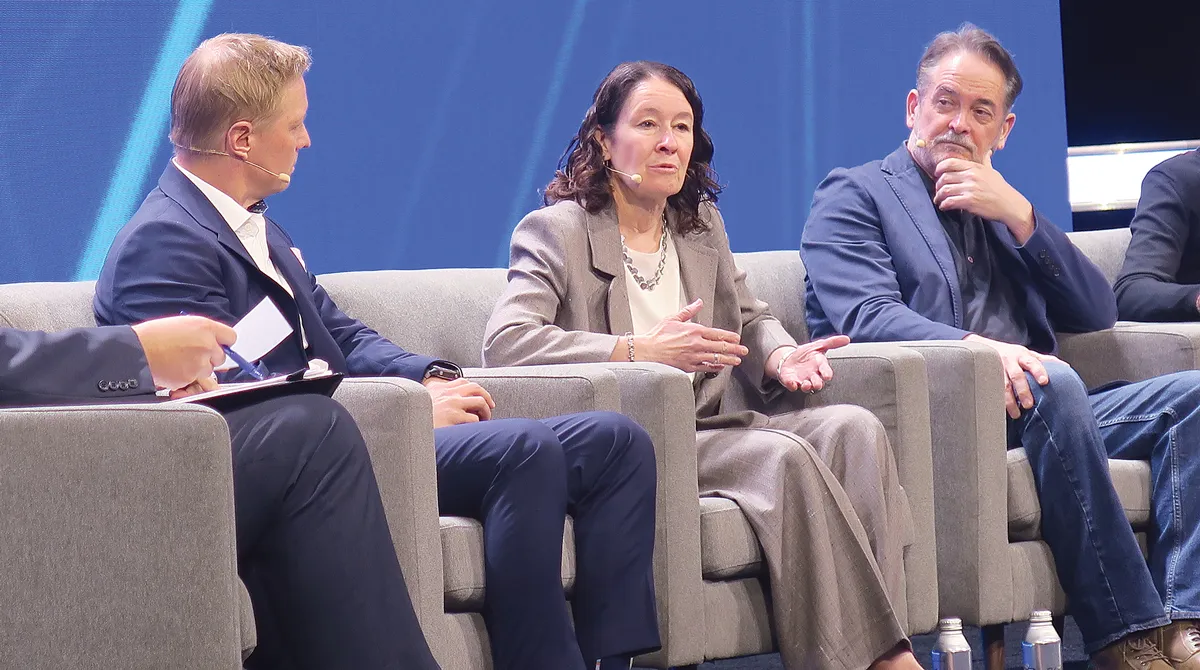 Sanger appears alongside Coretura’s Johan Lunden (left) and Platform Science’s Jack Kennedy at ACT Expo 2026. (Seth Clevenger/Transport Topics)
Key Takeaways:
- Penske is using AI today to identify maintenance needs and contextualize fleet performance, says Sherry Sanger, executive vice president of strategy and marketing.
- Sanger says connecting inconsistent data across equipment, telematics and customer systems remains a major barrier to dependable AI adoption in trucking.
- Over the next three to five years, Sanger expects AI to help transportation teams anticipate disruptions, evaluate operational trade-offs and access specialized knowledge.
Sherry Sanger, executive vice president of strategy and marketing at Penske Transportation Solutions, explains how artificial intelligence is enhancing fleet and maintenance operations.
Q: Penske has been investing in AI across multiple areas of its business. Where are you seeing the most meaningful results today?
A: We are seeing the greatest value when AI helps people understand an operating problem early enough to do something about it. Transportation and supply chain professionals make decisions every day that affect equipment, employees and customer commitments, often while working through information spread across several systems. AI can bring that information together and reveal relationships that would otherwise take considerable time and experience to uncover.
Across our business, that is helping us put fleet performance into context, identify developing maintenance needs and give people a clearer understanding of where an operation needs attention. The significance extends beyond any individual application. When a manager can understand why equipment is underused, for example, that knowledge can inform decisions about capacity, scheduling, and how the business serves its customers.
Q: Penske collects a massive amount of data given the size and scope of its operations and the number of vehicles it maintains, leases and operates. How is that data fueling Penske’s AI initiatives?
A: The value of our data comes from its connection to actual operating experience. We can look at how a vehicle was used, the conditions it encountered, the work performed on it, and what happened afterward. Those connections help us understand which signals matter and whether there’s a pattern with a practical and actionable meaning.
Fleet benchmarking illustrates the point. A fuel economy number has limited value until a manager understands what performance is reasonable for vehicles doing comparable work. Catalyst AI, Penske’s AI-powered fleet benchmarking tool, applies that context to help customers recognize meaningful differences and investigate the reasons behind them.
The larger opportunity for the industry is to use data to anticipate needs and improve how equipment, people and freight work together.
Image
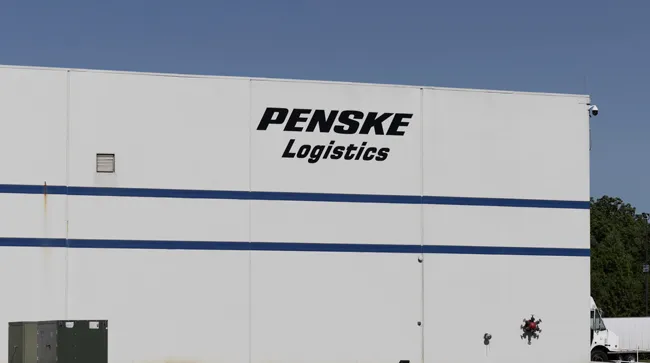
A Penske Logistics location in Tipp City, Ohio. (jetcityimage/Getty Images)
Q: Many trucking and logistics companies are moving from AI experimentation to implementation. What distinguishes businesses that are successfully operationalizing AI today? And what lessons have emerged from early AI deployments?
A: Successful companies understand the work well enough to know what needs to change and whether AI is the right tool for the problem. They can see the opportunities more clearly by identifying the person who will use a capability, the problem that person faces and the improvement that would make the investment worthwhile. That clarity gives an AI initiative a purpose that can carry it through development and into daily use. They also make data quality a priority from the beginning, with clear responsibility for ensuring that the information behind the recommendation is accurate, consistent and relevant to the decision it will support.
One of our most important lessons is that getting closer to the customer helps us learn faster. Observing how customers respond to an early idea reveals practical needs that can be difficult to recognize until they begin using a tool.
Q: As AI becomes more deeply embedded in transportation operations, how do you balance automation and human expertise, particularly in maintenance and fleet operations?
A: The balance depends on what is being decided and the potential impact of the decision. In transportation, a recommendation can affect a vehicle’s availability, a driver’s day or a customer’s ability to keep an operation running. Leaders have to understand those consequences when deciding which tasks can be automated and where people must retain control of the decision.
AI can help a maintenance professional or fleet manager consider far more information than would otherwise be possible, but that person also brings knowledge of the situation that may never be fully captured in the data. AI becomes more useful when it gives people enough evidence to understand a recommendation and apply their own experience.
PCS Software CEO Mark Hill discusses the advance of AI in the trucking industry. Tune in above or by going to RoadSigns.ttnews.com.
Q: What are the biggest barriers slowing AI adoption in trucking today, whether it’s data quality, organizational readiness, workforce concerns or something else?
A: One of the industry’s biggest challenges is bringing new capabilities into a business that already runs through many different systems. A fleet may use equipment from several manufacturers, work with multiple telematics providers, and exchange information with customers utilizing diverse systems. Before AI can provide a dependable view of that operation, the information has to be connected and made consistent enough to use.
That work requires resources and commitment, which makes the business case especially important. Companies need to understand how an investment will improve service, productivity, or the use of their assets, along with the effort required to integrate it and prepare people to use it.
Employees also need a clear understanding of how their work will change. Involving them early helps identify practical problems and gives them a role in shaping the solution.
Q: Looking ahead 3-5 years, which use cases for AI do you believe will be the most transformative for trucking operations and supply chains?
A: I believe some of the most significant advances will come from helping people understand how decisions affect the wider operation. Transportation operations and supply chains are deeply interconnected, which means a decision that improves one part of an operation can create pressures elsewhere. AI can help make those trade-offs clearer so that a change in equipment availability, a service requirement or a shipment delay can be understood in terms of what it means for the business.
That creates the possibility of greater foresight. A transportation team could evaluate how a developing disruption might affect capacity, staffing and customer commitments, then consider its options while there is still time to influence the outcome.
The other significant opportunity is making specialized knowledge more widely available. Much of this industry’s expertise has been built through decades of experience, and AI offers a way to bring more of it into everyday work.
Ultimately, progress should give the people responsible for moving goods more ability to shape what happens next.


