
[Stay on top of transportation news: Get TTNews in your inbox.]
Oil prices swing as vessel attacks reported around Hormuz
Brent crude falls 49 cents to $92.93 a barrel
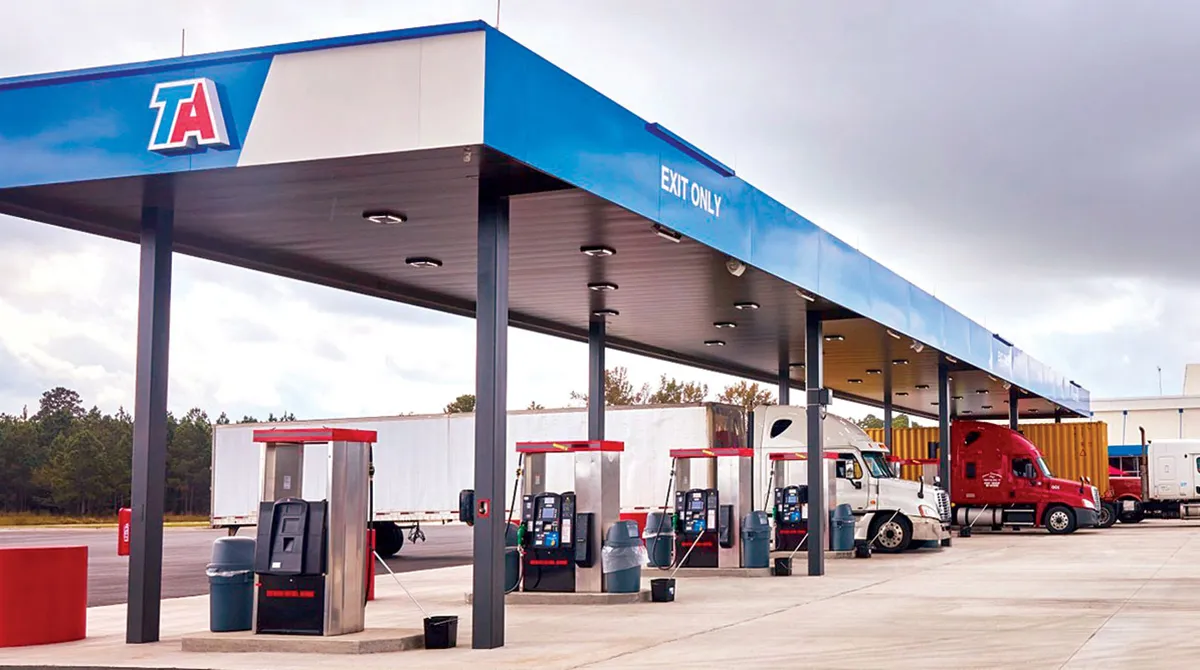 (TravelCenters of America via Facebook)
Key Takeaways:
- Brent crude hovered near $93 a barrel Nov. 17 as Middle East attacks competed with signs global oil supplies are outpacing demand.
- Oil flows through Hormuz jumped 78% in the third quarter, while the IEA forecast a roughly 2 million-barrel-a-day surplus this quarter.
- Risks remain as Iran threatened retaliation against civilian infrastructure and attacks on vessels continued around the Strait of Hormuz.
Oil swung between gains and losses as traders weighed flareups in the Middle East against signs supplies are outpacing demand.
Brent edged up near $93 a barrel, after earlier losing as much as 1.3%. In energy markets early Nov. 17, the price of Brent crude, the international standard, edged 49 cents lower to $92.93 a barrel. U.S. benchmark crude oil slid 51 cents to $86.23 per barrel.
Vessel attacks were reported in and around the Strait of Hormuz and Tehran targeted Bahrain for the third time in less than a week, aiming for a U.S. radar system.
Prices have plunged this month on strong supplies from the Middle East and as President Donald Trump remained reluctant to order mass attacks on Iran after the Democrats’ midterm victory. Vice President JD Vance told Fox News the U.S. wouldn’t allow the war to become an extended commitment and ruled out even a two-year involvement. “We’re not going to stay there forever,” he said.
“Given the robust oil flows from the Middle East over the past few weeks, oil prices have been under pressure even as Iranian attacks on tankers continue,” said Hamad Hussain, a senior economist at Capital Economics Ltd.
Risks still remain. Iran threatened to retaliate against civilian infrastructure near U.S. or Israeli military bases in retaliation for strikes on similar sites in the Islamic Republic. Major attacks on civilian infrastructure would represent an escalation of the war. Also, a third U.S. aircraft carrier strike group arrived Nov. 16 in the Persian Gulf region, giving Trump more military options.
20261117 UKMTO WARNING 209-26 #MaritimeSecurity #MarSec https://t.co/HttvX8HYuv
— UKMTO Operations Centre (@UK_MTO) November 17, 2026
Adding to tensions, U.S. intelligence indicated Iran was developing plans to target senior Trump administration officials by detonating a so-called dirty bomb or chemical weapon in Washington, CNN reported. A White House spokesperson told the station there are currently no credible threats.
In the Middle East, U.K. Maritime Trade Operations on Nov. 17 said a tanker that was hit on Nov. 16 north of Oman’s Khasab sustained a second strike, with the crew currently unaccounted for, in yet another sign of the risks to energy transits in the region. Iran also claimed that three ships hit mines near Hormuz on Nov. 17.
While Brent is up more than 50% this year, the global benchmark has slid from a six-month high set in late October as the market absorbs recovering supplies. Prices dropped 3.6% on Nov. 16, and are near the lowest since August.
Some traders appear to be “bottom fishing,” seeing an opportunity to buy oil at a bargain after the selloff, said Arne Lohmann Rasmussen, chief analyst at Global Risk Management. “But in general, a very nervous market.”
Oil flows through Hormuz jumped 78% in the third quarter to 9.1 million barrels a day from the previous three-month period, although they remain well below year-earlier levels, according to the U.S. Energy Information Administration. Saudi Arabian output surged in October, while the kingdom and the United Arab Emirates have both cut official selling prices.
The International Energy Agency has forecast a roughly 2 million-barrels-a-day surplus this quarter, while Goldman Sachs Group Inc. has flagged the risk of a glut next year.

Bob Toews, CEO of TruckDown, discusses winter readiness in the connected fleet era. Tune in above or by going to RoadSigns.ttnews.com.
In a sign that near-term supply conditions have become less tight, Brent’s prompt spread — the difference between its two nearest contracts — has narrowed. The gap was $2.43 a barrel in backwardation on Nov. 17, compared with more than $3 a month ago.
In the US, gasoline pump prices have fallen to the lowest since March, a welcome relief to US consumers. Also, average retail diesel prices have dropped below $6 a gallon for the first time since early September, easing inflationary pressures. Supplies of the key fuel had been squeezed by the impact of the U.S.-Iran war, as well as Ukrainian drone strikes on Russian refineries.


