[Stay on top of transportation news: Get TTNews in your inbox.]
Oil prices drop on robust supply
Brent crude falls 0.6% to $91.44 a barrel
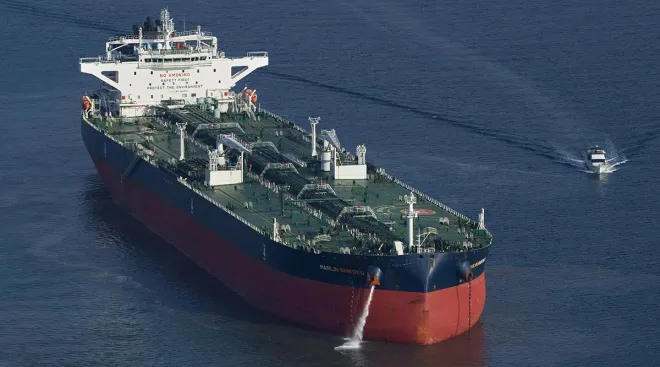
 Oil tankers and cargo vessels remain anchored off Port Sultan Qaboos in Muscat, Oman. (Elke Scholiers/Getty Images Europe via Bloomberg)
Key Takeaways:
- Oil headed for a third weekly decline, with Brent down more than 4% this week and trading below $92 a barrel.
- Robust Middle East exports and forecasts for a roughly 2 million-barrel-a-day supply surplus outweighed concerns about renewed U.S.-Iran hostilities.
- Oil could remain under pressure without fresh escalation, though uncertainty surrounding the Iran conflict may limit further declines.
Oil headed for a third weekly decline as traders weighed the risk of renewed U.S. strikes on Iran against ample supply.
Brent edged lower on Nov. 20, holding below $92 a barrel after a volatile session the day before. The global benchmark is down more than 4% this week as traders have retreated from risk assets, with signs of robust supply pulling prices lower in the absence of a major escalation in the Middle East.
Brent for January settlement fell 0.6% to $91.44 a barrel. West Texas Intermediate for January delivery, the most-active WTI contract, declined 0.4% to $82.11 a barrel. The December contract, which expires Nov. 20, fell 1% to $82.40
President Donald Trump told Axios on Nov. 19 he’s “not rushing into any decision” on Iran, while Energy Secretary Chris Wright played down concerns about exports from the region, saying on Fox News that flows through the Strait of Hormuz were at a record. The comments helped temper fears about the chances of a fresh round of U.S. strikes against the Islamic Republic.
Wider pressure in global markets has also weighed on crude this week, with a gauge of global stocks heading for its longest losing streak in more than three years and copper tumbling on nerves over the artificial intelligence trade. Treasuries rallied as investors retreated to bonds.
“Without fresh escalation, the market remains biased lower, with weakness across commodities and fragile risk appetite adding to the pressure,” said Arne Lohmann Rasmussen, chief analyst at Global Risk Management. “This is a broad-based selloff where weakening fundamentals accelerate the move in crude.”
US retail gasoline price average dropped 3.14cts/gal overnight to $3.6898/gal. All-time high water mark for Thanksgiving ($3.586/gal in 2022) now looks as though it may stand as highest cost turkey day ever. Still lots of downward price momentum.
— Tom Kloza (@TomKloza) November 20, 2026
Brent has fallen by about a fifth this month as supplies from the Middle East recovered and Trump held off on renewed strikes. Still, there’s been a recent flare-up in low-level fighting, with U.S. warplanes hitting Iran’s Qeshm Island this week and Tehran stepping up attacks on oil tankers crossing Hormuz.
At the same time, Tehran-backed Houthis continue to strike Riyadh, and regional tensions could rise further as the U.S. widens its blockade of Iran.
Despite the hostilities, crude’s retreat shows “geopolitics appears to be taking a back seat,” said Norbert Ruecker, head of economics at Julius Baer Group Ltd., pointing to robust Middle East exports and growing signs of a supply surplus. “Given today’s market realities, we are not surprised to see oil prices under pressure, and we believe this pressure is likely to persist.”
Underscoring the increasingly bearish supply picture, the International Energy Agency has forecast a roughly 2 million-barrel-a-day surplus this quarter, while Goldman Sachs Group Inc. has flagged the risk of a glut next year.
There are signs of looser fuel markets, too. European gasoil futures have fallen this week, which “really matters given the upheaval across markets amid inflation and rate-hike angst,” said Ole Sloth Hansen, head of commodity strategy at Saxo Bank. But crude may struggle to fall further “until we get solid evidence of a solution” to the Iran war, Hansen said.

Paul Rosa of Penske Truck Leasing breaks down what fleet operators need to know when EPA’s tougher 2027 NOx standard set to go into effect in January. Tune in above or by going to RoadSigns.ttnews.com.
In the U.S., average retail gasoline prices have dropped to $3.69 a gallon. That may moderate some of the public anger over high fuel bills that helped propel the Democrats to victories in the recent midterm elections.
While diesel has been slower to fall, refiners’ profits from making the fuel are dropping sharply — a sign that some factors that sent prices soaring this year may be starting to ease. So-called diesel cracks fell again on Nov. 19, shrinking to their lowest since the summer in both Europe and the U.S.