[Stay on top of transportation news: Get TTNews in your inbox.]
Lower diesel prices on U.S. export ban would be short-lived
With wars squeezing diesel supply, Trump is mulling ways to tame prices
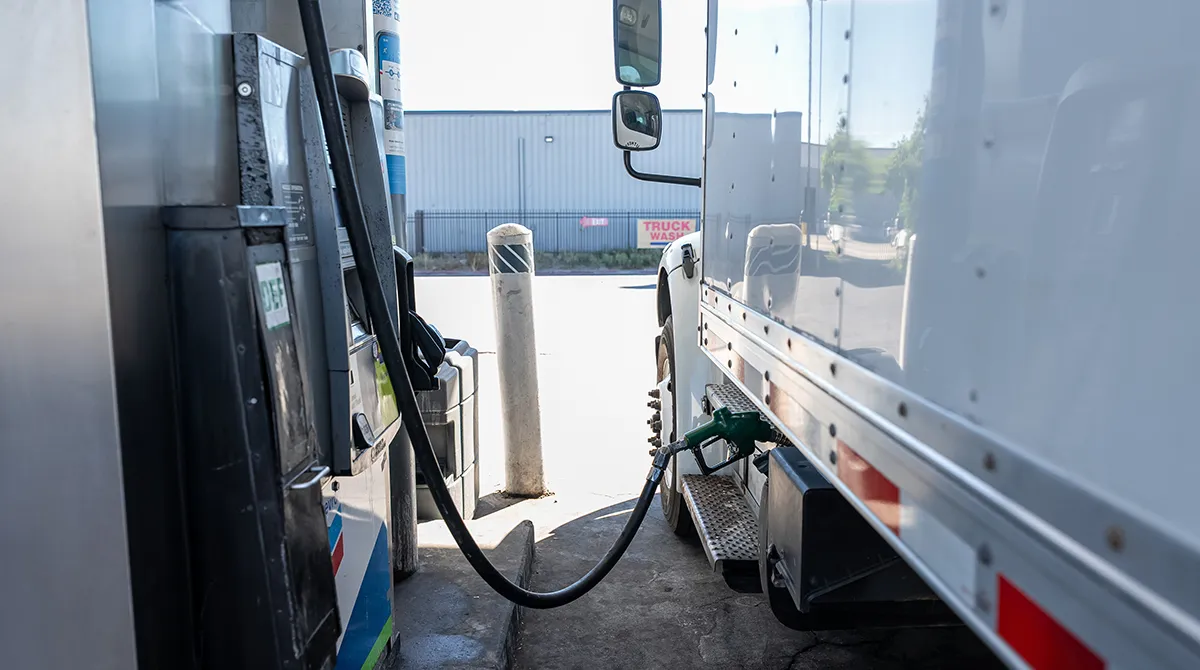 A tractor refuels with diesel at a Chevron truck stop in Tracy, Calif. (David Paul Morris/Bloomberg)
Key Takeaways:
- JPMorgan said a 30-day U.S. diesel export ban and Jones Act waiver could quickly cut retail diesel prices to about $4.70 a gallon.
- Analysts said redirected supplies would replenish record-low distillate inventories, but lower refining margins could prompt production cuts and reverse gains.
- Industry forecasts differ on timing, with storage potentially filling in three weeks to several months depending on refinery output and export restrictions.
A potential U.S. ban on diesel exports would slash domestic prices for the fuel at the outset, but the effect is likely to be short-lived, according to executives, traders and analysts.
A 30-day halt on U.S. overseas shipments combined with an existing waiver of the Jones Act — a law that requires goods shipped between American ports to be built, owned and crewed by Americans — “could work surprisingly well, at least initially,” JPMorgan Chase & Co. analysts including Natasha Kaneva wrote in a note to clients Sept. 24. Retail diesel prices would tumble to $4.70 a gallon within 15 days from record highs above $6.50 a gallon, the analysts said.
That’s because the export moratorium would push excess supplies toward the East Coast and the West Coast, which sorely need the fuel. Meanwhile, distillate fuel stockpiles, now at their lowest-ever seasonal level, would be replenished. JPMorgan projects that they would reach the five-year average within two weeks and would reach 140 million barrels after 30 days, a level last seen in 2021.
But the situation would degrade quickly after that point, the analysts warned. The economics would quickly make storage less attractive and squeeze profits, likely pushing refiners to process fewer barrels of crude oil and make less fuel of all kinds.
As war in Iran, Russia and Ukraine squeezes diesel supply, the Trump administration is mulling ways to tame prices ahead of the November midterm elections. Because the fuel is critical for freight, manufacturing, agriculture and heating, costlier diesel reverberates throughout the world’s economy. A ban on U.S. exports would hit some of the country’s key allies, including Brazil and the United Kingdom.
While President Donald Trump said he has encouraged his advisers to support an export ban, the White House denied a Politico report that it’s weighing a 90-day halt. Energy Secretary Chris Wright said the administration was looking to help the industry independently boost diesel supplies even in the absence of a government ban on foreign sales of the fuel.
API President & CEO @mj_sommers joined @kaileyleinz and @JMathieuReports on @BloombergTV to explain why diesel export restrictions would drive fuel prices higher and how permitting reform could help deliver more affordable energy for American consumers. pic.twitter.com/cVWRTVKrIN
— American Petroleum Institute (@APIenergy) September 23, 2026
Calculating how long an export ban would cut domestic diesel prices is tricky. It requires balancing the expected supply overhang — the U.S. exported 1.6 million barrels of diesel a day in August, overwhelmingly from the Gulf Coast, according to JPMorgan — with consumption, production and the ability to move fuel from the Gulf Coast to the East and West coasts. That transportation is a complicated process: Tankers can only carry so much fuel, and there are no fuel pipelines connecting Texas and Louisiana to California.
Some industry observers forecast that refilling U.S. storage could take longer than the 30 days estimated by JPMorgan, which means retail diesel prices could stay lower for longer. Citigroup Inc. said in a note that it would take “roughly two months” for distillate inventories to reach historical peak levels. Other traders have suggested about two to three months even if a blanket export ban for all fuels is enforced.
Still, others predict a shorter timeline. If exports are halted and refiners continue producing fuel at what are currently near-record rates, storage tanks will likely fill in six to eight weeks, according to a senior executive at a U.S. refiner not authorized to speak publicly about the matter. That’s why the administration is eyeing a temporary ban on exports, but if fuelmakers cut back on crude processing early on it would likely take several months or longer before tanks fill, the executive said.
On the Gulf Coast, it would likely take only four to eight weeks for storage to fill, according to Steven Barsamian, chief operating officer of The Tank Tiger, a company that brokers tank storage space among market participants.

Arpan Podduturi of Samsara examines how AI, telematics and onboard cameras are converging to protect drivers and reduce risk. Tune in above or by going to RoadSigns.ttnews.com.
Morgan Stanley analysts including Martijn Rats estimate it will take even less time, saying storage in the region would fill up within just three weeks before refineries slashed production. The amount of distillate fuel parked in Gulf Coast tanks is already above normal seasonal levels.
There’s also the possibility that refineries won’t fill storage at all because of the cost of holding onto surplus fuel, S&P Global Energy analysts including Debnil Chowdhury wrote earlier this week. Instead, they would likely cut production immediately, the analysts said.