[Stay on top of transportation news: Get TTNews in your inbox.]
Lack of empty tankers puts Gulf oil flow at risk
Empty tanker capacity has fallen about 40% since late August
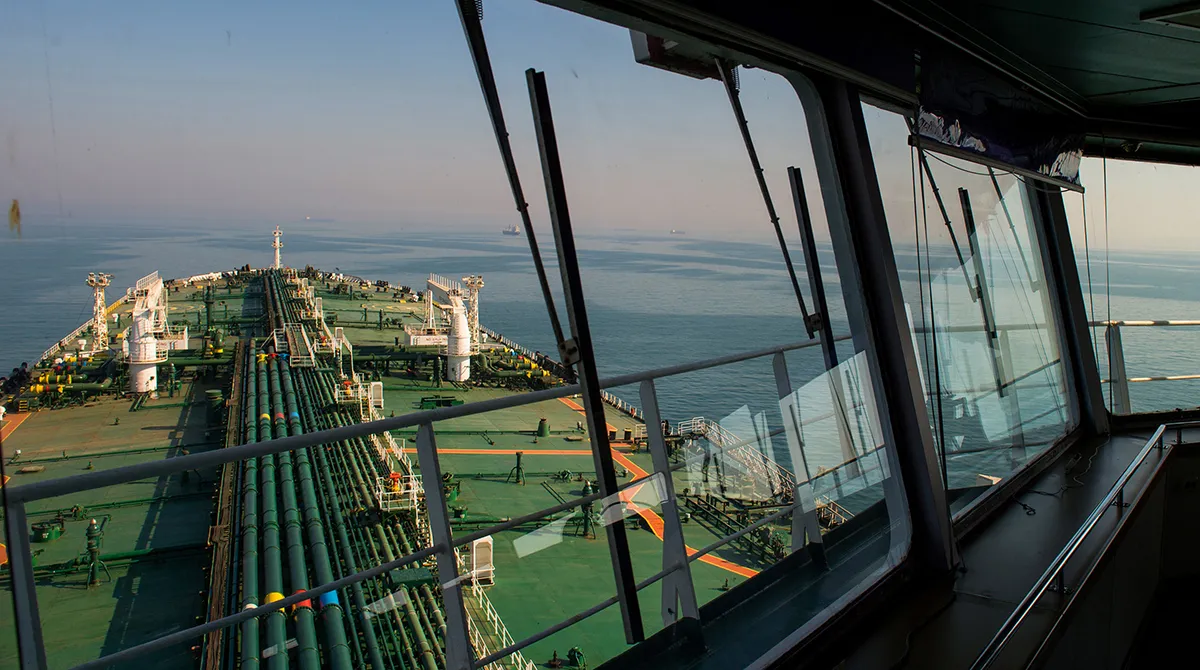 (Ali Mohammadi/Bloomberg)
Key Takeaways:
- Empty tanker capacity sailing to collect Middle East crude has fallen about 40% since late August, according to Tankertrackers.com.
- The decline raises concerns about sufficient vessels to move crude onward, even as ship-to-ship transfers outside the Persian Gulf remain high.
- A shortage of empty tankers could support freight rates while Iran’s attacks continue to deter some vessels from transiting the Strait of Hormuz.
The number of empty tankers sailing to collect cargoes of Middle East crude is sliding, a trend that could jeopardize the recent revival in the region’s oil flows to global markets, according to Tankertrackers.com, a firm that monitors vessel movements.
The industry uses two main ship types to get oil from the Persian Gulf to the world: very large crude carriers, which transport 2 million-barrel cargoes, and Suezmaxes that move about half that.
The collective capacity of those vessels sailing empty to the region has declined by about 40% since the end of August, according to Tankertrackers.com figures.
While the market is intensely focused on how much oil leaves the Middle East, those flows are only possible if there’s a steady stream of ships arriving to pick up the barrels.
The Iran war has meant that some vessels refuse to go through the Strait of Hormuz, instead receiving cargoes in locations like the Gulf of Oman from tankers that are willing to risk shuttling through the crucial waterway.
There are “not enough vacant tankers to take oil out of the region,” Tankertrackers.com’s co-founder, Samir Madani, said by WhatsApp. “It’s one thing to bring the oil out into the Gulf of Oman via the Strait of Hormuz, but it seems like there isn’t enough to take the oil out of the Gulf of Oman.”
20261116 UKMTO WARNING 208-26 - UPDATE 001 #MaritimeSecurity #MarSec https://t.co/B61knzBtPU
— UKMTO Operations Centre (@UK_MTO) November 17, 2026
In broad terms, there has been a dip in flows from the region at large so far this month, though it’s still unclear what the causes of the drop are, the exact scale of the decrease, or how long-lasting the decline will be, Madani said. For now, though, the number of ships transferring cargoes onto other ships outside the Persian Gulf remains high, enabling shipments toward customers to continue for the time being, he said.
Oil tanker rates have declined from record levels over the past few weeks, helping to reduce the cost of delivering crude to customers. Any shortage in the number of empty vessels would support rates.
Iran has attacked shipping consistently throughout the conflict, something that has deterred transits. The number of incidents reported officially jumped last month, and remains at high levels so far in November, according to data from the International Maritime Organization and the U.K. Maritime Trade Operations Centre.