
[Stay on top of transportation news: Get TTNews in your inbox.]
Narrowed Jones Act exemption slows energy cargo trade
Oil industry sources say the current waiver is a less useful transportation tool
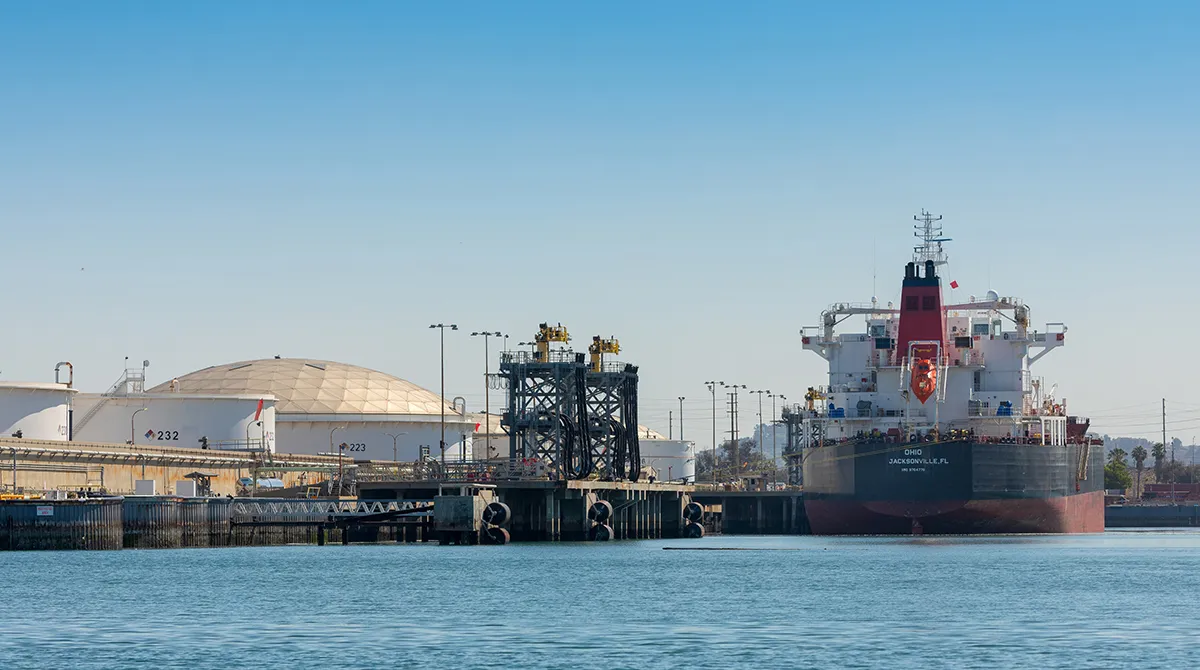 The Ohio chemical and oil products tanker unloads cargo at the Port of Long Beach in California on May 7. (Tim Rue/Bloomberg)
Key Takeaways:
- A narrowed Jones Act waiver sharply reduced foreign-flagged domestic energy shipments after Aug. 17, curbing fuel and crude movements from the Gulf Coast.
- Weekly Gulf Coast energy shipments to the East and West coasts fell by more than 500,000 barrels daily, raising pump-price concerns.
- With the waiver expiring Nov. 15, oil companies are seeking broader exemptions while maritime interests urge tighter limits.
Cargoes of American-made fuel and crude to parts of the country that badly need them have dropped in recent weeks after the White House pared back a waiver of long-standing shipping requirements, raising the risk of even higher pump prices while frustrating oil traders.
At issue is the century-old Jones Act that requires shipments between domestic ports occur on U.S.-built, flagged and manned vessels. An oil supply crunch ushered in by the Iran war prompted the White House in March to issue a sweeping temporary waiver, allowing foreign vessels to transport domestic energy shipments in an effort to cap rising prices.
But in mid-August, after pressure from shipbuilding interests and their Washington allies, the Trump administration narrowed the exemption to require case-by-case reviews of shipments. That has curbed a roaring trade that was supplying East and West coast ports with fuel produced on the U.S. Gulf Coast, as well as crude oil and products used in refining. As fuel supplies in areas such as New York and Los Angeles draw even tighter, the threat of higher pump prices is growing — while traders are bemoaning new constraints on a once-booming route.
The current iteration of the waiver is limiting the number of voyages that can occur, multiple people in the oil industry familiar with the process said, making it a significantly less useful tool to facilitate the movement of fuel, crude oil and other energy cargoes.
Foreign-flagged vessels made over 280 voyages carrying energy supplies to domestic ports under the blanket Jones Act exemptions from mid-March to mid-August, according to data from the U.S. Department of Transportation’s Maritime Administration.
Since Aug. 17, when the revised waiver went into effect, just nine energy cargoes have been transported on foreign-flagged ships, MARAD data shows.
Image
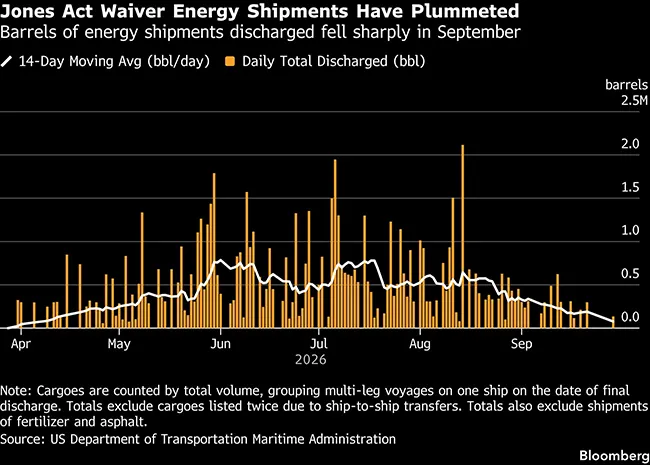
It’s a marked decline in traffic that the Trump administration had touted as an essential cost-savings measure and a key tool for stabilizing energy markets amid the Middle East conflict. Now, oil companies are pressuring the White House to formally relax the waiver again — or at least ensure case-by-case reviews don’t unnecessarily thwart cargoes — as they warn a strategy meant to help keep American energy supplies in American markets is no longer working.
“We’re sufficiently into this extension of the waiver that we can start to infer some trends,” said Colin Grabow, associate director at the Cato Institute’s Herbert A. Stiefel Center for Trade Policy Studies. “So far they seem to indicate a drop-off.”
The MARAD data may understate the volume of movements. A Bloomberg Government analysis showed that as of September, at least a dozen vessels had transported cargo without informing MARAD since the waiver was issued in March.
“The Jones Act waivers have allowed significantly more supply — including vital energy products, industrial materials and agricultural necessities — to reach U.S. ports faster,” said White House spokeswoman Taylor Rogers. “The administration has issued the waivers to provide certainty and stability for the U.S. and global economies, while also providing safeguards and support for our maritime industry.”
Weekly energy shipments from the U.S. Gulf Coast to the East and West coasts have fallen by over 500,000 barrels a day since mid-August, effectively back to pre-war levels, according to weekly totals compiled by Vortexa. Even accounting for foreign imports, this September marked the fewest arrivals of fuel and oil to the West Coast seasonally since 2020.
Foreign-flagged vessels are typically more readily available — and cheaper to use — than Jones Act-compliant vessels. Oil and gas companies, long constrained to pipeline shipments and a limited fleet of U.S.-built vessels, cheered the initial waiver.
But the sweeping exemptions also drew fierce blowback from the country’s shipbuilding industry, which sees the law as a bulwark protecting American maritime might.
The current Jones Act exemption requires a multistep pre-clearance process. Instead of simply notifying MARAD ahead of a shipment and after, shippers must first request permission to move cargo on a foreign-flagged vessel.
MARAD then surveys all shipowners with Jones Act-compliant vessels over 24 hours to ensure that the movement couldn’t occur on a U.S.-built vessel. After that, the Department of Defense reviews the results and issues a decision.
The pre-clearance process itself is slow and unwieldy, multiple people familiar said, and frequent denials have led some companies to abandon pursuing approvals. Frequently, the surveys indicate that ships are available that aren’t feasible for a given transport — including, for instance, turning up vessels that are too small and would require multiple voyages, outside companies’ available windows.
The Anduril announcement is a major vote of confidence in America's shipbuilding talent. @WhiteHouse, that same confidence should extend to the commercial Jones Act fleet. America can’t claim maritime dominance while giving away our domestic cargo to foreign ships. ⚓️ https://t.co/omvMuCVMdC
— AMP Maritime 🇺🇸 (@AMPmaritime) October 7, 2026
In the view of the American Maritime Partnership, an industry group representing U.S. shipping and shipbuilding interests, the curtailed transits prove there are few cases where voyages are necessary for national security, a waiver requirement.
“American companies have offered vessels to customers seeking waivers, both before the case-by-case process and since it began in August,” said Jennifer Carpenter, president of the AMP. “Yet those customers continue looking to the waiver process as an alternative to normal commercial practice.”
Now, with the current waiver set to expire on Nov. 15, a fight is once again unfolding between the country’s shipbuilding and oil industries.
Oil and refining companies have lobbied the White House to overhaul the waiver — an effort that picked up steam as the administration briefly mulled banning U.S. diesel exports — some of the people said.
But the White House is also hearing from maritime interests that want to move in the opposite direction.
“American vessel owners continue to be harmed by the ongoing waiver and have lost contracts as shippers opt to try their luck at securing waivers, either to replace American vessels with foreign ones or as a commercial cudgel to drive lower rates,” Carpenter said.


