[Stay on top of transportation news: Get TTNews in your inbox.]
Dyed diesel order will offer little relief, ag sector says
Farmers already have access, but many have wrapped up harvest
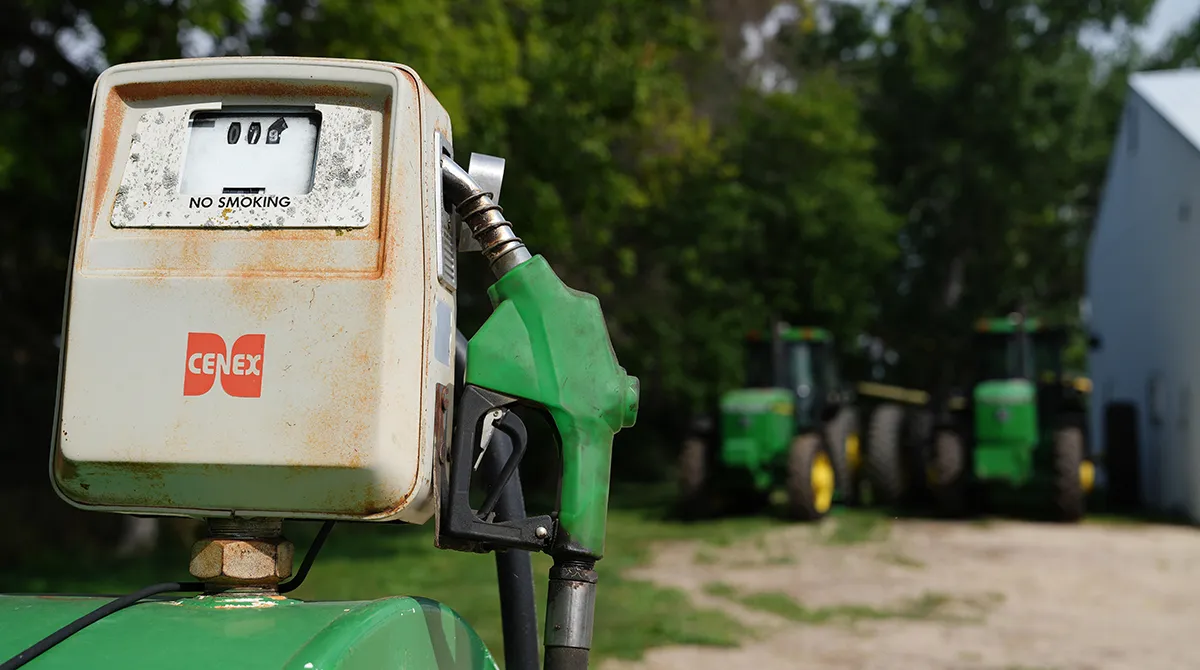 A diesel fuel tank on a corn and soybean farm in Northfield, Minn. (Ellen Schmidt/AP/file)
Key Takeaways:
- President Donald Trump expanded on-road use of red-dyed diesel, but farmers and truckers said the move offers limited relief from record-high fuel prices.
- Diesel averaged $6.30 a gallon Wednesday, up more than 70% year over year, as refinery constraints and war-related supply disruptions drove costs higher.
- Industry groups await IRS guidance while economists and farmers warned increased demand for dyed diesel could strain supplies and reduce benefits.
SIOUX FALLS, S.D. — Farmers, truckers and economists say a move to cut taxes on diesel will provide little relief from record-high fuel prices that have soared since the U.S. attacked Iran months ago.
Industry groups said they appreciate President Donald Trump’s executive order expanding the use of a diesel now reserved for off-road work, but farmers already have access to the fuel and many have already wrapped up harvest. Truckers will struggle to navigate differing state rules.
READ MORE: Trump dyed diesel order raises questions for trucking
“In the context of diesel prices that are over 2 dollars more than they were last year, it just doesn’t come close to closing that wound,” said Matt Perdue, president of the North Dakota Farmers Union.
With less than a month to go before the November election, diesel prices continue to hit record highs as some farmers transport their crops for processing and others rush to complete their fall harvest. Many have been feeling the squeeze as costs for inputs like diesel, fertilizer and seed have soared thanks to refinery constraints and supply disruptions amid the Iran war.
Diesel averaged $6.30 per gallon across the country on Oct. 7, more than 70% higher than one year ago, according to motor club AAA. The executive order defers the $0.24 federal tax per gallon of regular diesel, used for road projects, until the end of the year. Most states also levy their own tax on diesel.
“Dyed” diesel is the same as regular diesel, except for its red dye to help law enforcement enforce penalties for on-road use. It's already allowed for off-road purposes like farming equipment, such as tractors and combines, as well as construction and heating uses.
Who will see benefits
Savings can compound if states take similar actions; many have eased restrictions or waived taxes on dyed diesel, including South Dakota and Iowa. Perdue said North Dakota has waived the tax on regular diesel. But where the state decision is focused on farmers, he believes the federal decision would largely benefit those on other levels of the supply chain.
On Friday, I directed TN state departments to suspend enforcement of dyed diesel restrictions through the end of October to provide relief for farmers & foresters during harvest season. Thank you, @RealDonaldTrump, for standing with the Tennesseans who feed & fuel our country.
— Gov. Bill Lee (@GovBillLee) October 6, 2026
READ MORE: Texas allows wider use of dyed diesel
Farmers who will see the most benefit are those who haul their own product, like livestock or fresh produce, on public roads. Those who have already wrapped up harvesting won't see savings.
“Most of our diesel use is behind us,” said Perdue, who grows spring wheat, durum and canola on his family farm.
Easing limits on red-dyed diesel will likely have a minimal effect for small truckers, who pay for fuel up front, said Todd Spencer, president and CEO of trade group the Owner-Operator Independent Drivers Association. He estimates every $1 increase per gallon in fuel costs independent truckers about $400 more per week.
Increased demand for dyed diesel
The savings will be small, but it could still increase competition for dyed diesel, said David Ortega, food economics and policy professor at Michigan State University.
“I think there's a real chance this could backfire and make the situation worse for farmers," he said. “Basically anybody that’s running a truck on the highway on regular diesel can now be using this off-highway diesel. Even someone that owns a diesel pickup truck potentially has access to this other type of diesel.”
Perdue in North Dakota said he expects a “rush for dyed diesel, and we’ll see how the supply responds.”
But not all dyed diesel pump stations are set up for larger trucks like semis, said Paul Mitchell, a professor of agricultural and applied economics at the University of Wisconsin-Madison.
“It’s going to come down to infrastructure ability to get your vehicles to a place that you can use and fill them up with,” he said.
Supply shortages persist
Last month, Trump had threatened a diesel export ban, though he later said it is off the table. On Friday, G7 countries agreed to release 100 million barrels of oil and fuel products.

PCS Software CEO Mark Hill discusses the advance of AI in the trucking industry. Tune in above or by going to RoadSigns.ttnews.com.
“One of the problems we have right now in the world is there’s not enough diesel fuel,” said Gregg Ibendahl, farm management specialist at Kansas State University.
But underlying causes like geopolitical issues won't be solved overnight.
“The problem we’ve accumulated right now with the Strait of Hormuz and the Russia-Ukraine war, those are going to be longer term things to get fixed,” he said. “Getting that world supply back up again is going to be, I think, at least a year, even in the best cases.”
Anderson reported from New York.