
[Stay on top of transportation news: Get TTNews in your inbox.]
Canadian oil bypasses California stop as freight surges
Nation’s oil producers look to reduce dependence on U.S. during trade war
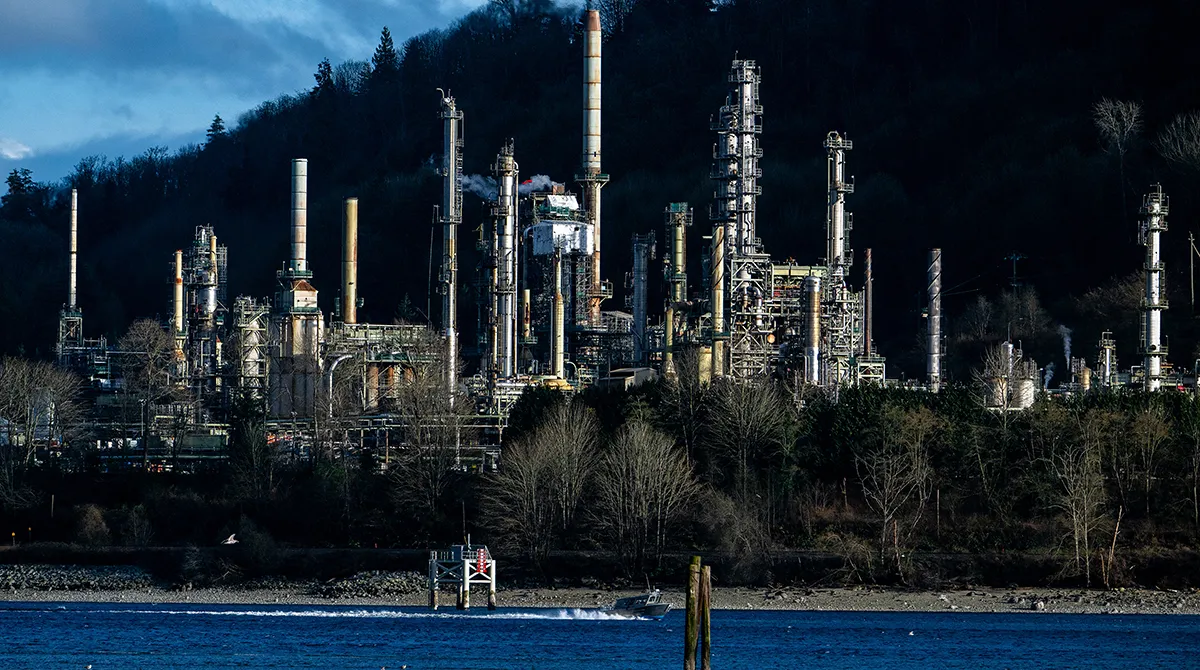 The Burnaby Refinery in Burnaby, British Columbia. (James MacDonald/Bloomberg)
Key Takeaways:
- Canadian crude shipments are bypassing a pit stop off the California coast and heading straight to Asia as skyrocketing shipping rates make the detour less economical and the nation’s oil producers look to reduce dependence on the US during an ongoing tra
- Record VLCC shipping rates after the Iran war and greater Aframax availability made direct shipments about 54% the cost of VLCC routes.
- Trans Mountain was commissioned to advance a new 1 million-barrel-a-day pipeline and deep-water port to expand Asian exports and reduce U.S. dependence.
Canadian crude shipments are bypassing a pit stop off the California coast and heading straight to Asia as skyrocketing shipping rates make the detour less economical and the nation’s oil producers look to reduce dependence on the U.S. during an ongoing trade war.
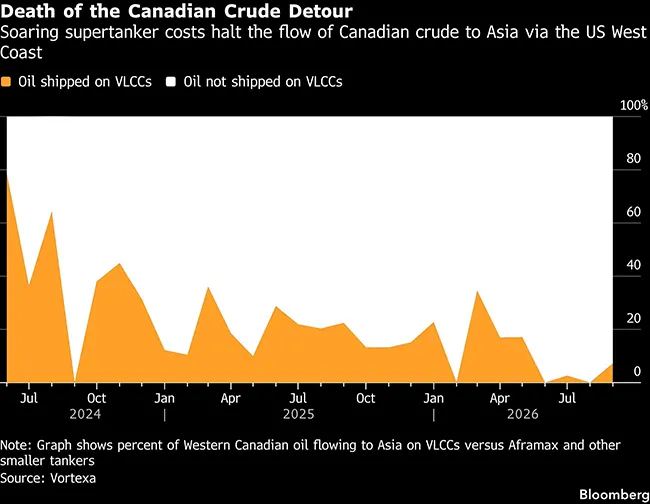
Last month, no Canadian crude from Vancouver to Asia was first transferred to a supertanker while en route. The switch typically happens in the Pacific Area Lightering zone off Southern California as the marine terminal near Vancouver isn’t equipped to handle large oil tankers.
In June 2024, 78% of the Canadian oil shipped to Asia was first moved onto so-called Very Large Crude Carriers, or VLCCs, before reaching its destination.
Fallout from the Iran war has shrunk the availability of VLCCs, sending shipping rates to record highs.
Combined with a greater availability of smaller Aframax vessels in the western Pacific, shipping Canadian oil directly to Asia on those vessels is now about 54% of the cost of going the long route on VLCCs, according data provided by Nick Watt, head of freight pricing at Argus.
The 2024 startup of the expanded 890,000-barrel-a-day Trans Mountain pipeline, which runs from Alberta to the Westridge terminal near Vancouver, opened up Asian markets to significant exports of heavy Canadian oil sands crude for the first time. But the terminal itself, and the constraints of the Burrard Inlet, mean VLCCs can’t access Westridge while Aframax ships can. A VLCC can carry about 2 million barrels compared with an Aframax, which hauls up to 750,000 barrels when full.
Image
Trans Mountain Corp., which is owned by the Canadian government, has been commissioned to spearhead work on a new million-barrel-a-day pipeline that would roughly follow the existing conduit route but would terminate at a new deepwater port that can accommodate VLCCs.
The project, an initiative of Alberta’s government that has been approved by Canadian Prime Minister Mark Carney, is designed to boost exports to Asia, allowing Canadian oil producers to reduce their dependence on the U.S. amid a trade war that has frayed relations.


