[Stay on top of transportation news: Get TTNews in your inbox.]
Werner's Leathers expects accelerated capacity reductions
CEO cites capacity cuts, firm spot rates and higher barriers to market entry as reasons for optimism
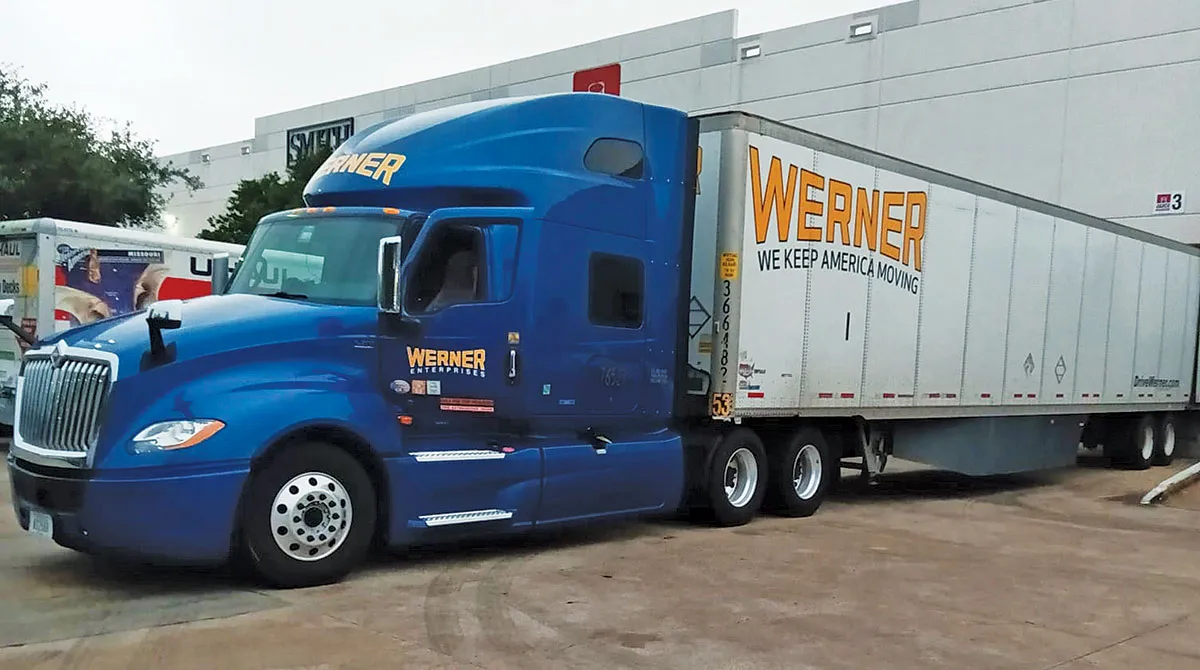 Werner CEO said the carrier made investments in recruiting, driver training and onboarding costs to seat trucks and support customer demand. (Werner Enterprises via Facebook)
Key Takeaways:
- Werner Enterprises CEO Derek Leathers said Oct. 27 that declining trucking capacity signals the early stages of a multiyear industry upcycle.
- Werner reported third-quarter net income of $6.6 million as revenue rose 23% to $950.5 million, reversing a year-earlier loss.
- Leathers expects peak revenue and spot rates to strengthen as holiday demand meets capacity reductions, though fuel, labor and reserve costs remain pressures.
Werner Enterprises CEO Derek Leathers expressed optimism Oct. 27 that trucking is entering an upcycle as industry capacity declines.
The Department of Transportation accelerated an ongoing decline in capacity last year by tightening enforcement of non-domiciled commercial driver licenses and English-language proficiency standards. This came amid a prolonged downcycle that was driven by an oversupply of capacity from the last upcycle, when compared with freight demand.
“We remain in the early innings of capacity reductions as a result of enforcement efforts,” Leathers said during the company’s third-quarter earnings call. “Greater agency collaboration and data sharing, combined with increased use of technology, will further accelerate capacity attrition.”
Leathers added that disciplined operators are facing less of a threat from noncompliant capacity as it becomes more challenging for new supply to enter the market. He also noted that insurance premiums, carrier vetting, heightened litigation risk, high fuel costs and stringent regulatory requirements are further escalating these reductions by creating an even higher barrier to entry.
“This structural floor creates a stronger, more sustainable market backdrop, paving the way for further rate increases, reduced volatility and healthier operating margins,” said Leathers, who was recently elected American Trucking Associations’ new chairman. “While there was some easing in spot rates in July and August, tender rejections remained elevated, and we’ve seen improvement in spot rates more recently.”
The National Retail Federation found in its peak-season forecast that retail sales are expected to grow 4.2% year over year in November and December as a resilient consumer base overcomes inflation, higher fuel costs and a sluggish labor market. That would translate to total spending of $1.01 trillion. Leathers expects ongoing spot rate increases throughout the remainder of the year as the volume gains clash with the ongoing capacity reductions.
“We expect peak revenue to outperform the last couple of years,” Leathers said. “While high fuel costs and interest rates are pressing consumers to seek value, our strong footprint in discount grocery and nondiscretionary retail positions us well. With retailers carrying leaner inventories, we believe demand could play a larger role.”
The Omaha, Neb.-based freight carrier and logistics company posted net income attributable to itself of $6.6 million, or 11 cents a diluted share. That compared with a loss of $20.6 million, negative 34 cents, in the prior-year period. Total revenue increased 23% to $950.5 million from $771.5 million.
“We delivered these results despite significant near-term cost pressures,” Leathers said. “We faced sharply rising fuel prices, escalating driver onboarding and retention costs, and elevated reserve development. Cumulatively, these items negatively impacted our results by approximately 18 cents per share compared to the second quarter.”
Werner Q3 2026 Earnings Presentation
Leathers highlighted three main takeaways from the quarter. He first noted that ongoing efforts to restructure the one-way network and expand the dedicated fleet are translating into improved asset productivity, network yield and structural cost efficiency. Second, he expressed optimism that the industry is in the early stages of a multiyear upcycle. His final point was that the near-term costs impacting results did not change the trajectory of the underlying business.
“Given the opportunities we see ahead, we made a deliberate decision to accelerate investments in driver hiring and retention,” Leathers said. “We made a significant investment in incremental recruiting, driver training and onboarding costs to seat trucks and support customer demand.”
Results by segment
Truckload Transportation Services revenue increased 37% to $714 million from $519.8 million. Operating income was $23.2 million, compared with an operating loss of $13.8 million.
Logistics revenue declined 7% to $215.8 million from $232.6 million. Operating loss was $386,000, compared with a gain of $3.01 million.
Werner ranks No. 19 on the Transport Topics Top 100 list of the largest for-hire carriers in North America and No. 30 on the TT Top 100 list of the largest logistics companies.