
[Stay on top of transportation news: Get TTNews in your inbox.]
Volvo pivots to long-range hybrid cars
Drivers demand more electric power to help offset surging fuel prices
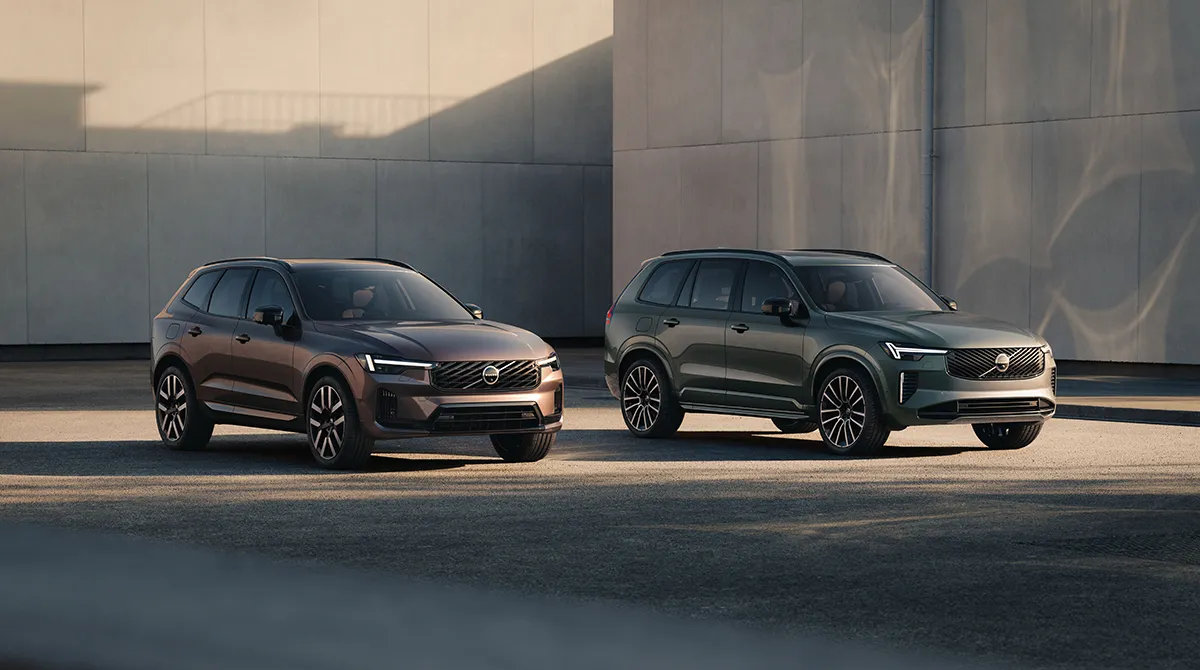 The new Volvo XC60 and the Volvo XC90. (Volvo Cars)
Key Takeaways:
- Volvo Car launched long-range plug-in hybrid XC60 and XC90 SUVs in Europe and the U.S. with electric-only ranges of 124 and 99 miles, respectively.
- The automaker said strong hybrid demand, high fuel prices and limited charging infrastructure are slowing the shift to fully electric vehicles.
- Volvo expects combustion-engine vehicles to remain necessary into the next decade as it maintains a flexible path toward eventual full electrification.
Volvo Car AB is rolling out new long-range plug-in hybrids in Europe and the U.S., betting demand for the dual technology will persist well into the next decade.
The Swedish manufacturer controlled by China’s Geely said Sept. 15 it’s launching its first long-range hybrids for the European and American markets as versions of the best-selling XC60 and XC90. The SUVs have more powerful batteries and a range as far as 124 miles and 99 miles, respectively, on a single charge.
READ MORE: Volvo Trucks electric lineup captures 2027 ITOY award
Initially seen as a steppingstone to battery-only vehicles, plug-in hybrids are being given a much longer lease of life as drivers demand more electric power to help offset surging fuel prices. Charging networks also remain insufficient in many countries, slowing the transition to pure EVs.
“Five years ago, perhaps people thought electrification was a linear story: it would take four years, everything would look like Norway and then we’d be done by 2030,” Volvo Car Chief Commercial Officer Erik Severinson said in an interview.
The transition has proved less straightforward, prompting Volvo to take a more flexible approach, he added. “We have a pragmatic solution. A bridge that will probably take us several years into the next decade.”
Plug-in hybrids depend on two powertrains — an internal combustion engine and an electric motor — which increases their cost, complexity and weight.
Chinese manufacturers including BYD, Geely and Chery have helped reshape the segment with a new generation of the vehicles. They’re equipped with more efficient batteries, allowing them to travel much farther on electric power alone.
Mercedes-Benz Group AG, BMW AG and Volkswagen AG continue to offer a broad mix of powertrains as the shift to fully electric vehicles proceeds unevenly across markets. Hybrid offerings from the three German manufacturers, as well as from the likes of Toyota Motor Corp.’s Lexus and Jaguar Land Rover Automotive Plc’s Range Rover, will likely compete with the new XC60 and XC90 in the U.S. and Europe.
Higher fuel prices stoked by the U.S.-Israeli war on Iran have also had an impact. The fallout from the conflict prompted more U.S. drivers to opt for hybrids made by Japanese and South Korean automakers this spring, leaving U.S. automakers largely on the sidelines.
Robust hybrid demand is also an unexpected boon for Horse Powertrain, a joint venture created by Renault SA and Geely in 2023 with 18 manufacturing sites across three continents employing around 19,000 workers.
Horse supplies Volvo with engines from its factory in Skövde northeast of Gothenburg, continuing a tradition that began almost 100 years ago when the plant belonged to the Swedish manufacturer. It was later spun off into Aurobay Sweden AB before becoming part of Horse.
Volvo formally scaled back its electrification ambitions two years ago, abandoning a goal of selling only full EVs by 2030. It still intends to eventually become a fully electric carmaker, but no longer has a specific deadline.

Arpan Podduturi of Samsara examines how AI, telematics and onboard cameras are converging to protect drivers and reduce risk. Tune in above or by going to RoadSigns.ttnews.com.
“We can’t be dogmatic and say it has to happen in a certain way when that’s not what the market looks like,” Severinson said. “There could be a need well into the next decade for products with combustion engines.”
Last year, Volvo launched the XC70 extended-range plug-in hybrid in China, where such vehicles have become increasingly popular. It’s currently Volvo’s best-selling car there.
“If we hadn’t had it, the situation would probably have been even more difficult,” Severinson said. Volvo has said it's exploring potential additional markets for the XC70 at a later stage, not including Europe.


