[Stay on top of transportation news: Get TTNews in your inbox.]
TFI’s Bédard bemoans ‘broken record’ of disappointment in LTL
Carrier to hire staff from peers as centerpiece of improvement plans
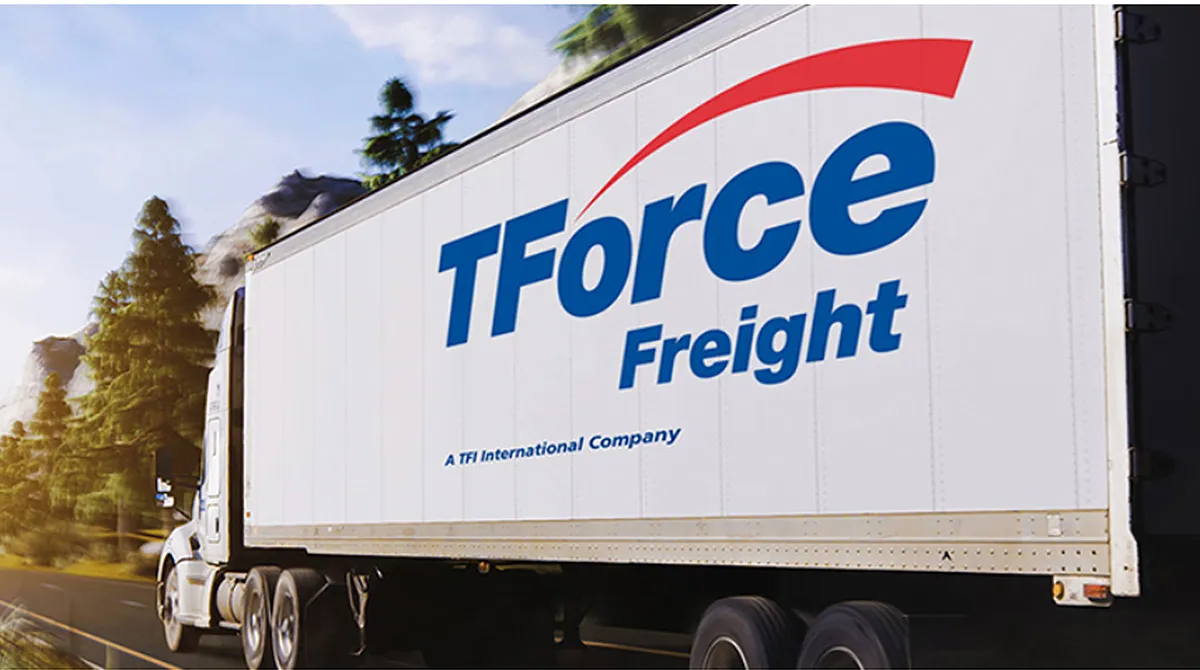 (TForce Freight)
Key Takeaways:
- TFI International’s U.S. LTL operations disappointed management in the third quarter as the division’s operating ratio worsened to 91.3 from 88.8.
- LTL revenue before fuel surcharges fell 1.4% to $677.7 million while operating income dropped 42.9% to $44.4 million.
- CEO Alain Bédard said TFI plans to recruit managers from rival carriers and expand its nonunion fleet to strengthen U.S. LTL operations.
TFI International’s U.S. less-than-truckload operations disappointed the Montreal-based trucking conglomerate’s management team in the third quarter of 2026, especially Alain Bédard, and personnel changes were promised.
Longtime Chairman and CEO Bédard likened the division’s performance in the most recent quarter to a “broken record,” hammering the performance of managers up and down its U.S. LTL operations, which operate under the TForce Freight brand.
As a result, the executive told analysts and investors during TFI’s third-quarter 2026 earnings call that the carrier plans to raid its peers for replacements.
The LTL unit’s operating ratio weakened to 91.3 in Q3, from 88.8 in the year-ago period.
A carrier’s OR provides insight on how well a company is balancing its costs and revenue generation. The lower the ratio, the better a company’s performance. An OR of 80 is considered exceptional, with most LTL carriers running an OR of between 85 and 90.
But Bédard drilled down a little more during TFI’s Oct. 30 earnings call, scornfully noting: “When we report a 91 OR … our U.S. operation is closer to a 97 OR, and our Canadian operation is more like a sub-75 OR operation.”
“It’s not [an] issue of the driver or the dock guys or the union, it’s the issue of the local management that are not managing properly or effectively those guys,” said the company’s top executive, whose candor on earnings calls is atypical for executives at large, publicly traded companies in trucking or other industries.
Symptomatic of the problem was, in contrast to many of its peers, TFI’s LTL division posting a 3.6% decrease in its average weight per shipment in the most recent quarter to 1,480 pounds, from 1,535 pounds a year earlier.
Bédard said spillover from the truckload segment revival powering the ongoing freight market rebound is boosting rival carriers’ LTL operations.
“We’re saying to our U.S. LTL guys, ‘guys, wake up, let’s piggyback our U.S. LTL commercial team working with our truckload commercial team to get more of that industrial freight in our LTL environment,’ ” the executive said.
“At first with the old team there, we got pushback. Oh, there’s lots of claims, all kinds of stories. But now this is something that’s ongoing to try to improve,” he added.
TFI became a major player in the U.S. LTL market in 2021 with its $800 million acquisition of UPS Freight, which it subsequently rebranded as TForce Freight.
Truckload margin soars
Highlighting the strength of the industrial market, revenue before fuel surcharges at TFI’s truckload division — including the former Daseke flatbed operations — rose 10.1% to $753 million in Q3, from $684.1 million in the same period 12 months earlier. The division’s operating income of $100.2 million increased 91%, from $52.6 million in the year-earlier period.
In contrast, the LTL division’s revenue before fuel surcharges dipped 1.4% to $677.7 million, from $687.0 million in the year-ago period, at a time when rates are rising. The unit’s operating income fell 42.9% to $44.4 million, from $77.7 million in the year-earlier period, although it also included a $14.4 million office-related real estate impairment charge.
TFI ranks No. 3 in the Transport Topics truckload segment rankings. Overall, TFI ranks No. 6 on the Top 100 list of the largest for-hire carriers in North America. The company ranks No. 8 on the LTL segment list.
TForce Freight, the largest part of the LTL division, also continued to be hurt by a lack of density compared with its peers, according to TFI management.
“Our density is so bad that when you have inflation like we went through in Q2 and in Q3 with fuel, I mean, that turns to be more of a negative,” said Bédard.
The Department of Energy’s weekly nationwide diesel price average was $6.352 a gallon on Oct. 26 and has not been below $6 a gallon since early September. In contrast, the price hovered around $3.70 a gallon in the same period 12 months earlier.
Nonunion additions
TFI plans to fill in those density gaps by adding to the company’s nonunion fleet.

►Freight Upturn Bodes Well
►The Market Has Finally Turned
►Business Optimism Growing
►Fleets Investing in AI, Efficiency
►Carriers See Diesel Enduring
►Interactive Map
►2025 Yielded Mixed Results
Sector Rankings
LTL | TL/Dedicated
Intermodal/Drayage
Package/Courier | Air/Expedited
Refrigerated | Flatbed/Heavy
Tank/Bulk | Household/Commercial
The company bought Hercules Forwarding for an undisclosed sum in March 2024. A nonunion LTL carrier with an emphasis on intra-U.S. and U.S.-to-Canada cross-border transportation, Hercules is part of the solution, according to Bédard.
But TFI, as Bédard has previously indicated, may also buy a “brother” for TForce Freight.
Another problem has been TForce Freight’s legacy contract with UPS, said Bédard, but the deal is set to end in January 2027, which augurs positively for the unit.
“Once we fix that, TFI is going to be like, ‘Wow, that’s the big rock that we have in our shoe,’ ” he quipped.
Bédard is also positive about plans to hire service center managers and executives away from TFI’s peers to help bolster U.S. LTL operations.