
[Stay on top of transportation news: Get TTNews in your inbox.]
Tesla’s Semi tractor makes public debut in Europe
European deliveries projected to begin as soon as late 2027
 Tesla’s largest Semi customer to date is Swedish transport-as-a-service and autonomous vehicle company Einride. (teslaeurope via X)
Key Takeaways:
- Tesla introduced the Semi to Europe at IAA Transportation and is targeting customer deliveries by the end of 2027.
- The European model will closely resemble the North American standard-range Semi with modifications for regulatory compliance.
- Tesla plans an initial charging network of at least 22 locations to support Semi customers in Europe.
HANNOVER, Germany — Tesla’s battery-electric Semi tractor made its European debut Sept. 15, bringing the truck maker’s challenge to established commercial vehicle manufacturers across the Atlantic with a target date for customer deliveries there of late 2027.
The truck destined for Europe will closely resemble Tesla’s standard-range Semi offered in North America, where customers currently can choose between standard-range and long-range configurations, program lead Dan Priestley said from IAA Transportation.
Vehicles for European customers will be built at Tesla’s Reno, Nev., manufacturing plant, which is ramping up toward full-scale production. Priestley said the company has not ruled out building a truck assembly plant in Europe.
“All the major technology pieces — the frame rails, the chassis, battery pack, drive axles — all of them are the same,” Priestley told Transport Topics on the sidelines of the conference.
The primary differences involve equipment for regulatory requirements, including lighting, mirrors, trailer interfaces, splash guards and tachographs, which are devices that record vehicle data.
Semi is coming to Europe
– Up to 550km of range at 40T (fully loaded)
– 1 kWh/km energy consumption
– Megacharger at up to 800 kW recovers ~60% of range in 30 minutes
– ePTO up to 25kW
– 40T gross combination weight, 9,100kg curb weighthttps://t.co/sE4RpWb2w4 pic.twitter.com/swNCxNvfnV— Tesla Europe, Middle East & Africa (@teslaeurope) September 11, 2026
“I’m really excited that we’ve developed a global multimarket platform,” Priestley said. “That allows us to take something to a different scale, and to bring over a ton of learnings and have the two markets learn and help each other along the way.”
Tesla has not yet opened its European order book for the Semi. The company is focusing first on demonstration programs with prospective customers during the first half of 2027, with deliveries targeted by the end of that year, Priestley said.
Tesla expects to build “many thousands” of Semi tractors before the end of 2026, Priestley said in April.
Site work at the Reno facility adjacent to the company’s Gigafactory Nevada complex began in 2023. Tesla unveiled the Semi in 2017 and originally targeted a 2019 production launch. The Reno plant is designed to build as many as 1,000 trucks a week, or 50,000 annually.
Priestley told IAA attendees that Tesla will begin hosting carrier visits at the factory during the week of Sept. 21.

Arpan Podduturi of Samsara examines how AI, telematics and onboard cameras are converging to protect drivers and reduce risk. Tune in above or by going to RoadSigns.ttnews.com.
The European-spec Semi will have a curb weight of less than 9,100 kilograms, or 20,000 pounds. The powertrain uses three independent motors mounted on the rear axles and delivers up to 800 kilowatts of power.
“We feel very strongly that this is a good fit for a number of European duty cycles,” Priestley told attendees. “With an efficiency of 1 kilowatt-hour per kilometer, this provides excellent operating cost.”
Tesla chose a 3-axle configuration to maximize payload capacity and efficiency, Priestley said, adding that the two drive axles work together to help achieve the truck’s targeted energy consumption.
Image
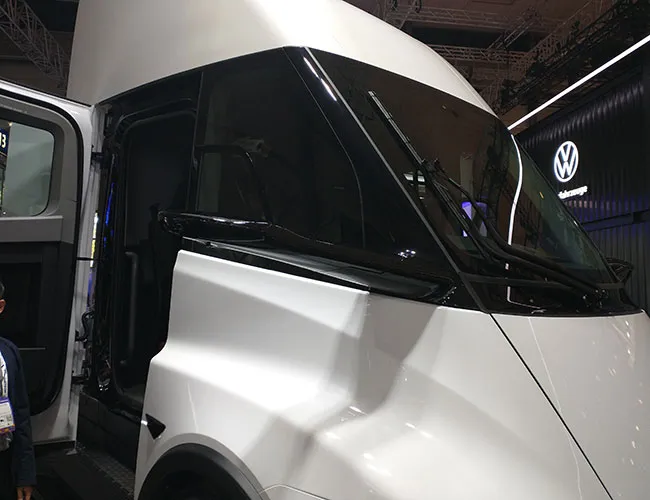
European homogulated Tesla Semi on display at IAA Transportation in Hannover, Germany. (Keiron Greenhalgh/Transport Topics)
Tesla also plans to establish a dedicated charging network for Semi customers, competing with the Milence joint venture backed by Daimler Truck, Volvo Group and Traton Group.
Priestley showcased a map outlining plans for at least 22 charging locations during the initial rollout in 2027.
“These are not just single stations with single posts,” he said, noting that each location will feature megawatt charging equipment.
Tesla’s largest Semi customer to date is Swedish transport-as-a-service and autonomous vehicle company Einride, which announced in August plans to add 500 Semis to its North American fleet.
Priestley said lessons learned from North American customers such as PepsiCo and ArcBest will be applied as Tesla enters the European market.
“While I understand there are absolutely differences and nuances and unique aspects to the European trucking market,” he said, “we have a confidence that we can meet the demands of that market because we are leveraging all of the learnings through our North American operation.”


